

San Jose to El Paso Car Shipping Route
San Jose to El Paso covers approximately 1,172 miles depending on the routing a carrier selects. Carriers access the San Jose metro via I-280, US-101, I-880, and SR-87, which feed the Santa Clara County grid efficiently. Most loads leave San Jose heading south on US-101 to connect with I-5 near Stockton or Gilroy, then transition east via I-10 through the Inland Empire, Palm Springs, and the Sonoran Desert into El Paso. The drive is logistically demanding — two long desert stretches, multiple inspection checkpoints, and elevation swings near the Arizona-New Mexico border. Putting your car on a carrier saves you that entire drive. For a breakdown of what that's worth, see https://california.auto-transport-shipping.com/articles/benefits-of-auto-transport-service-vs-driving-yourself.html
El Paso's demand drivers are specific and reliable. Fort Bliss, one of the largest Army installations in the United States, generates continuous military PCS traffic — soldiers relocating in and out keep carrier interest in the corridor high. The University of Texas at El Paso enrolls over 24,000 students, creating predictable August and January demand spikes. Major regional employers include the William Beaumont Army Medical Center, various Juárez-facing manufacturing and logistics firms, and a growing healthcare sector. Weather is a real factor: summer heat across the Sonoran Desert pushes into the 110°F range along I-10 through Arizona, and winter can bring ice events near the New Mexico highlands. Plan accordingly and review https://california.auto-transport-shipping.com/articles/auto-transport-mistakes-to-avoid.html before you book.
San Jose to El Paso Car Shipping Rates
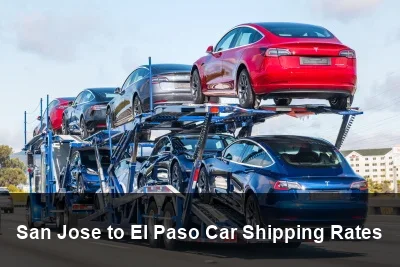
Rates on the San Jose to El Paso lane are shaped by the 1,172-mile distance, which puts this in the mid-to-long haul tier where per-mile costs are lower than short runs but fuel exposure is significant. Summer heat across the Arizona and New Mexico desert adds minor risk premiums for some carriers, and UTEP semester start dates in late July and August push demand — and prices — upward. Fuel price swings hit this corridor more than average due to the desert mileage. See how fuel affects your quote at https://california.auto-transport-shipping.com/articles/how-gas-prices-impact-california-auto-transport-fees.html
What affects the cost of San Jose to El Paso car shipping:
- Vehicle type and size — larger vehicles take more carrier space; aftermarket additions like lift kits, oversized mirrors, or roof accessories can add fees
- Open vs. enclosed transport — open is lower cost with stronger carrier availability; enclosed protects against weather, debris, and road conditions
- Standard vs. expedited pickup — expedited prioritizes your vehicle for the next available dispatch, typically at a $100–$300 premium
- Time of year — peak demand seasons drive rates higher; off-peak windows offer the most competitive pricing
- Fuel costs — diesel prices affect carrier rates; longer routes are more sensitive to fuel price swings
- Vehicle condition — non-running vehicles require special loading equipment and cost more to ship
| Vehicle Type | Open Car Shipping (Est.) | Enclosed Car Shipping (Est.) |
|---|---|---|
| Sedan | $750 – $1,000 | $1,350 – $1,750 |
| SUV / Crossover | $900 – $1,150 | $1,550 – $2,000 |
| Pickup Truck | $900 – $1,200 | $1,550 – $2,100 |
| Minivan | $900 – $1,150 | $1,550 – $2,000 |
| Luxury / Classic Car | $1,050 – $1,400 | $1,850 – $2,350 |
| Non-Running Vehicle | Add $150–300 | Add $150–300 |
* Estimated ranges based on recent San Jose to El Paso shipments. Actual rate depends on vehicle, locations, booking date, and current fuel costs. Use the form on this page to compare real quotes from licensed carriers.
Open vs. Enclosed: The Right Call for This Desert Run
Open transport is the practical choice for most standard vehicles on this route. The I-10 corridor through the Sonoran Desert is well-traveled and carrier-dense, and open carriers handle it daily without issue. Enclosed makes sense if you're moving a classic car, a low-clearance exotic, or a vehicle you can't afford to have exposed to blowing desert grit or rare but possible hail events in the New Mexico stretch. Enclosed carriers are less frequent on this lane, so expect a longer wait time and a rate premium of 40–60% over open. For most late-model vehicles, open is the right call.
How Long Does San Jose to El Paso Car Shipping Take?
Standard transit from San Jose to El Paso runs 4 to 7 days once a carrier is assigned. Carrier assignment typically takes 1 to 3 business days from booking, longer during summer demand peaks driven by Fort Bliss PCS cycles and UTEP move-ins. The driving distance is roughly 1,172 miles, achievable in two hard driving days for a solo driver, but carriers follow HOS regulations and often carry multiple vehicles, which adds time. If you need faster placement, expedited options exist — see https://california.auto-transport-shipping.com/articles/california-expedited-car-shipping-fast-cost.html for how that affects cost.
| Service Type | Typical Transit | Pickup Window | Best For |
|---|---|---|---|
| Open — Standard | 3–5 days | 2–5 business days | Best value; most common choice on this route |
| Open — Expedited | 2–3 days | 1–2 business days | Firm arrival date; faster dispatch window |
| Enclosed — Standard | 3–5 days | 3–7 business days | Luxury, classic, or modified vehicles |
| Enclosed — Expedited | 2–3 days | 1–3 business days | High-value vehicles on a firm delivery deadline |
** Summer heat across Arizona can slow carriers who avoid midday driving to protect multi-vehicle loads. Winter ice events on I-10 near Las Cruces or the Organ Mountains occasionally delay delivery by one to two days. Book with buffer time during August PCS season and January semester starts.
San Jose to El Paso — Route & Logistics
Carriers pick up in San Jose via I-280, US-101, I-880, or SR-87 depending on the specific staging location in Santa Clara County. From San Jose, the primary carrier route runs south on US-101 to I-5 or cuts east via SR-152, connecting to I-10 near the Coachella Valley. I-10 then runs the full stretch east through Arizona and New Mexico into El Paso.
Key Corridor Waypoints
- Gilroy, CA Carriers exiting the San Jose metro often stage or adjust loads near Gilroy, where US-101 and SR-152 intersect. SR-152 provides the eastbound cut toward I-5 and eventual I-10 access. This junction is a practical waypoint for carriers consolidating Bay Area pickups from San Jose, Sunnyvale, and Santa Clara before committing to the eastern run.
- Palm Springs / Coachella Valley, CA After picking up I-10 near Banning, carriers pass through the Coachella Valley, sitting at roughly 100–200 feet elevation before climbing briefly over the San Gorgonio Pass area near 2,600 feet. This is a natural rest and fuel point. Temperatures here regularly exceed 110°F in July and August, which factors into carrier scheduling and departure timing.
- Phoenix, AZ Phoenix is the major mid-route interchange. Carriers may swap drivers, fuel, or relay loads here. I-10 runs directly through the metro, connecting to I-17 north and southbound routes. Some carriers with partial loads pick up or drop off vehicles here, which can slightly adjust delivery windows. Phoenix sits at roughly 1,100 feet elevation.
- Tucson, AZ Tucson at roughly 2,400 feet elevation marks the last major Arizona city before the New Mexico line. State agricultural inspection checkpoints near the Arizona-California border are already behind the carrier at this point. Tucson is a common overnight stop for carriers on this corridor and a secondary staging hub for loads heading into El Paso.
- Las Cruces, NM Las Cruces sits at about 3,900 feet elevation, just 45 miles from El Paso on I-10. This is where New Mexico terrain can introduce winter weather risk — the Organ Mountains to the east can channel wind and occasional ice onto the highway. Carriers typically complete final delivery coordination here before the short final leg into El Paso.
- El Paso, TX El Paso sits at roughly 3,740 feet elevation at the far western tip of Texas. I-10 runs directly through the city. Fort Bliss occupies a large area to the northeast of downtown. Carriers accessing the east side and northeast areas near Fort Bliss have straightforward routes off I-10 and US-54. Central and downtown El Paso require more careful navigation.
Pickup & Delivery Access
- Pickup Access in San Jose San Jose's street grid and freeway access make carrier pickup straightforward. I-880, I-280, US-101, and SR-87 all provide entry to the Santa Clara County suburbs. Tech campus areas in North San Jose, Sunnyvale, and Santa Clara work well as staging or meet points. Wide surface streets in most residential areas accommodate standard multi-car haulers. Narrow downtown blocks near SAP Center should be avoided for carrier meets.
- Delivery Access in El Paso El Paso is largely carrier-accessible off I-10 and US-54. Northeast El Paso neighborhoods near Fort Bliss are straightforward for standard open carriers. Central and downtown areas have tighter streets and occasional construction zones, so staging a few blocks out on a wide commercial street is advisable. The west side near UTEP can have parking constraints during peak move-in periods in August and January.
- Nearby Pickup Locations Carriers picking up in San Jose regularly extend service to Sunnyvale, Cupertino, Mountain View, and Santa Clara. Call 1‑800‑590‑6492 to confirm door-to-door availability at your address.
Open vs. Enclosed Car Shipping: San Jose to El Paso
Both options use licensed, insured carriers and deliver door to door. For a full breakdown, read the pros and cons of open vs. enclosed car shipping.
Open Car Shipping
Most Popular- Lower cost — the practical choice for most vehicles
- More carriers available on this corridor
- Faster dispatch from booking to pickup
- Works well for sedans, SUVs, trucks, and minivans
- Vehicle rides on an open multi-car carrier
- Cargo insurance required on all licensed carriers
Estimated cost: $750 – $1,200
Enclosed Car Shipping
Premium Protection- Full protection from weather, debris, and road grime
- Best for luxury, exotic, and classic vehicles
- Recommended for low-clearance and custom-built cars
- Wheel-net or soft-tie systems prevent contact damage
- Higher cargo coverage — commonly $500,000 per load
- White-glove handling by experienced operators
Estimated cost: $1,350 – $2,100
Not sure which is right for your vehicle? Call 1-800-590-6492 and we'll point you in the right direction. Also worth reading: the top 10 questions to ask any car shipping company before you commit.
How to Prepare Your Car for Shipping to El Paso
A little prep before pickup protects you if there's ever a dispute about your vehicle's condition. This checklist is from our full guide on preparing your car for transport:
- Remove all personal belongings from the interior and trunk
- Leave only a quarter tank of fuel — enough to load and unload
- Take date-stamped photos of the full exterior and interior
- Remove or disable toll transponders (FasTrak, E-ZPass, etc.)
- Retract or remove roof racks, spoilers, antennas, and bike mounts
- Make sure the battery is charged and tires are properly inflated
- Tell the carrier about any existing leaks or mechanical issues
- Deactivate the car alarm before the carrier arrives
- Write down the mileage on the Bill of Lading at pickup
- Fold in side mirrors if the vehicle is wider than standard
Personal items: Most carriers won't cover belongings left in the car. Read the full rules on shipping personal items in your vehicle. Also review our Bill of Lading guide so you know exactly what to check at pickup and delivery.
When to Ship Your Car from San Jose to El Paso
This route has two defined demand peaks: summer military PCS season tied to Fort Bliss reassignment orders, typically running May through August, and UTEP semester starts in late July and January. Both push carrier demand and booking lead times up. Winter on this corridor is generally mild along I-10, but cold snaps can affect the New Mexico section near Las Cruces. For winter-specific transport considerations, see https://california.auto-transport-shipping.com/articles/auto-transport-challenges-during-the-winter.html
Spring (March–May)
Spring is the most favorable booking window on this lane. Demand is moderate, desert temperatures are manageable, and carrier availability is solid before the summer PCS rush. If your move has flexibility, March through early May offers competitive rates and realistic 4–6 day transit windows. Book 7–14 days ahead for best carrier selection and pricing on this corridor.
Summer PCS Season (June–August)
Fort Bliss PCS orders generate the highest demand spike of the year on this lane. Carriers fill quickly in June and July. UTEP student moves compound demand in late July and August. Book 2–3 weeks ahead, expect rates to run 10–20% above baseline, and account for the fact that extreme Arizona heat — often 108–115°F along I-10 — can influence carrier scheduling and pacing.
Fall Semester Move-In (August–September)
UTEP's fall semester start in late August draws student vehicle shipments from the Bay Area. If you're a student or parent shipping a car from the San Jose area, booking in early-to-mid August gives you better rate options than waiting until the last two weeks of the month. Carrier capacity to El Paso tightens notably around August 15–30 each year.
Winter (December–February)
Winter is the slowest demand period on this lane and generally the most affordable. The I-10 desert corridor is typically passable, but ice events near Las Cruces and the Organ Mountains are real — they happen a few times per season and can add 1–2 days to delivery. Budget extra transit time if shipping in January or February and review winter transport considerations before booking.
Spring Semester Start (January)
UTEP's spring semester creates a secondary demand spike in early January. Military PCS orders also tend to cluster at the start of the new year. If you're shipping a vehicle to El Paso for a January start, aim to book before December 20. Carriers prioritize confirmed bookings placed before the holiday slowdown for January dispatch windows.
How to Choose a San Jose to El Paso Car Shipping Company
Getting multiple quotes is step one — knowing what to look for in those quotes matters just as much. Our guide on how to select a car shipping company covers the full process. Here are the six things that matter most:
FMCSA Registration
Every carrier or broker must hold a valid MC number. Verify any company at FMCSA SAFER before you book.
Proof of Insurance
Ask for a current certificate of insurance. Open carriers typically carry $100,000–$250,000 per load; enclosed commonly $500,000 or more. Learn what auto transport insurance covers.
All-In Pricing
Your quote should be a final number with no fees added after booking. Know the difference between brokers and carriers and confirm what the quote covers before you agree.
Bill of Lading
A complete Bill of Lading is filled out at pickup and delivery. Our Bill of Lading guide explains what to check. Never sign an incomplete one.
Real Reviews
Check Google and the BBB. Look at how they handled complaints and damage claims — that tells you more than a five-star average from happy customers.
Route Experience
A carrier who runs San Jose to El Paso regularly knows that the critical decision point is at Gilroy — whether to take SR-152 east to I-5 and then I-10, or stay on US-101 south before cutting inland. Experienced drivers account for I-5 agricultural inspection wait times near the Kern County line. They know the Coachella Valley heat window and adjust departure times to avoid midday desert crossings in summer. They know that El Paso delivery to Fort Bliss housing areas off Pleasonton Road and Sheridan Road is straightforward, while delivery to central El Paso near the university requires advance communication with the customer to find a viable meet point. Phoenix is the standard relay point for two-driver operations. A carrier who knows this corridor doesn't guess at those logistics — they build them into the dispatch plan from the start.
San Jose to El Paso Car Shipping — FAQ
How much does it cost to ship a car from San Jose to El Paso?
Rates on the San Jose to El Paso lane generally run between $850 and $1,350 for open transport on a standard sedan or mid-size vehicle, depending on time of year, fuel prices, and carrier availability. Enclosed transport typically runs $1,400 to $2,100 for the same vehicle. Rates are highest during the summer Fort Bliss PCS season from June through August and during UTEP semester starts in late July and January. Spring and winter offer the most competitive pricing. The exact rate you're quoted depends on your vehicle's size, the specific pickup and delivery addresses, and how quickly you need the vehicle moved. Fuel price fluctuations directly affect this corridor's pricing — see https://california.auto-transport-shipping.com/articles/how-gas-prices-impact-california-auto-transport-fees.html for how that works.
How long does San Jose to El Paso car shipping take?
Once a carrier is assigned to your order, transit from San Jose to El Paso runs 4 to 7 days. Carrier assignment itself typically takes 1 to 3 business days from booking under normal conditions, though during summer PCS season at Fort Bliss, that window can stretch to 4 to 5 days if you haven't booked far enough in advance. The total door-to-door timeline from when you submit your order to when the vehicle arrives is typically 6 to 10 days. If you need faster service, expedited dispatch options can compress carrier assignment to 24 to 48 hours. For details on that, see https://california.auto-transport-shipping.com/articles/california-expedited-car-shipping-fast-cost.html
Is my car insured during transport from San Jose to El Paso?
Yes. Every carrier operating legally in the United States is required by federal law to carry cargo insurance. That coverage is active from the moment your vehicle is loaded onto the carrier at pickup in San Jose until it is unloaded at delivery in El Paso. Before the carrier departs, both you and the driver complete a Bill of Lading documenting the vehicle's existing condition. If damage occurs during transport, that document is your baseline for a claim. Review your personal auto insurance policy as well — some policies extend coverage during transport. For a full explanation of how carrier insurance works, see https://california.auto-transport-shipping.com/articles/understanding-auto-transport-insurance.html and for what to do if damage occurs, see https://california.auto-transport-shipping.com/articles/how-to-file-a-claim-for-vehicle-damage-during-transport.html
Should I choose open or enclosed transport for this route?
Open transport is the right choice for most standard vehicles on the San Jose to El Paso corridor. The I-10 route through the desert is heavily traveled, carriers run it daily, and open transport handles it without incident for the vast majority of shipments. Enclosed transport is worth the added cost if you're shipping a classic car, a low-clearance performance vehicle, or any vehicle where even minor road debris or dust exposure is unacceptable. Enclosed carriers are less frequent on this lane, so expect a longer wait for carrier assignment — sometimes 3 to 6 additional days. The premium runs roughly 40–60% over open. For a full comparison of both options, see https://california.auto-transport-shipping.com/articles/open-vs-enclosed-auto-transport-pros-and-cons.html
Do I have to be present at pickup in San Jose and delivery in El Paso?
You or an authorized representative must be present at both pickup and delivery to sign the Bill of Lading. At pickup in San Jose, you and the driver walk around the vehicle together, document existing condition, and you sign the inspection report. At delivery in El Paso, you inspect the vehicle again and sign confirming receipt. If you can't be present personally — which is common for military PCS moves or corporate relocations — you can designate someone else to sign on your behalf. That person needs to be reachable and available at the scheduled window. For more on the Bill of Lading and what it means for your shipment, see https://california.auto-transport-shipping.com/articles/california-auto-transport-bill-of-lading-information.html
How does the Fort Bliss PCS cycle affect shipping availability and rates?
Fort Bliss is one of the largest Army installations in the country, and its PCS assignment cycles are the single biggest demand driver on the El Paso end of this corridor. The primary PCS windows run from late May through August, when the bulk of military reassignment orders take effect. During that period, demand for carriers heading into El Paso rises significantly, rates increase 10–20% above baseline, and carrier availability tightens. If you have PCS orders to Fort Bliss and know your report date, book your vehicle transport as soon as orders are in hand — ideally 3 to 4 weeks ahead during summer. January also sees a secondary PCS spike. Booking early is the most effective way to control costs and secure a reliable carrier.
What weather should I expect to affect my shipment along this route?
The primary weather risk on the San Jose to El Paso corridor is summer heat along the I-10 stretch through Arizona. Temperatures in the Phoenix-to-Tucson section regularly hit 108–115°F in July and August. Reputable carriers factor this into their scheduling, sometimes adjusting departure times to drive through the hottest sections during cooler overnight hours. This can slightly extend transit time but protects your vehicle and the carrier's equipment. The secondary weather risk is winter ice near Las Cruces, New Mexico, where the Organ Mountains can channel cold air onto I-10. This happens a few times per winter season and can add 1 to 2 days to your delivery window. For more on winter transport, see https://california.auto-transport-shipping.com/articles/auto-transport-challenges-during-the-winter.html
Can I ship a vehicle from Sunnyvale, Cupertino, Mountain View, or Santa Clara instead of San Jose proper?
Yes. Carriers accessing the San Jose metro can pick up throughout Santa Clara County. Sunnyvale, Cupertino, Mountain View, and Santa Clara are all fully accessible via the same freeway network — I-280, US-101, and I-880 run through or directly adjacent to all of these cities. For most addresses in these communities, a carrier can come directly to your location. Wide arterial streets in these Silicon Valley suburbs accommodate standard multi-car haulers without issue. When you fill out your quote, use your actual address — the rate calculation will reflect your specific pickup location, not just the San Jose metro generally.
Ready to Ship Your Car from San Jose to El Paso?
One form gets you up to 10 free quotes from licensed, insured carriers. Compare costs and transit times and book the best deal for your schedule.