

San Francisco to Oakland Car Shipping Route
San Francisco to Oakland spans roughly 12 miles by road, with the Bay Bridge (I-80) serving as the primary crossing for most carriers. Alternate approaches include staging from South San Francisco via US-101 or from the Peninsula via I-280, with carriers merging onto I-80 east before crossing into Oakland. Because much of San Francisco's street grid is too narrow or steeply graded for multi-car haulers, carriers frequently use staging points in South San Francisco, Brisbane, or the East Bay flats near Emeryville. For a move this short, shipping your vehicle instead of driving it avoids mileage, tolls, and coordination hassle — see why at https://california.auto-transport-shipping.com/articles/benefits-of-auto-transport-service-vs-driving-yourself.html.
Oakland demand is anchored by several institutions that generate consistent vehicle moves. The former Oakland Army Base site — now the Oakland Global Trade and Logistics Center — draws commercial and fleet moves. Kaiser Permanente's Oakland headquarters and Highland Hospital attract medical professional relocations. UC Berkeley, less than three miles north, produces heavy student and faculty vehicle demand each August and January. The Port of Oakland handles imported vehicle staging and export loads, tightening carrier availability in the surrounding Seventh Street corridor during peak port cycles. Bay fog and Bay Bridge congestion during commute windows can affect pickup and delivery scheduling. Before booking, review https://california.auto-transport-shipping.com/articles/auto-transport-mistakes-to-avoid.html to avoid common coordination errors.
San Francisco to Oakland Car Shipping Rates
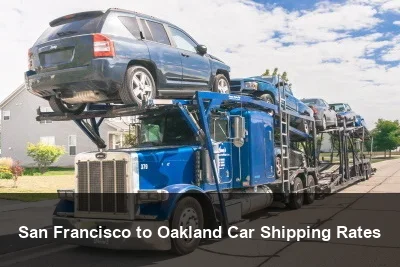
At roughly 12 miles, San Francisco to Oakland falls into the ultra-short distance tier, where base mileage rates are less of a factor than minimum carrier fees and staging costs. Expect a flat minimum charge rather than a per-mile rate. Summer tech-relocation demand and the August UC Berkeley move-in surge can tighten carrier availability and push prices slightly higher. Fuel costs on such a short run are minimal, but Bay Bridge tolls factor into carrier overhead. See how fuel pricing affects transport fees at https://california.auto-transport-shipping.com/articles/how-gas-prices-impact-california-auto-transport-fees.html.
What affects the cost of San Francisco to Oakland car shipping:
- Vehicle type and size — larger vehicles take more carrier space; aftermarket additions like lift kits, oversized mirrors, or roof accessories can add fees
- Open vs. enclosed transport — open is lower cost with stronger carrier availability; enclosed protects against weather, debris, and road conditions
- Standard vs. expedited pickup — expedited prioritizes your vehicle for the next available dispatch, typically at a $100–$300 premium
- Time of year — peak demand seasons drive rates higher; off-peak windows offer the most competitive pricing
- Fuel costs — diesel prices affect carrier rates; longer routes are more sensitive to fuel price swings
- Vehicle condition — non-running vehicles require special loading equipment and cost more to ship
| Vehicle Type | Open Car Shipping (Est.) | Enclosed Car Shipping (Est.) |
|---|---|---|
| Sedan | $350 – $500 | $700 – $950 |
| SUV / Crossover | $400 – $600 | $800 – $1,100 |
| Pickup Truck | $400 – $600 | $800 – $1,100 |
| Minivan | $400 – $600 | $800 – $1,100 |
| Luxury / Classic Car | $500 – $700 | $950 – $1,300 |
| Non-Running Vehicle | Add $100–200 | Add $100–200 |
* Estimated ranges based on recent San Francisco to Oakland shipments. Actual rate depends on vehicle, locations, booking date, and current fuel costs. Use the form on this page to compare real quotes from licensed carriers.
Open vs. Enclosed on the SF-to-Oakland Bay Crossing
For a standard daily driver crossing from San Francisco to Oakland, open transport is the practical choice. The route is short, weather conditions are mild, and the Bay Bridge crossing takes minutes. Enclosed transport makes sense if you're moving a classic car, luxury vehicle, or anything you'd normally garage-keep. Salt air near the Bay is a real factor for paint-sensitive vehicles on longer storage timelines, but for a direct short-haul move, open carriers handle this corridor cleanly and are far more available on short notice.
How Long Does San Francisco to Oakland Car Shipping Take?
Driving time between San Francisco and Oakland is under 30 minutes under normal traffic conditions, but auto transport doesn't work on driving time alone — it works on carrier scheduling and load consolidation. On this corridor, transit is typically one to three days from confirmed pickup, accounting for carrier routing, load sequencing, and the multi-stop nature of most Bay Area runs. Carriers running Peninsula or South Bay stops often complete Oakland deliveries the same day or next morning. If timing is critical, expedited options exist — see https://california.auto-transport-shipping.com/articles/california-expedited-car-shipping-fast-cost.html for cost implications.
| Service Type | Typical Transit | Pickup Window | Best For |
|---|---|---|---|
| Open — Standard | 1–2 days | 1–3 business days | Best value; most common choice on this route |
| Open — Expedited | Same–1 day | Next day–1 business day | Firm arrival date; faster dispatch window |
| Enclosed — Standard | 2–3 days | 2–5 business days | Luxury, classic, or modified vehicles |
| Enclosed — Expedited | 1–2 days | 1–2 business days | High-value vehicles on a firm delivery deadline |
** Bay Bridge congestion during morning and evening commute hours — roughly 7–9 a.m. and 4–7 p.m. — can delay carrier access. Summer fog and occasional high-wind advisories on the Bay Bridge can also add hours. Schedule pickups and deliveries for midday windows when possible.
San Francisco to Oakland — Route & Logistics
Carriers on this route access I-80 east from San Francisco staging points or via US-101 from the South Bay, crossing into Oakland over the Bay Bridge. The total carrier driving distance is approximately 12 miles. Most multi-car haulers avoid surface streets in SF's Tenderloin, Nob Hill, and Haight districts entirely, staging instead in flat industrial zones before the bridge approach.
Key Corridor Waypoints
- South San Francisco / Brisbane Staging, CA Multi-car carriers heading from the Peninsula frequently stage in the flat industrial corridors along US-101 between South San Francisco and Brisbane before merging north toward the Bay Bridge on-ramp. This avoids the steep grades and narrow lanes of central SF. If your pickup is in a restricted SF neighborhood, this is a likely carrier meet point.
- I-80 East On-Ramp, San Francisco, CA Carriers enter I-80 east from either the 7th Street/Harrison Street approach in SoMa or from the elevated connector near the 101/80 interchange. This is the primary chokepoint — Bay Bridge approach traffic during peak hours can delay carrier departure by 30 to 60 minutes. Midday loading windows improve on-time departure.
- San Francisco–Oakland Bay Bridge The 4.5-mile Bay Bridge carries carriers directly into the East Bay. Multi-car haulers are permitted on the bridge with standard commercial vehicle clearance. Toll costs are factored into carrier overhead on this lane. High-wind advisories occasionally restrict oversized vehicles; carriers monitor real-time Caltrans alerts before crossing.
- West Oakland / Emeryville, CA After the bridge touchdown, carriers exit into West Oakland or continue north to Emeryville — a flat, industrially zoned area that serves as the primary East Bay staging zone. Emeryville's easy I-80 access and warehouse district make it ideal for multi-car carrier positioning before final Oakland delivery runs.
- Downtown Oakland / Grand Lake, CA Final delivery in Oakland's denser residential and commercial zones — Grand Lake, Temescal, Uptown, and Lake Merritt — requires smaller shuttle or door-to-door coordination in some blocks. Most flatbed or 7-car carrier rigs can access major arterials like Telegraph, Broadway, and MacArthur. Narrower residential side streets may require a short drive from a corner staging point.
Pickup & Delivery Access
- Pickup Access in San Francisco San Francisco's urban core presents real constraints for multi-car carriers. Streets in Nob Hill, Pacific Heights, the Castro, and Haight-Ashbury are too steep or narrow for standard 7-car haulers. Pickups are most efficient from flat areas: SoMa, Potrero Hill's lower blocks, the Dogpatch, or Mission District arterials. If your vehicle is in a restricted neighborhood, plan to drive to a carrier-accessible meet point near the I-80 on-ramp corridor.
- Delivery Access in Oakland Oakland delivery access is generally better than San Francisco — the East Bay street grid is flatter and more carrier-friendly. Broadway, Telegraph, MacArthur Boulevard, and the International Boulevard corridor handle standard multi-car rigs without issue. The Fruitvale and Laurel districts have tighter residential streets where carriers may request a corner or parking lot meet. The Port of Oakland's Seventh Street approach is restricted to credentialed vehicles; coordinate staging outside the port perimeter.
- Nearby Pickup Locations Carriers picking up in San Francisco regularly extend service to Oakland, Berkeley, South San Francisco, and Daly City. Call 1‑800‑590‑6492 to confirm door-to-door availability at your address.
Open vs. Enclosed Car Shipping: San Francisco to Oakland
Both options use licensed, insured carriers and deliver door to door. For a full breakdown, read the pros and cons of open vs. enclosed car shipping.
Open Car Shipping
Most Popular- Lower cost — the practical choice for most vehicles
- More carriers available on this corridor
- Faster dispatch from booking to pickup
- Works well for sedans, SUVs, trucks, and minivans
- Vehicle rides on an open multi-car carrier
- Cargo insurance required on all licensed carriers
Estimated cost: $350 – $600
Enclosed Car Shipping
Premium Protection- Full protection from weather, debris, and road grime
- Best for luxury, exotic, and classic vehicles
- Recommended for low-clearance and custom-built cars
- Wheel-net or soft-tie systems prevent contact damage
- Higher cargo coverage — commonly $500,000 per load
- White-glove handling by experienced operators
Estimated cost: $700 – $1,100
Not sure which is right for your vehicle? Call 1-800-590-6492 and we'll point you in the right direction. Also worth reading: the top 10 questions to ask any car shipping company before you commit.
How to Prepare Your Car for Shipping to Oakland
A little prep before pickup protects you if there's ever a dispute about your vehicle's condition. This checklist is from our full guide on preparing your car for transport:
- Remove all personal belongings from the interior and trunk
- Leave only a quarter tank of fuel — enough to load and unload
- Take date-stamped photos of the full exterior and interior
- Remove or disable toll transponders (FasTrak, E-ZPass, etc.)
- Retract or remove roof racks, spoilers, antennas, and bike mounts
- Make sure the battery is charged and tires are properly inflated
- Tell the carrier about any existing leaks or mechanical issues
- Deactivate the car alarm before the carrier arrives
- Write down the mileage on the Bill of Lading at pickup
- Fold in side mirrors if the vehicle is wider than standard
Personal items: Most carriers won't cover belongings left in the car. Read the full rules on shipping personal items in your vehicle. Also review our Bill of Lading guide so you know exactly what to check at pickup and delivery.
When to Ship Your Car from San Francisco to Oakland
The San Francisco-to-Oakland corridor runs consistently year-round without the hard weather windows that affect mountain or Central Valley routes. Demand peaks in summer — June through August — driven by tech company relocation cycles, UC Berkeley's August move-in, and general Bay Area PCS and corporate transfer activity. Pricing tightens modestly during peak weeks. Fog and mild winter conditions pose minimal transport risk, though Bay Bridge wind events are more frequent November through March. For general winter transport considerations, see https://california.auto-transport-shipping.com/articles/auto-transport-challenges-during-the-winter.html.
UC Berkeley Move-In (August)
UC Berkeley's fall semester move-in runs through mid-August and generates significant vehicle volume between San Francisco and the East Bay. Students, families, and graduate housing moves all compete for carrier slots on this corridor during the same two-week window. Book three to four weeks early if your move falls between August 1st and 20th. Carrier availability tightens noticeably, and minimum rates may apply with less flexibility.
Summer Tech Relocation Season (June–August)
Bay Area tech company onboarding cycles produce consistent vehicle moves June through August as new hires relocate from other cities or between SF neighborhoods and Oakland. This is the highest-demand window on the corridor. Rates hold at or slightly above baseline. If you're coordinating a corporate relocation, confirm your carrier booking before your start date rather than the week of your move.
Spring Shoulder Season (March–May)
Spring is the most cost-efficient window to ship on this route. Carrier availability is higher, demand hasn't peaked yet, and Bay weather is cooperative. If your timeline is flexible and your move falls between March and May, you're likely to get faster scheduling and more carrier options than in peak summer. This is also a good window for coordinating port vehicle pickups near Oakland.
Winter Fog and Bridge Conditions (November–March)
Winter on this corridor means dense Bay fog, not snow or ice. Fog rarely stops carriers but can slow Bay Bridge approach traffic and affect scheduling windows. High-wind advisories on the bridge are more common November through February and can briefly hold oversized loads. Plan delivery windows with a one-day buffer during this period. Rates are typically at their lowest point of the year.
Port of Oakland Shipping Cycles (Year-Round)
The Port of Oakland runs import and export vehicle cycles year-round, with periodic surges tied to international shipping schedules. During peak port intake weeks, carrier access near the Seventh Street and Maritime Street perimeter is restricted and congested. If your delivery or pickup is near the port zone, confirm access windows with your carrier in advance to avoid wait times at the gate.
How to Choose a San Francisco to Oakland Car Shipping Company
Getting multiple quotes is step one — knowing what to look for in those quotes matters just as much. Our guide on how to select a car shipping company covers the full process. Here are the six things that matter most:
FMCSA Registration
Every carrier or broker must hold a valid MC number. Verify any company at FMCSA SAFER before you book.
Proof of Insurance
Ask for a current certificate of insurance. Open carriers typically carry $100,000–$250,000 per load; enclosed commonly $500,000 or more. Learn what auto transport insurance covers.
All-In Pricing
Your quote should be a final number with no fees added after booking. Know the difference between brokers and carriers and confirm what the quote covers before you agree.
Bill of Lading
A complete Bill of Lading is filled out at pickup and delivery. Our Bill of Lading guide explains what to check. Never sign an incomplete one.
Real Reviews
Check Google and the BBB. Look at how they handled complaints and damage claims — that tells you more than a five-star average from happy customers.
Route Experience
A carrier who runs the SF-to-Oakland lane regularly knows details that a carrier new to the Bay Area doesn't. They know the Bay Bridge has a hard restriction window for oversized vehicles during high-wind advisories and that Caltrans posts alerts 30 to 60 minutes before enforcement — enough time to stage in Emeryville and wait it out. They know the SoMa I-80 on-ramp approach handles a 75-foot rig cleanly while the alternative Market Street routing doesn't. They know Oakland's Fruitvale district has permit parking enforcement that starts at 8 a.m. on residential blocks, so early-morning deliveries need to land before enforcement begins. They know the Port of Oakland's Seventh Street gate requires advance credentialing — you can't walk a rig in cold. These are the details that prevent delays on what should be a same-day or next-day move.
San Francisco to Oakland Car Shipping — FAQ
How much does it cost to ship a car from San Francisco to Oakland?
Because the distance is only about 12 miles, standard per-mile rates don't apply — carriers charge a flat minimum fee to cover the cost of positioning, loading, bridge tolls, and unloading. On this corridor, expect to pay a minimum floor charge rather than a distance-calculated rate. Enclosed transport will cost more than open. The August UC Berkeley move-in window and summer tech relocation season can push pricing slightly higher due to demand. The most accurate number comes from a live quote based on your vehicle type, transport method, and exact dates — use the form on this page to get one.
How long does San Francisco to Oakland car shipping take?
Driving time is under 30 minutes, but auto transport runs on carrier scheduling, not driving time. On this corridor, most confirmed shipments are completed within one to three days of pickup. Carriers running multi-stop Bay Area routes often complete Oakland deliveries the same day or the following morning after San Francisco pickup. Factors that extend transit include Bay Bridge congestion during peak commute hours, high-wind bridge restrictions, and port staging conflicts near the Oakland delivery zone. If your move is time-sensitive, expedited options exist — see https://california.auto-transport-shipping.com/articles/california-expedited-car-shipping-fast-cost.html for what that costs on a short-haul route like this.
Is my car insured during transport from San Francisco to Oakland?
Yes. Every licensed auto transport carrier is required by federal law to carry cargo liability insurance covering your vehicle during transport. Before your carrier loads the vehicle, a bill of lading is completed documenting your car's condition — that document is your baseline for any damage claim. On a short route like SF to Oakland, damage events are rare, but the process is the same regardless of distance. Review your carrier's insurance certificate before shipping. For a full breakdown of how coverage works, see https://california.auto-transport-shipping.com/articles/understanding-auto-transport-insurance.html. If damage does occur, follow the steps at https://california.auto-transport-shipping.com/articles/how-to-file-a-claim-for-vehicle-damage-during-transport.html.
Should I choose open or enclosed transport for this route?
For most standard vehicles on the San Francisco-to-Oakland corridor, open transport is the right call. The route is short, weather is mild, and open carriers cross the Bay Bridge multiple times daily. Enclosed transport is worth the premium if you're shipping a classic car, high-value luxury vehicle, or a show car where any road debris or salt-air exposure matters. Bay proximity is a real consideration for long-term storage, but for a direct point-to-point move of 12 miles, open carriers handle it cleanly. For a full comparison of both options, see https://california.auto-transport-shipping.com/articles/open-vs-enclosed-auto-transport-pros-and-cons.html.
Do I have to be present at pickup and delivery?
You or an authorized representative must be present at both pickup and delivery to sign the bill of lading. The bill of lading documents your vehicle's condition before loading and after delivery — it's the only record that protects you if a dispute arises. If you can't be there in person, you can designate someone else: a neighbor, property manager, or family member. Make sure whoever you designate understands what to look for at delivery inspection. Don't sign off on delivery until you've walked the vehicle. For details on what the bill of lading covers, see https://california.auto-transport-shipping.com/articles/california-auto-transport-bill-of-lading-information.html.
Can carriers actually get into San Francisco neighborhoods to pick up my car?
Multi-car carriers — typically 65 to 75 feet long — cannot safely access most of San Francisco's residential neighborhood streets. Grades in Nob Hill, Pacific Heights, and Twin Peaks exceed what loaded haulers can navigate, and lane widths in the Castro, Haight, and Richmond districts don't accommodate these rigs. Carriers serving SF pickups typically stage in flat industrial zones in SoMa, Dogpatch, or Potrero Hill, or further south in Brisbane and South San Francisco. If your vehicle is parked in a restricted neighborhood, plan to drive it to a meet point near the I-80 approach before the carrier loads.
Does the Bay Bridge toll affect my transport cost?
Yes, Bay Bridge tolls are a real operating cost for carriers on this corridor and are factored into the minimum flat rate you'll pay. For passenger vehicles, the Bay Bridge toll is currently $7 cash or $6 with FasTrak — but multi-axle commercial carriers pay significantly more based on axle count and gross vehicle weight. A loaded 7-car hauler crossing the Bay Bridge pays a higher commercial toll tier. This is part of why minimum charges on ultra-short Bay Area routes like SF to Oakland are higher relative to distance than you might expect on a 200-mile interstate run.
Is this route viable for shipping a vehicle related to a military PCS or base access?
The former Oakland Army Base — now the Oakland Global Trade and Logistics Center — no longer functions as an active military installation, so traditional military PCS shipping tied to base housing isn't a factor at that specific site. However, personnel moving between installations in the Bay Area — including Coast Guard facilities in the region — do use the SF-to-Oakland corridor for vehicle moves. If you're shipping under a military PCS order, confirm whether your orders qualify you for government-rate transport programs. Either way, the carrier availability on this route is reliable enough to support time-sensitive PCS move windows with reasonable notice.
Ready to Ship Your Car from San Francisco to Oakland?
One form gets you up to 10 free quotes from licensed, insured carriers. Compare costs and transit times and book the best deal for your schedule.