

San Francisco to Boston Car Shipping Route
San Francisco to Boston covers approximately 3,095 miles by road. Carriers accessing this route from San Francisco typically stage in the East Bay — Oakland or Fremont — to avoid the steep grades and narrow residential streets in much of SF proper. From those staging points, they pick up I-80 East, which is the primary transcontinental artery for this corridor, crossing the Sierra Nevada at Donner Pass (elevation 7,057 feet), the Great Salt Lake Desert, and the Midwest before connecting to I-90 East through upstate New York and into Massachusetts. For context on why most customers choose transport over driving this distance, see https://california.auto-transport-shipping.com/articles/benefits-of-auto-transport-service-vs-driving-yourself.html.
Boston's inbound demand is anchored by a dense cluster of institutions and employers. MIT, Harvard, Boston University, Northeastern, and Tufts generate consistent student and faculty vehicle shipments, particularly in August and September. The biotech and life sciences sector in Kendall Square draws relocating employees from Bay Area firms like Genentech and Moderna's California offices. Joint Base Cape Cod and Hanscom Air Force Base in Bedford pull military PCS moves throughout the year. Winter weather between November and March — snowstorms across Wyoming, Iowa, and western Massachusetts — can add transit days and occasionally triggers surcharges. Before you book, review https://california.auto-transport-shipping.com/articles/auto-transport-mistakes-to-avoid.html to avoid common scheduling and documentation errors.
San Francisco to Boston Car Shipping Rates
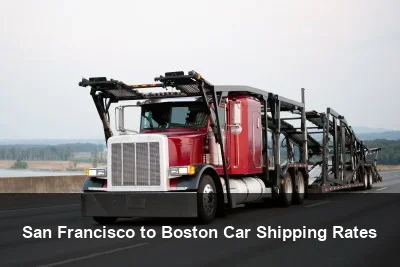
San Francisco to Boston is a long-haul route, and distance is the dominant pricing factor. Base rates on this corridor typically range from $1,100 to $1,900 for a standard sedan on open transport, depending on season and carrier availability. Fuel costs across 3,095 miles are a significant component of what you pay — see how pump prices affect your quote at https://california.auto-transport-shipping.com/articles/how-gas-prices-impact-california-auto-transport-fees.html. Rates climb in late summer when student and corporate relocation demand peaks. Winter surcharges may apply when carriers face mountain pass delays or storm-related rerouting.
What affects the cost of San Francisco to Boston car shipping:
- Vehicle type and size — larger vehicles take more carrier space; aftermarket additions like lift kits, oversized mirrors, or roof accessories can add fees
- Open vs. enclosed transport — open is lower cost with stronger carrier availability; enclosed protects against weather, debris, and road conditions
- Standard vs. expedited pickup — expedited prioritizes your vehicle for the next available dispatch, typically at a $100–$300 premium
- Time of year — peak demand seasons drive rates higher; off-peak windows offer the most competitive pricing
- Fuel costs — diesel prices affect carrier rates; longer routes are more sensitive to fuel price swings
- Vehicle condition — non-running vehicles require special loading equipment and cost more to ship
| Vehicle Type | Open Car Shipping (Est.) | Enclosed Car Shipping (Est.) |
|---|---|---|
| Sedan | $1,100 – $1,600 | $1,900 – $2,700 |
| SUV / Crossover | $1,300 – $1,900 | $2,200 – $3,100 |
| Pickup Truck | $1,300 – $1,950 | $2,200 – $3,150 |
| Minivan | $1,300 – $1,900 | $2,200 – $3,100 |
| Luxury / Classic Car | $1,550 – $2,200 | $2,600 – $3,600 |
| Non-Running Vehicle | Add $200–400 | Add $200–400 |
* Estimated ranges based on recent San Francisco to Boston shipments. Actual rate depends on vehicle, locations, booking date, and current fuel costs. Use the form on this page to compare real quotes from licensed carriers.
Open vs. Enclosed: What This 3,000-Mile Route Demands
Open transport is the practical choice for most vehicles on this corridor. The route crosses high-desert terrain in Nevada and Utah, flat agricultural stretches in the Midwest, and salt-treated winter roads in New York and Massachusetts — conditions that open carriers handle routinely. If you are shipping a classic car, a high-value exotic, or a new luxury vehicle and the move falls between November and March, enclosed transport adds meaningful protection from road salt spray and storm debris. Expect to pay 40 to 60 percent more for enclosed. For most daily drivers, open is the right call.
How Long Does San Francisco to Boston Car Shipping Take?
San Francisco to Boston typically takes 7 to 12 days from the time a carrier picks up your vehicle. The driving distance alone — just over 3,000 miles — requires a minimum of four to five days of actual transit even with an experienced team. Carrier availability from Bay Area staging points, load consolidation time, and required driver rest stops all add to that baseline. If your delivery window is tight, expedited options exist but carry a premium. Review what expedited service actually involves at https://california.auto-transport-shipping.com/articles/california-expedited-car-shipping-fast-cost.html before assuming it solves a last-minute booking.
| Service Type | Typical Transit | Pickup Window | Best For |
|---|---|---|---|
| Open — Standard | 7–10 days | 2–5 business days | Best value; most common choice on this route |
| Open — Expedited | 5–7 days | 1–2 business days | Firm arrival date; faster dispatch window |
| Enclosed — Standard | 7–10 days | 4–8 business days | Luxury, classic, or modified vehicles |
| Enclosed — Expedited | 5–7 days | 2–4 business days | High-value vehicles on a firm delivery deadline |
** Winter weather is the most common cause of extended transit on this route. Donner Pass can close or slow I-80 significantly between December and March, and storms across Wyoming and Iowa can add 24 to 48 hours. Northeast snowstorms may delay final delivery into Boston. Budget an extra two to three days buffer if you are shipping between November and April.
San Francisco to Boston — Route & Logistics
Carriers on this route leave San Francisco via US-101 or I-280 to reach East Bay staging points in Oakland or Fremont, then pick up I-80 East. I-80 carries the load for the bulk of the route — across Nevada, Utah, and Wyoming — before connecting to I-90 East at Evanston, Wyoming, which runs continuously through the Midwest, upstate New York, and into Massachusetts, terminating near Boston.
Key Corridor Waypoints
- Oakland / Fremont, CA The practical staging ground for most carriers departing the Bay Area. San Francisco's dense grid, steep hills, and narrow streets make it difficult for multi-car haulers to maneuver safely. Carriers typically ask that vehicles meet them at a flat, accessible lot in Oakland or Fremont before the truck picks up I-80 East toward Sacramento.
- Donner Pass, CA (Elevation 7,057 ft) The first major geographic hurdle after Sacramento. I-80 climbs the Sierra Nevada through Donner Pass, where winter conditions — snow, ice, chain control requirements — can slow or stop fully loaded carriers. Between November and April, carriers monitor Caltrans chain control zones closely. A storm can add 12 to 24 hours to transit at this single point.
- Salt Lake City, UT A common overnight stop and driver rest point, roughly 750 miles from Oakland. Carriers often refuel and inspect loads here. Salt Lake is also where some carriers pick up or drop off additional vehicles, adjusting load before the long Wyoming and Nebraska stretch. I-80 continues east through the Great Salt Lake Desert from this junction.
- Cheyenne, WY Cheyenne sits at approximately 6,063 feet and is a known winter trouble spot on I-80. High-wind advisories and ground blizzards frequently affect this stretch between October and April, sometimes forcing carriers to hold position for hours. Experienced drivers on this corridor know to check Wyoming DOT alerts before committing to the Cheyenne-to-Laramie segment.
- Cleveland, OH A major mid-route waypoint where I-80 and I-90 run parallel along the Lake Erie shoreline. Some carriers switch from I-80 to I-90 East here, depending on load stops in upstate New York. Cleveland is also a realistic second overnight point on longer transits, roughly 2,200 miles into the route from Oakland.
- Boston, MA (I-90 / I-93 Junction) The Massachusetts Turnpike (I-90) delivers carriers into the western suburbs of Boston. Final delivery into the city itself depends on the destination neighborhood. Beacon Hill, the North End, and downtown Boston have street access limitations for large haulers. South Boston, the Seaport District, and suburban staging lots in Dedham or Braintree are commonly used for final handoff.
Pickup & Delivery Access
- Pickup Access in San Francisco Multi-car carriers cannot safely navigate most of San Francisco's residential streets — grades exceeding 20 percent and parked cars on narrow lanes make it impractical. Carriers will typically ask your vehicle to meet them at a flat staging area in Oakland, Berkeley, or South San Francisco. BART-accessible lots near the Coliseum station in Oakland are a common meet point. Confirm the exact meet location when your carrier contacts you.
- Delivery Access in Boston Boston's older street grid creates the same access constraints as San Francisco, particularly in Beacon Hill, the North End, Charlestown, and Dorchester. Large carriers staging on city streets may face permit requirements or time-of-day restrictions. Suburban handoff points in Dedham, Braintree, or Waltham are frequently used. Confirm your carrier's plan for last-mile delivery before your vehicle arrives in Massachusetts so you are not caught off guard.
- Nearby Pickup Locations Carriers picking up in San Francisco regularly extend service to Oakland, Berkeley, South San Francisco, and Daly City. Call 1‑800‑590‑6492 to confirm door-to-door availability at your address.
Open vs. Enclosed Car Shipping: San Francisco to Boston
Both options use licensed, insured carriers and deliver door to door. For a full breakdown, read the pros and cons of open vs. enclosed car shipping.
Open Car Shipping
Most Popular- Lower cost — the practical choice for most vehicles
- More carriers available on this corridor
- Faster dispatch from booking to pickup
- Works well for sedans, SUVs, trucks, and minivans
- Vehicle rides on an open multi-car carrier
- Cargo insurance required on all licensed carriers
Estimated cost: $1,100 – $1,950
Enclosed Car Shipping
Premium Protection- Full protection from weather, debris, and road grime
- Best for luxury, exotic, and classic vehicles
- Recommended for low-clearance and custom-built cars
- Wheel-net or soft-tie systems prevent contact damage
- Higher cargo coverage — commonly $500,000 per load
- White-glove handling by experienced operators
Estimated cost: $1,900 – $3,150
Not sure which is right for your vehicle? Call 1-800-590-6492 and we'll point you in the right direction. Also worth reading: the top 10 questions to ask any car shipping company before you commit.
How to Prepare Your Car for Shipping to Boston
A little prep before pickup protects you if there's ever a dispute about your vehicle's condition. This checklist is from our full guide on preparing your car for transport:
- Remove all personal belongings from the interior and trunk
- Leave only a quarter tank of fuel — enough to load and unload
- Take date-stamped photos of the full exterior and interior
- Remove or disable toll transponders (FasTrak, E-ZPass, etc.)
- Retract or remove roof racks, spoilers, antennas, and bike mounts
- Make sure the battery is charged and tires are properly inflated
- Tell the carrier about any existing leaks or mechanical issues
- Deactivate the car alarm before the carrier arrives
- Write down the mileage on the Bill of Lading at pickup
- Fold in side mirrors if the vehicle is wider than standard
Personal items: Most carriers won't cover belongings left in the car. Read the full rules on shipping personal items in your vehicle. Also review our Bill of Lading guide so you know exactly what to check at pickup and delivery.
When to Ship Your Car from San Francisco to Boston
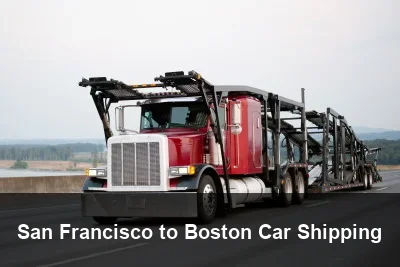
This route has a pronounced late-summer demand spike driven by university move-ins — MIT, Harvard, Boston University, and Northeastern all see incoming students and faculty in August and September. That surge compresses carrier availability and pushes rates up 15 to 25 percent from mid-July through early September. Winter is the opposite in demand but the most operationally challenging for transit. For a full breakdown of winter shipping risks on long-haul corridors, see https://california.auto-transport-shipping.com/articles/auto-transport-challenges-during-the-winter.html.
Spring (March–May)
Demand moderates after winter and before the summer surge. Carriers are running the corridor regularly, rates are closer to baseline, and mountain pass conditions have typically cleared by late April. This is one of the better windows to book if your timing is flexible. Donner Pass and the Wyoming stretch are generally passable without chain requirements by early May, reducing the risk of transit delays.
Summer Peak (June–August)
The highest-demand period on this corridor. Bay Area tech workers relocating to Boston's Route 128 biotech cluster and university personnel moving ahead of the fall semester drive up bookings sharply. Book four to six weeks in advance if you are targeting a July or August pickup. Rates during this window can run 20 percent above off-season pricing. Weather is favorable across the entire route, and transit times trend toward the shorter end.
Student Move-In (August–September)
MIT, Harvard, Boston University, Northeastern, and Tufts all begin fall terms in late August and early September. This creates a concentrated inbound vehicle surge into the Boston metro. Carriers on this lane fill quickly during this window. If your move is tied to a university enrollment date, book as early as possible — last-minute bookings in late August face both higher rates and longer dispatch waits due to carrier saturation.
Winter (November–March)
The most operationally complex window for this route. Donner Pass, the Wyoming plains, and the Massachusetts Turnpike all face snow and ice conditions. Transit times lengthen, and carriers may apply weather surcharges. Budget 10 to 14 days rather than 7 to 10. Enclosed transport is worth serious consideration if your vehicle is high-value, as road salt from treated highways in the Midwest and New England will reach open-carrier vehicles.
Military PCS Season (May–August)
Joint Base Cape Cod and Hanscom Air Force Base in Bedford, MA receive PCS transfers primarily between May and August, aligning with the military's standard PCS cycle. Service members shipping from the Bay Area — including those at Naval Station Treasure Island or the Presidio of Monterey — targeting these installations should book well ahead of report dates. PCS moves qualify for specific timeline requirements; confirm your ship date before scheduling.
How to Choose a San Francisco to Boston Car Shipping Company
Getting multiple quotes is step one — knowing what to look for in those quotes matters just as much. Our guide on how to select a car shipping company covers the full process. Here are the six things that matter most:
FMCSA Registration
Every carrier or broker must hold a valid MC number. Verify any company at FMCSA SAFER before you book.
Proof of Insurance
Ask for a current certificate of insurance. Open carriers typically carry $100,000–$250,000 per load; enclosed commonly $500,000 or more. Learn what auto transport insurance covers.
All-In Pricing
Your quote should be a final number with no fees added after booking. Know the difference between brokers and carriers and confirm what the quote covers before you agree.
Bill of Lading
A complete Bill of Lading is filled out at pickup and delivery. Our Bill of Lading guide explains what to check. Never sign an incomplete one.
Real Reviews
Check Google and the BBB. Look at how they handled complaints and damage claims — that tells you more than a five-star average from happy customers.
Route Experience
A carrier who runs San Francisco to Boston regularly knows not to attempt pickup inside the SF city limits with a full multi-car hauler — they stage in Oakland or Fremont and coordinate a meet-point. They know to check Wyoming DOT wind advisories before leaving Salt Lake City, because a high-wind closure between Cheyenne and Laramie can hold a truck for four hours. They know that delivering into Cambridge or Beacon Hill requires a smaller shuttle vehicle or a suburban staging lot and that scheduling a Boston delivery on a Monday morning means competing with commercial traffic on the I-90 ramp into the city. They also know which Cleveland and Buffalo truck stops allow overnight parking with a loaded carrier. That operational familiarity is the difference between a 9-day transit and a 13-day transit.
San Francisco to Boston Car Shipping — FAQ
How much does it cost to ship a car from San Francisco to Boston?
Rates on this corridor typically range from $1,100 to $1,900 for a standard sedan on open transport. Enclosed transport runs 40 to 60 percent higher. The exact figure depends on vehicle size, the specific pickup and delivery addresses, current fuel prices, and the time of year. Late summer — July through early September — is the most expensive window due to university and corporate relocation demand. Winter rates are lower but may include weather surcharges if carriers face mountain pass delays. Get a quote with your actual dates to see a current rate for your vehicle.
How long does San Francisco to Boston car shipping take?
Plan for 7 to 12 days from carrier pickup to delivery. The driving distance is just over 3,095 miles, which requires a minimum of four to five days of road time under normal conditions. Carrier scheduling, load consolidation in the East Bay, and mandatory driver rest stops add to that baseline. Winter transits run longer — Donner Pass and the Wyoming stretch are the most common delay points, and storms in either location can add 24 to 48 hours. If your schedule is tight, ask about expedited options before booking standard service.
Is my car insured during transport from San Francisco to Boston?
Every licensed carrier is required to carry cargo insurance that covers your vehicle while it is on the truck. Before your vehicle is loaded, you and the driver complete a Bill of Lading documenting its pre-transport condition. At delivery, inspect your vehicle carefully against that same document before signing. If damage occurred in transit, the Bill of Lading is your primary evidence for a claim. For a full breakdown of what carrier insurance covers and what it excludes, read https://california.auto-transport-shipping.com/articles/understanding-auto-transport-insurance.html. If you need to file a claim, the process is explained at https://california.auto-transport-shipping.com/articles/how-to-file-a-claim-for-vehicle-damage-during-transport.html.
Should I choose open or enclosed transport for this route?
Open transport is the right call for most vehicles on this run. The route crosses environments that open carriers handle routinely — high desert, flat Midwest, and suburban New England. If you are shipping between November and March, road salt from treated highways in Wyoming, Ohio, and Massachusetts will reach your vehicle on an open carrier. For a daily driver, that is normal wear. For a classic car, a new luxury vehicle, or a low-clearance exotic, enclosed transport provides meaningful protection from salt spray and storm debris. A detailed comparison of both options is available at https://california.auto-transport-shipping.com/articles/open-vs-enclosed-auto-transport-pros-and-cons.html.
Do I have to be present at pickup and delivery?
You do not have to be personally present, but someone you authorize must be available at both ends to sign the Bill of Lading. At pickup, the authorized person walks the vehicle with the driver, confirms the condition documentation, and hands over the keys. At delivery, they perform the same inspection before signing off. If damage is signed off as accepted at delivery, your ability to file a claim is significantly weakened. For a full explanation of what the Bill of Lading covers and why it matters, see https://california.auto-transport-shipping.com/articles/california-auto-transport-bill-of-lading-information.html.
How does winter weather affect shipping from San Francisco to Boston?
Winter is operationally the most difficult window for this corridor. Three separate sections carry meaningful weather risk: Donner Pass on I-80 in California can require chains or close temporarily between December and March; the I-80 stretch through Cheyenne and Laramie, Wyoming is prone to ground blizzards and high-wind closures; and the Massachusetts Turnpike sees ice and snowstorms from November through April. Each of these can add 12 to 48 hours to transit independently. If you are shipping between November and March, budget 10 to 14 days rather than the standard 7 to 10. For more on what winter shipping involves, see https://california.auto-transport-shipping.com/articles/auto-transport-challenges-during-the-winter.html.
Does shipping timing matter for military PCS moves to the Boston area?
Yes, significantly. Hanscom Air Force Base in Bedford and Joint Base Cape Cod both receive PCS orders primarily in the May through August cycle. If you are shipping from the Bay Area — from the Presidio of Monterey, Naval Station Treasure Island, or any NorCal installation — to one of these Massachusetts bases, book your transport as soon as your orders are confirmed. The summer window is the highest-demand period on this lane, and carrier slots fill quickly. Military members should also confirm whether their orders include vehicle shipping entitlements before booking, as that affects how you structure the contract.
Can the carrier pick up my vehicle directly from my address in San Francisco?
In many cases, no. Multi-car haulers — the standard 7 to 10 car carriers used on long-haul runs — cannot safely navigate steep grades, narrow residential streets, or blocks with restricted turning radii that are common in much of San Francisco. Neighborhoods like Noe Valley, the Inner Sunset, Pacific Heights, and the Castro are effectively inaccessible to large carriers. Your dispatcher will work with you to identify a flat, accessible meet point, typically in Oakland, Fremont, or South San Francisco. BART-accessible parking lots in Oakland near the Coliseum are a frequently used option. Confirm the exact staging location before your pickup date.
Ready to Ship Your Car from San Francisco to Boston?
One form gets you up to 10 free quotes from licensed, insured carriers. Compare costs and transit times and book the best deal for your schedule.