

San Francisco to Tulsa Car Shipping Route
San Francisco to Tulsa covers approximately 1,845 miles. Carriers accessing this route from San Francisco typically avoid the dense city core and use the Bay Bridge to reach I-80 in Oakland, or stage vehicles in South San Francisco and Daly City before connecting to US-101 south toward the I-580 interchange. From there, I-80 east through Sacramento and over Donner Pass in the Sierra Nevada is the primary corridor, eventually connecting to I-80 through the Nevada desert before carriers transition to I-15 south and I-40 east through Arizona and New Mexico into Oklahoma. Shipping your vehicle rather than driving eliminates roughly 27–30 hours of road time, fuel costs, and mechanical wear. See the full breakdown at https://california.auto-transport-shipping.com/articles/benefits-of-auto-transport-service-vs-driving-yourself.html
Tulsa's inbound demand comes from several concrete sources. The University of Tulsa enrolls over 4,000 students, many arriving from California, driving August and January shipment spikes. The energy sector—ONEOK, Williams Companies, and Citgo's Tulsa refinery—generates steady corporate relocation volume. Tulsa International Airport and American Airlines maintenance operations there also produce employee transfers. Weather is a real factor: Donner Pass can close or slow carrier movement in winter, and Oklahoma ice storms between December and February can delay final delivery. Spring tornado season adds uncertainty to scheduling in April and May. Understanding these risks before you book helps you avoid common planning errors—review https://california.auto-transport-shipping.com/articles/auto-transport-mistakes-to-avoid.html before confirming your dates.
San Francisco to Tulsa Car Shipping Rates
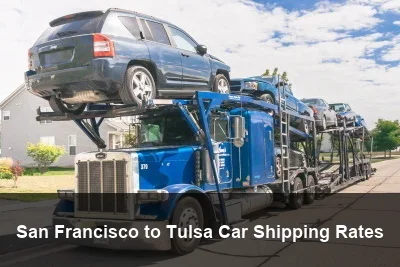
Rates on this corridor are driven by distance—at 1,845 miles, you're in the upper tier of mid-range hauls—and by fuel costs along I-80 and I-40, two of the highest-traffic freight corridors in the country. Spring and late summer see demand spikes tied to university move-ins and corporate relocation season, which pushes spot rates up 10–15 percent. Winter pricing can also rise when Donner Pass conditions force carriers onto alternate routes, increasing mileage and time. Fuel surcharges directly affect your quote; see how that's calculated at https://california.auto-transport-shipping.com/articles/how-gas-prices-impact-california-auto-transport-fees.html
What affects the cost of San Francisco to Tulsa car shipping:
- Vehicle type and size — larger vehicles take more carrier space; aftermarket additions like lift kits, oversized mirrors, or roof accessories can add fees
- Open vs. enclosed transport — open is lower cost with stronger carrier availability; enclosed protects against weather, debris, and road conditions
- Standard vs. expedited pickup — expedited prioritizes your vehicle for the next available dispatch, typically at a $100–$300 premium
- Time of year — peak demand seasons drive rates higher; off-peak windows offer the most competitive pricing
- Fuel costs — diesel prices affect carrier rates; longer routes are more sensitive to fuel price swings
- Vehicle condition — non-running vehicles require special loading equipment and cost more to ship
| Vehicle Type | Open Car Shipping (Est.) | Enclosed Car Shipping (Est.) |
|---|---|---|
| Sedan | $1,100 – $1,600 | $1,900 – $2,700 |
| SUV / Crossover | $1,300 – $1,900 | $2,200 – $3,100 |
| Pickup Truck | $1,300 – $1,950 | $2,200 – $3,150 |
| Minivan | $1,300 – $1,900 | $2,200 – $3,100 |
| Luxury / Classic Car | $1,550 – $2,200 | $2,600 – $3,600 |
| Non-Running Vehicle | Add $200–400 | Add $200–400 |
* Estimated ranges based on recent San Francisco to Tulsa shipments. Actual rate depends on vehicle, locations, booking date, and current fuel costs. Use the form on this page to compare real quotes from licensed carriers.
Open vs. Enclosed: What This Specific Route Actually Needs
The SF-to-Tulsa corridor crosses desert in Arizona and New Mexico—road debris and blowing sand are real—but it's not a route that demands enclosed transport for standard vehicles. Open transport is appropriate for most sedans, trucks, and SUVs. If you're shipping a classic car, luxury vehicle, or anything with a value above $70,000, enclosed is worth the 30–40 percent premium. The Sierra Nevada segment in winter also raises exposure to road salt and grit, which makes enclosed a reasonable call between November and March even for near-luxury vehicles.
How Long Does San Francisco to Tulsa Car Shipping Take?
Standard transit on this route runs five to eight business days from pickup to delivery. Carrier frequency from the Bay Area staging points in Oakland and Stockton is the first variable—expect one to five days from booking to actual pickup. The drive itself, at 1,845 miles, typically runs two to three days for a carrier team or three to four days for a solo driver. This lane moves consistently but isn't an expedited corridor by default. If your timeline is tight, ask about expedited options: https://california.auto-transport-shipping.com/articles/california-expedited-car-shipping-fast-cost.html
| Service Type | Typical Transit | Pickup Window | Best For |
|---|---|---|---|
| Open — Standard | 7–10 days | 2–5 business days | Best value; most common choice on this route |
| Open — Expedited | 5–7 days | 1–2 business days | Firm arrival date; faster dispatch window |
| Enclosed — Standard | 7–10 days | 4–8 business days | Luxury, classic, or modified vehicles |
| Enclosed — Expedited | 5–7 days | 2–4 business days | High-value vehicles on a firm delivery deadline |
** Donner Pass can slow or reroute carriers between November and April when chain controls or closures are in effect—add one to two days in those conditions. Oklahoma ice storms between December and February can delay final delivery into Tulsa. Build buffer into your schedule during those months.
San Francisco to Tulsa — Route & Logistics
Carriers on this route leave the Bay Area via the Bay Bridge to I-80 in Oakland, or via US-101 to I-580 eastbound. From Sacramento, I-80 continues east over Donner Pass at 7,056 feet into Nevada. At Winnemucca or Battle Mountain, routes can vary; most continue on I-80 to I-15 south, then east on I-40 through Kingman, Flagstaff, Albuquerque, and Amarillo before reaching Tulsa via I-44 from Oklahoma City—covering approximately 1,845 miles total.
Key Corridor Waypoints
- Oakland / Emeryville, CA The practical staging point for San Francisco shipments. Carriers use the Bay Bridge to avoid SF's narrow grades and restricted streets in neighborhoods like Russian Hill and the Haight. Multi-car haulers often pick up additional Bay Area vehicles in Emeryville or Berkeley before committing to the eastbound run on I-80. This adds a few hours but fills the truck and keeps your rate competitive.
- Sacramento, CA A major consolidation hub roughly 90 miles east of Oakland. Carriers frequently add vehicles here for the eastbound run, and it's a common overnight stop for solo drivers. Sacramento sits at near sea level—after this point the route climbs steadily toward the Sierra Nevada. If you're tracking your shipment, Sacramento is typically the last urban checkpoint before the mountain segment.
- Donner Pass, CA (Elevation 7,056 ft) The most operationally significant point on the route. Caltrans enforces chain controls here regularly between November and April, and full closures occur several times each winter. Carriers plan around these windows carefully. In summer, it's a non-issue. If your ship date falls in winter, confirm your carrier's contingency plan for this segment—delays here cascade into the rest of the schedule.
- Albuquerque, NM The primary overnight rest point on the second day of the haul. Carriers transitioning from I-25 north to I-40 east pass through here, and it serves as a fuel and driver rest stop. Sitting at 5,312 feet, Albuquerque can also see winter weather that catches drivers off guard in December and January. Most carriers are familiar with this and plan accordingly.
- Amarillo, TX The last major waypoint before Oklahoma. Amarillo sits at the eastern edge of the Texas Panhandle on I-40 and is a common fuel stop and inspection point. From here it's roughly 360 miles to Tulsa via I-40 east and I-44 north. Spring weather between March and May can introduce thunderstorm and tornado watches in this stretch—carriers may hold here briefly until conditions clear.
- Tulsa, OK (via I-44 / I-244) Carriers enter Tulsa from the southwest via I-44, transitioning to I-244 through the urban core. Most residential deliveries in midtown and south Tulsa are straightforward for standard car haulers. The Pearl District and some older neighborhoods near downtown have tighter streets that may require a meet-point delivery. Your driver will confirm the final delivery location 12–24 hours before arrival.
Pickup & Delivery Access
- Pickup Access in San Francisco San Francisco's street grid creates real problems for multi-car carriers—steep grades in Noe Valley, Pacific Heights, and the Sunset, combined with parking enforcement, make direct residential pickup impractical for most addresses. Carriers typically coordinate a meet point near a flat, accessible area: the waterfront near the Embarcadero, Caltrain parking areas in South San Francisco, or commercial zones in Daly City. Berkeley and Oakland are straightforward staging alternatives if your schedule allows.
- Delivery Access in Tulsa Most of Tulsa is carrier-accessible without special logistics. South Tulsa, Broken Arrow, and Jenks have wide residential streets and easy curb access for standard multi-car haulers. Downtown Tulsa and the Brady Arts District have tighter blocks and loading restrictions that may require a nearby parking lot or staging on a main commercial street. Carriers serving this market know the area—confirm your delivery address when booking so they can flag any access issues upfront.
- Nearby Pickup Locations Carriers picking up in San Francisco regularly extend service to Oakland, Berkeley, South San Francisco, and Daly City. Call 1‑800‑590‑6492 to confirm door-to-door availability at your address.
Open vs. Enclosed Car Shipping: San Francisco to Tulsa
Both options use licensed, insured carriers and deliver door to door. For a full breakdown, read the pros and cons of open vs. enclosed car shipping.
Open Car Shipping
Most Popular- Lower cost — the practical choice for most vehicles
- More carriers available on this corridor
- Faster dispatch from booking to pickup
- Works well for sedans, SUVs, trucks, and minivans
- Vehicle rides on an open multi-car carrier
- Cargo insurance required on all licensed carriers
Estimated cost: $1,100 – $1,950
Enclosed Car Shipping
Premium Protection- Full protection from weather, debris, and road grime
- Best for luxury, exotic, and classic vehicles
- Recommended for low-clearance and custom-built cars
- Wheel-net or soft-tie systems prevent contact damage
- Higher cargo coverage — commonly $500,000 per load
- White-glove handling by experienced operators
Estimated cost: $1,900 – $3,150
Not sure which is right for your vehicle? Call 1-800-590-6492 and we'll point you in the right direction. Also worth reading: the top 10 questions to ask any car shipping company before you commit.
How to Prepare Your Car for Shipping to Tulsa
A little prep before pickup protects you if there's ever a dispute about your vehicle's condition. This checklist is from our full guide on preparing your car for transport:
- Remove all personal belongings from the interior and trunk
- Leave only a quarter tank of fuel — enough to load and unload
- Take date-stamped photos of the full exterior and interior
- Remove or disable toll transponders (FasTrak, E-ZPass, etc.)
- Retract or remove roof racks, spoilers, antennas, and bike mounts
- Make sure the battery is charged and tires are properly inflated
- Tell the carrier about any existing leaks or mechanical issues
- Deactivate the car alarm before the carrier arrives
- Write down the mileage on the Bill of Lading at pickup
- Fold in side mirrors if the vehicle is wider than standard
Personal items: Most carriers won't cover belongings left in the car. Read the full rules on shipping personal items in your vehicle. Also review our Bill of Lading guide so you know exactly what to check at pickup and delivery.
When to Ship Your Car from San Francisco to Tulsa
This route has two clear demand peaks: late summer (July–August) tied to University of Tulsa enrollment and Bay Area corporate relocations, and spring (March–April) when general relocation season ramps up. Both windows push rates and pickup wait times up. Winter is operationally the most complex—Donner Pass conditions and Oklahoma ice storms can extend transit by one to three days. See the full winter picture at https://california.auto-transport-shipping.com/articles/auto-transport-challenges-during-the-winter.html before booking a December through February move.
Spring Relocation Season (March–May)
Corporate relocation and general PCS movement picks up sharply in March and holds through May. Rates on this corridor typically climb 10–15 percent above winter baseline. Oklahoma tornado season also begins in April, which can introduce delivery delays near Tulsa. Book three to four weeks ahead if your move falls in this window. Carriers fill quickly, and last-minute bookings often pay a premium or face extended pickup waits.
Summer Peak (June–August)
The highest-demand window on this route. University of Tulsa's fall semester begins in late August, driving a concentrated wave of student vehicle shipments from California. Bay Area tech and energy sector relocations also cluster here. Expect rates at or near annual highs and pickup wait times of three to five days unless you book four or more weeks out. Desert heat through Arizona and New Mexico is a consideration for vehicles with known cooling system issues.
University of Tulsa Move-In (Late July–August)
This is the single most route-specific demand driver on this corridor. University of Tulsa's fall enrollment pulls a concentrated wave of vehicles from California each year in late July and August. If you're a student or shipping for a student, booking six weeks ahead is not excessive. January sees a smaller spring semester repeat. Carriers who know this lane anticipate these spikes and price accordingly—waiting until two weeks out in August will cost you.
Winter Caution (November–February)
Two separate weather risks stack in winter: Donner Pass chain controls or closures in California and Oklahoma ice storms on the delivery end. Either can add one to two days to transit independently; both together can stretch the window to ten or more days. Rates may also carry a slight premium when carriers factor in risk and rerouting costs. Review winter-specific planning at https://california.auto-transport-shipping.com/articles/auto-transport-challenges-during-the-winter.html before committing to a winter ship date.
Military PCS Season (May–July)
Fort Sill in Lawton, Oklahoma—roughly 120 miles southwest of Tulsa—drives significant PCS vehicle movement each summer. Many service members process through Tulsa-area housing before or after reporting. This adds to an already-busy summer lane from the Bay Area, where Travis Air Force Base and NAS Alameda alumni also generate transfer volume. Military shippers should confirm carrier availability and understand their branch's reimbursement documentation requirements before booking.
Fall Shoulder Season (September–October)
The most favorable booking window on this route. Demand drops after the August university peak, carrier availability is better, and weather is cooperative at every segment of the route—Sierra Nevada passes are clear, Oklahoma summer heat has broken, and tornado season is inactive. Rates typically run 8–12 percent below summer peak. If your timeline is flexible and your move can land in September or early October, this is when to schedule it.
How to Choose a San Francisco to Tulsa Car Shipping Company
Getting multiple quotes is step one — knowing what to look for in those quotes matters just as much. Our guide on how to select a car shipping company covers the full process. Here are the six things that matter most:
FMCSA Registration
Every carrier or broker must hold a valid MC number. Verify any company at FMCSA SAFER before you book.
Proof of Insurance
Ask for a current certificate of insurance. Open carriers typically carry $100,000–$250,000 per load; enclosed commonly $500,000 or more. Learn what auto transport insurance covers.
All-In Pricing
Your quote should be a final number with no fees added after booking. Know the difference between brokers and carriers and confirm what the quote covers before you agree.
Bill of Lading
A complete Bill of Lading is filled out at pickup and delivery. Our Bill of Lading guide explains what to check. Never sign an incomplete one.
Real Reviews
Check Google and the BBB. Look at how they handled complaints and damage claims — that tells you more than a five-star average from happy customers.
Route Experience
A carrier who regularly runs San Francisco to Tulsa knows that the Bay Bridge approach from Oakland is faster and more practical than trying to load in the city itself—SF's grades and street widths eliminate most of the city's residential streets as viable pickup points. They know Donner Pass chain control schedules well enough to plan overnight stops in Sacramento during high-risk winter windows rather than getting caught at the summit. They know the I-40 corridor through Flagstaff can see unexpected late-spring snowfall above 7,000 feet elevation. And they know that Tulsa's Pearl District requires a staging call before arrival—the streets don't accommodate a full 75-foot rig without planning. That operational familiarity is what separates a carrier who's run this lane fifty times from one running it for the first time.
San Francisco to Tulsa Car Shipping — FAQ
How much does it cost to ship a car from San Francisco to Tulsa?
On this 1,845-mile corridor, open transport for a standard sedan or SUV typically runs between $1,050 and $1,450 depending on the season, fuel prices, and how quickly you need pickup. Enclosed transport adds 30–40 percent. Rates are highest in late July and August due to University of Tulsa enrollment demand and general summer relocation volume. Winter pricing can also spike slightly when Donner Pass conditions increase carrier operating costs. Fuel surcharges are a real variable on a haul this long—see how they're calculated at https://california.auto-transport-shipping.com/articles/how-gas-prices-impact-california-auto-transport-fees.html. The most accurate quote comes from filling out the form with your vehicle type, dates, and both addresses.
How long does San Francisco to Tulsa car shipping take?
Total time from booking to delivery is typically seven to twelve business days. After booking, expect one to five days before a carrier picks up your vehicle—Bay Area staging in Oakland or Stockton is common, and this lane dispatches three to five times weekly rather than daily. Transit itself runs five to eight days depending on driver scheduling, weather at Donner Pass, and Oklahoma delivery conditions. If your timeline is fixed, ask about expedited options at https://california.auto-transport-shipping.com/articles/california-expedited-car-shipping-fast-cost.html. Winter bookings should build in an extra two to three days of buffer for Sierra Nevada and Oklahoma weather events.
Is my car insured during transport from San Francisco to Tulsa?
Every licensed carrier operating on this route is required by federal law to carry cargo liability insurance—minimum $750,000 for most carriers. That coverage applies to your vehicle during loading, transport, and unloading. However, carrier policies often contain exclusions for pre-existing damage, acts of weather, and interior contents, which is why the condition report at pickup—the Bill of Lading—matters. Document every existing scratch, chip, and dent before handing over your keys. If damage occurs in transit, you'll need that documentation to file a claim. Read the full insurance overview at https://california.auto-transport-shipping.com/articles/understanding-auto-transport-insurance.html and the claims process at https://california.auto-transport-shipping.com/articles/how-to-file-a-claim-for-vehicle-damage-during-transport.html.
Should I choose open or enclosed transport for the San Francisco to Tulsa route?
Open transport is appropriate for the large majority of vehicles on this corridor. The route crosses desert through Arizona and New Mexico—some road debris and dust exposure—but that's typical of any cross-country haul and doesn't justify the enclosed premium for standard vehicles. Enclosed becomes a reasonable choice if you're shipping a vehicle valued over $70,000, a classic or collector car, or any vehicle with a fresh paint job or custom bodywork. The Sierra Nevada segment in winter adds some salt and grit exposure, making enclosed worth considering for near-luxury vehicles between November and March. Read the full comparison at https://california.auto-transport-shipping.com/articles/open-vs-enclosed-auto-transport-pros-and-cons.html.
Do I have to be present at pickup in San Francisco and delivery in Tulsa?
You or an authorized representative must be present at both pickup and delivery to sign the Bill of Lading—the condition report that documents your vehicle's state before and after transport. This document is your primary protection if you need to file a damage claim, so don't delegate it to someone who won't inspect the vehicle carefully. In San Francisco, where direct residential pickup is often impractical, coordinate a meet point in advance and make sure whoever meets the carrier has authority to sign. The same applies in Tulsa. Full details on the Bill of Lading process are at https://california.auto-transport-shipping.com/articles/california-auto-transport-bill-of-lading-information.html.
Does winter weather on this route cause significant delays?
Yes, and it's worth planning for specifically. Donner Pass on I-80 in California sits at 7,056 feet and sees chain controls or full closures multiple times each winter between November and April. When that happens, carriers either wait or reroute south through I-40 at lower elevation—either way, expect one to two additional days. On the delivery end, Oklahoma ice storms between December and February can make Tulsa-area roads impassable for a day or two. Both events can stack in the same shipment. Build buffer into any winter booking and review the detailed breakdown at https://california.auto-transport-shipping.com/articles/auto-transport-challenges-during-the-winter.html before committing to a December through February ship date.
I'm PCS-ing through Fort Sill or a Tulsa-area base. Is there anything specific I should know?
Fort Sill in Lawton, Oklahoma is roughly 120 miles southwest of Tulsa, and many service members process through Tulsa-area housing before reporting. PCS moves concentrated in May through July add to an already-busy summer lane from the Bay Area, where Travis Air Force Base near Fairfield generates its own transfer volume. Book as early as your orders allow—six weeks ahead is reasonable for a June or July PCS window. Confirm your branch's vehicle shipping reimbursement requirements before booking, as documentation and carrier certification rules vary. Your carrier should be able to provide a transport agreement that meets standard DOD paperwork requirements.
Why do carriers stage in Oakland or South Bay instead of picking up directly in San Francisco?
Multi-car carrier trucks—typically 75 to 80 feet long and loaded with six to nine vehicles—cannot safely navigate most of San Francisco's residential streets. The city has grades exceeding 20 percent in neighborhoods like Russian Hill, Noe Valley, and the Sunset, and street widths in older neighborhoods are simply too narrow for a loaded hauler to maneuver. Oakland's flatlands, South San Francisco's commercial zones, and Daly City's accessible surface streets are where carriers realistically load. If you're in SF proper, plan to drive your vehicle to a meet point or use an East Bay address. Your carrier will confirm the exact staging location when they call to schedule pickup.
Ready to Ship Your Car from San Francisco to Tulsa?
One form gets you up to 10 free quotes from licensed, insured carriers. Compare costs and transit times and book the best deal for your schedule.