

Glendale to Washington DC Car Shipping Route
Glendale sits at the convergence of I-5, SR-2, and I-210, giving carriers multiple access points into the broader LA freeway grid. From there, most transcontinental loads head south on I-5 to pick up I-10 east through the Inland Empire and into the Arizona desert, or connect via I-15 to I-40 for a more northern desert crossing through Needles and Kingman. The route covers approximately 2,671 miles before terminating in the DC metro. Driving that yourself would take four to five days of continuous highway time and add significant mileage to your vehicle. Shipping removes those costs and risks entirely — see https://california.auto-transport-shipping.com/articles/benefits-of-auto-transport-service-vs-driving-yourself.html for a full breakdown.
Washington DC's demand drivers are institutional and durable. Joint Base Anacostia-Bolling, Fort McNair, and the Pentagon complex in neighboring Arlington generate continuous PCS shipments. Civilian federal agencies — including the Department of Homeland Security, Department of Energy, and dozens of contractor campuses in Bethesda and Tysons Corner — produce steady relocation volume. Universities including Georgetown, George Washington, American, Howard, and Catholic University bring student shipments every August and May. Seasonally, the DC corridor sees elevated demand in late spring as PCS orders activate and again in August before the academic year. Harsh winter weather across Oklahoma, Tennessee, and the Appalachian approach to DC can affect scheduling — review https://california.auto-transport-shipping.com/articles/auto-transport-mistakes-to-avoid.html before you book.
Glendale to Washington DC Car Shipping Rates
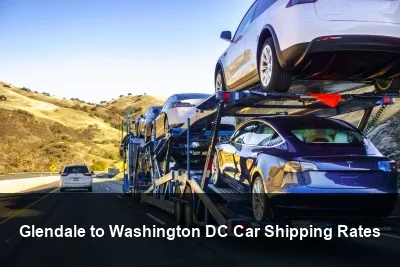
At 2,671 miles, this is a long-haul route and is priced accordingly. Base rates typically range from $1,100 to $1,900 for a standard sedan on open transport, depending on season and fuel costs. Summer PCS season (May through August) drives the highest demand and the highest rates. Fuel surcharges on this corridor are meaningful — the route crosses multiple high-fuel-cost states. For context on how diesel prices affect your quote, see https://california.auto-transport-shipping.com/articles/how-gas-prices-impact-california-auto-transport-fees.html.
What affects the cost of Glendale to Washington DC car shipping:
- Vehicle type and size — larger vehicles take more carrier space; aftermarket additions like lift kits, oversized mirrors, or roof accessories can add fees
- Open vs. enclosed transport — open is lower cost with stronger carrier availability; enclosed protects against weather, debris, and road conditions
- Standard vs. expedited pickup — expedited prioritizes your vehicle for the next available dispatch, typically at a $100–$300 premium
- Time of year — peak demand seasons drive rates higher; off-peak windows offer the most competitive pricing
- Fuel costs — diesel prices affect carrier rates; longer routes are more sensitive to fuel price swings
- Vehicle condition — non-running vehicles require special loading equipment and cost more to ship
| Vehicle Type | Open Car Shipping (Est.) | Enclosed Car Shipping (Est.) |
|---|---|---|
| Sedan | $1,100 – $1,600 | $1,900 – $2,700 |
| SUV / Crossover | $1,300 – $1,900 | $2,200 – $3,100 |
| Pickup Truck | $1,300 – $1,950 | $2,200 – $3,150 |
| Minivan | $1,300 – $1,900 | $2,200 – $3,100 |
| Luxury / Classic Car | $1,550 – $2,200 | $2,600 – $3,600 |
| Non-Running Vehicle | Add $200–400 | Add $200–400 |
* Estimated ranges based on recent Glendale to Washington DC shipments. Actual rate depends on vehicle, locations, booking date, and current fuel costs. Use the form on this page to compare real quotes from licensed carriers.
Open or Enclosed: What This 2,671-Mile Corridor Actually Demands
Open transport is the right call for most standard vehicles on this route. The carrier network running LA to DC is large enough that open loads move reliably and on schedule. Enclosed makes sense if you're shipping a vehicle valued over $80,000, a classic car, or a low-clearance exotic — primarily because the route passes through desert dust in Arizona and New Mexico and wet mountain conditions in the Appalachians. If your car is a daily driver in good condition, open is the practical choice and will save you $400 to $700 on this distance.
How Long Does Glendale to Washington DC Car Shipping Take?
Plan for 7 to 10 days door to door on this corridor under normal conditions. Carriers covering 2,671 miles average roughly 400 to 500 miles per day accounting for HOS (hours of service) federal driving regulations, mandatory rest stops, and load consolidation time. Glendale's proximity to the LA carrier hub means dispatch usually happens within one to three days of booking. If your timeline is tighter than that, expedited single-driver or team-driver options exist — see https://california.auto-transport-shipping.com/articles/california-expedited-car-shipping-fast-cost.html for what expedited service actually costs on long-haul routes.
| Service Type | Typical Transit | Pickup Window | Best For |
|---|---|---|---|
| Open — Standard | 7–10 days | 2–5 business days | Best value; most common choice on this route |
| Open — Expedited | 5–7 days | 1–2 business days | Firm arrival date; faster dispatch window |
| Enclosed — Standard | 7–10 days | 4–8 business days | Luxury, classic, or modified vehicles |
| Enclosed — Expedited | 5–7 days | 2–4 business days | High-value vehicles on a firm delivery deadline |
** Winter weather is the most common delay factor on this corridor. Ice and snow on I-40 through New Mexico and Texas panhandle, and winter storms descending from the Appalachians into Virginia, can add one to three days between December and February. Book with realistic buffer time if your delivery window is firm.
Glendale to Washington DC — Route & Logistics
Carriers access this corridor from Glendale via I-5 south to the I-10 interchange or SR-2 west to the I-5/US-101 junction. From I-10 east, the primary cross-country spine runs through Tucson, El Paso, San Antonio, Houston or Amarillo, then northeast through Tennessee or Virginia into the DC metro, totaling approximately 2,671 miles of highway distance.
Key Corridor Waypoints
- Glendale to Pomona, CA (I-10 on-ramp) Carriers departing Glendale use I-5 south to merge onto I-10 east at the East LA interchange, one of the busiest interchanges in the US. The stretch through the Inland Empire — Ontario, Fontana, Pomona — is where multi-load carriers typically complete final staging before the long desert run. Expect some congestion through this corridor during peak commute windows, which dispatchers account for when setting departure times.
- Tucson, AZ (I-10 / I-19 junction) Tucson is a standard overnight staging point for carriers running the southern I-10 corridor. At roughly 500 miles from the LA basin, it falls within a legal driving day. Carriers may switch drivers here or combine with loads originating from Phoenix. Elevation drops to approximately 2,400 feet through the Sonoran Desert; heat in summer months requires attention to tire pressure and any fluids in your vehicle's cabin.
- El Paso, TX (I-10 / I-25 junction) El Paso marks the Texas state line crossing and sits at 3,740 feet elevation. It's a significant carrier staging hub where westbound and eastbound loads are sometimes reshuffled. Carriers on this corridor will clear a weigh station inspection here. From El Paso, the route continues east on I-10 or transitions north on I-25 and I-40 depending on which path the dispatcher assigned.
- Oklahoma City, OK (I-40 / I-35 junction) Oklahoma City is the major mid-country junction point where I-40 meets I-35. Carriers running the northern desert route via I-40 through Amarillo reach OKC at approximately 1,400 miles into the trip. Many dispatch here for a second overnight. Winter storms, particularly ice storms, are most severe in this region between November and March and are the most common cause of multi-day transit delays on this corridor.
- Nashville, TN (I-40 / I-65 junction) Nashville is the last major carrier hub before the eastern approach to DC. At roughly 2,100 miles from Glendale, it falls within a three-day driving window. Carriers staging here often connect with loads from other southeast origins to fill any remaining capacity. From Nashville, the route continues east on I-40 through Knoxville and then northeast on I-81 through the Shenandoah Valley into Virginia.
- Northern Virginia (I-95 / I-395 approach to DC) The final approach into Washington DC runs north on I-95 through Fredericksburg and then I-395 into the DC metro. Traffic congestion through Springfield, Alexandria, and the 14th Street Bridge corridor is significant during peak hours. Carriers delivering to DC proper often stage in Falls Church or Arlington and schedule residential drop-offs during mid-morning weekday windows to avoid gridlock and restricted street access.
Pickup & Delivery Access
- Pickup Access in Glendale Glendale's flat commercial grid — particularly along Brand Boulevard, Colorado Street, and the Glendale Galleria vicinity — is fully carrier-accessible for standard 75-foot auto transport rigs. Hillside neighborhoods such as Chevy Chase Canyon, Sparr Heights, and upper La Crescenta typically require a nearby meet point at a flat commercial parking lot or church lot. Burbank and Pasadena residents can also coordinate pickup at central Glendale staging points without additional fees in most cases.
- Delivery Access in Washington DC Washington DC proper has significant carrier access constraints. Large auto transport trucks cannot navigate many residential blocks in Capitol Hill, Georgetown, Adams Morgan, or Columbia Heights without risk of height or turn restrictions. Most carriers stage in nearby Arlington, VA or Hyattsville, MD and coordinate a final-mile delivery meeting at a large parking area. Customers in Navy Yard, Anacostia, or Northeast DC should confirm a staging meet point with their carrier dispatcher in advance.
- Nearby Pickup Locations Carriers picking up in Glendale regularly extend service to Burbank, Pasadena, and La Crescenta. Call 1‑800‑590‑6492 to confirm door-to-door availability at your address.
Open vs. Enclosed Car Shipping: Glendale to Washington DC
Both options use licensed, insured carriers and deliver door to door. For a full breakdown, read the pros and cons of open vs. enclosed car shipping.
Open Car Shipping
Most Popular- Lower cost — the practical choice for most vehicles
- More carriers available on this corridor
- Faster dispatch from booking to pickup
- Works well for sedans, SUVs, trucks, and minivans
- Vehicle rides on an open multi-car carrier
- Cargo insurance required on all licensed carriers
Estimated cost: $1,100 – $1,950
Enclosed Car Shipping
Premium Protection- Full protection from weather, debris, and road grime
- Best for luxury, exotic, and classic vehicles
- Recommended for low-clearance and custom-built cars
- Wheel-net or soft-tie systems prevent contact damage
- Higher cargo coverage — commonly $500,000 per load
- White-glove handling by experienced operators
Estimated cost: $1,900 – $3,150
Not sure which is right for your vehicle? Call 1-800-590-6492 and we'll point you in the right direction. Also worth reading: the top 10 questions to ask any car shipping company before you commit.
How to Prepare Your Car for Shipping to Washington DC
A little prep before pickup protects you if there's ever a dispute about your vehicle's condition. This checklist is from our full guide on preparing your car for transport:
- Remove all personal belongings from the interior and trunk
- Leave only a quarter tank of fuel — enough to load and unload
- Take date-stamped photos of the full exterior and interior
- Remove or disable toll transponders (FasTrak, E-ZPass, etc.)
- Retract or remove roof racks, spoilers, antennas, and bike mounts
- Make sure the battery is charged and tires are properly inflated
- Tell the carrier about any existing leaks or mechanical issues
- Deactivate the car alarm before the carrier arrives
- Write down the mileage on the Bill of Lading at pickup
- Fold in side mirrors if the vehicle is wider than standard
Personal items: Most carriers won't cover belongings left in the car. Read the full rules on shipping personal items in your vehicle. Also review our Bill of Lading guide so you know exactly what to check at pickup and delivery.
When to Ship Your Car from Glendale to Washington DC
This corridor operates year-round but has clear pricing and timing peaks. PCS military season from May through August produces the highest demand and the least carrier availability at standard rates. Summer is also university move-in season for the DC metro's large student population. Winter crossings are operationally riskier — storms across Oklahoma, Tennessee, and the Appalachians can delay transit significantly. For a detailed look at winter transport risks, see https://california.auto-transport-shipping.com/articles/auto-transport-challenges-during-the-winter.html.
Spring PCS Season (March–May)
Military PCS orders activating for summer assignments start flooding the Glendale-to-DC corridor in March. Joint Base Anacostia-Bolling and Fort McNair reassignments, plus Pentagon-adjacent contractor relocations in Arlington and Bethesda, drive early booking demand. Rates begin climbing in April. If you have a PCS order effective June or July, booking in March secures better pricing and carrier selection before the peak window tightens.
Peak Summer Demand (June–August)
June through August is the highest-demand, highest-rate period on this corridor. Military relocations, university arrivals at Georgetown, GWU, American, and Howard University, and general summer relocation season all compete for the same carrier capacity. Expect rates at the top of the range and lead times of three to five days for dispatch. Book at least two to three weeks out if your move date is fixed during this window.
Fall Academic Season (September–October)
Demand drops from its summer peak but remains elevated through October as late-start graduate programs and federal fiscal-year transitions drive additional relocations. Fall is generally the best combination of reasonable pricing and reliable transit weather. The desert crossing is cooler, and the Appalachian mountain approach into Virginia is clear of winter precipitation through most of October. A practical window for value-conscious shippers.
Winter Corridor Risk (November–February)
Winter is the lowest-demand period but carries the highest transit risk. Ice storms across Oklahoma and the Texas panhandle on I-40, and Appalachian snow events in Virginia and West Virginia on I-81, are the two most common delay sources. Budget an extra two to three days of buffer in your delivery expectation. Enclosed transport may be worth the premium if your vehicle is high-value and you're shipping between December and January.
University Move-Out (April–May)
May produces a significant reverse-flow of vehicles from DC back to California as students at DC-area universities finish the academic year. This westbound volume actually helps eastbound Glendale-to-DC pricing stay reasonable in late April, since carriers have confirmed return loads. If you're shipping east in May, you benefit from that carrier balance. Coordinate pickup timing with your academic calendar to align with available dispatch windows.
How to Choose a Glendale to Washington DC Car Shipping Company
Getting multiple quotes is step one — knowing what to look for in those quotes matters just as much. Our guide on how to select a car shipping company covers the full process. Here are the six things that matter most:
FMCSA Registration
Every carrier or broker must hold a valid MC number. Verify any company at FMCSA SAFER before you book.
Proof of Insurance
Ask for a current certificate of insurance. Open carriers typically carry $100,000–$250,000 per load; enclosed commonly $500,000 or more. Learn what auto transport insurance covers.
All-In Pricing
Your quote should be a final number with no fees added after booking. Know the difference between brokers and carriers and confirm what the quote covers before you agree.
Bill of Lading
A complete Bill of Lading is filled out at pickup and delivery. Our Bill of Lading guide explains what to check. Never sign an incomplete one.
Real Reviews
Check Google and the BBB. Look at how they handled complaints and damage claims — that tells you more than a five-star average from happy customers.
Route Experience
A carrier who regularly runs Glendale to Washington DC knows several things a one-off transporter doesn't. They know to stage in the Burbank Airport industrial area rather than trying to navigate Brand Boulevard with a full load during afternoon traffic. They know that the I-10/I-405 interchange in West LA is a reliable bottleneck and schedule departures before 6 AM or after 9 PM. They know that El Paso weigh stations run slow on Mondays and that Oklahoma City ice storms move in fast — dispatchers on this lane watch weather 72 hours out. They know the Arlington staging lots that accept 75-foot rigs near the DC delivery zone, and they know to call DC-area customers with a same-day window, not just a same-week estimate, because street access in Georgetown or Capitol Hill requires precise timing.
Glendale to Washington DC Car Shipping — FAQ
How much does it cost to ship a car from Glendale to Washington DC?
Shipping a standard sedan from Glendale to Washington DC on open transport typically runs between $1,100 and $1,900 depending on the time of year, fuel surcharges, and how quickly you need it moved. SUVs and trucks run $100 to $300 more due to size and weight. Enclosed transport adds $400 to $700 over the open rate. Rates peak between June and August during military PCS and university move-in season. Booking two to three weeks ahead of your preferred date gives you the best pricing leverage on this 2,671-mile corridor.
How long does Glendale to Washington DC car shipping take?
Standard transit on this corridor is 7 to 10 days from pickup to delivery under normal conditions. Dispatch from Glendale typically takes one to three business days after booking, and the driving distance of approximately 2,671 miles accounts for the rest. Carriers are subject to federal Hours of Service regulations, which limit daily driving time and require mandatory rest periods. Winter weather through Oklahoma and the Appalachian approach into Virginia is the most common delay factor, potentially adding one to three days. If your timeline is firm, expedited shipping options are available — see https://california.auto-transport-shipping.com/articles/california-expedited-car-shipping-fast-cost.html.
Is my car insured during transport from Glendale to Washington DC?
Yes. Licensed auto transport carriers are required by federal law to carry cargo liability insurance covering your vehicle while it's loaded on the truck. Before your carrier takes possession, both you and the driver complete a Bill of Lading inspection documenting your vehicle's existing condition. At delivery in DC, you repeat that inspection — any new damage documented there is the carrier's liability. Read https://california.auto-transport-shipping.com/articles/understanding-auto-transport-insurance.html to understand coverage limits, and if something does go wrong, https://california.auto-transport-shipping.com/articles/how-to-file-a-claim-for-vehicle-damage-during-transport.html walks you through the claims process step by step.
Should I choose open or enclosed transport for the Glendale to Washington DC route?
Open transport is the right choice for most vehicles on this route. The carrier volume between Los Angeles and DC is high enough that open loads move on reliable schedules, and the savings over enclosed are substantial — typically $400 to $700. Enclosed makes practical sense if your vehicle is worth $80,000 or more, is a classic or collector car, or has a low ground clearance that makes ramp loading on a standard open carrier a concern. The desert section of this route through Arizona and New Mexico does expose vehicles to dust and sand, but that's normal wear for any vehicle in that region. Review https://california.auto-transport-shipping.com/articles/open-vs-enclosed-auto-transport-pros-and-cons.html for a full comparison before deciding.
Do I have to be present at pickup in Glendale and delivery in Washington DC?
You don't have to be there yourself, but someone with authority to sign the Bill of Lading does need to be present at both ends. That can be a trusted friend, family member, or building manager — anyone you authorize. At pickup in Glendale, that person signs off on the vehicle's pre-transport condition inspection. At delivery in DC, they confirm the vehicle arrived without new damage. The Bill of Lading is your legal protection on both ends, so it matters who signs it and what's noted. See https://california.auto-transport-shipping.com/articles/california-auto-transport-bill-of-lading-information.html for details on what to look for during the inspection.
How does military PCS relocation affect shipping availability on this route?
Military PCS orders heavily influence carrier availability and pricing on the Glendale-to-Washington DC corridor. Joint Base Anacostia-Bolling, Fort McNair, and the Pentagon's surrounding contractor campuses in Arlington and Bethesda generate a significant volume of vehicle shipments between March and August. During that window, carrier capacity tightens and rates reach their seasonal peak. If you have PCS orders with a summer effective date, booking in February or March gives you access to better pricing and more carrier options. Most carriers are familiar with the military delivery logistics in the DC metro and can accommodate base access coordination if needed.
What winter weather should I expect on the Glendale to Washington DC route?
This corridor crosses two distinct winter weather risk zones. The first is the Oklahoma and Texas panhandle section of I-40, where ice storms can develop rapidly between November and March and force carriers to hold position for 24 to 48 hours. The second is the Appalachian approach into Virginia via I-81, where winter storms can drop significant snow and ice on mountain grades. Either event can add one to three days to your transit time. If you're shipping between December and February, build buffer into your expected delivery window and discuss realistic timing with your dispatcher. See https://california.auto-transport-shipping.com/articles/auto-transport-challenges-during-the-winter.html for full guidance on winter shipping.
Can carriers access my neighborhood in Washington DC for delivery?
Many DC residential neighborhoods are difficult or impossible for a full-size 75-foot auto transport rig to navigate. Georgetown's narrow brick streets, the dense rowhouse blocks of Capitol Hill, and the one-way grid of Adams Morgan all present real access problems for large carriers. Most carriers serving DC proper stage their loads in Arlington, VA or Hyattsville, MD and arrange a meeting point at a large parking area — a shopping center lot, a church lot, or a commuter parking facility near a Metro station. This is standard practice on this route, not an exception. Confirm your delivery meet-point logistics with your dispatcher before your carrier departs California.
Ready to Ship Your Car from Glendale to Washington DC?
One form gets you up to 10 free quotes from licensed, insured carriers. Compare costs and transit times and book the best deal for your schedule.