
Santa Ana to Virginia Beach Car Shipping Route
The Santa Ana to Virginia Beach route covers approximately 2,680 miles. Carriers access the highway network via SR-55 to SR-22 or directly onto I-5 southbound, merging onto I-10 east near downtown Los Angeles or continuing to I-40 east from Barstow. The corridor crosses the Mojave Desert, climbs through New Mexico and Texas, and transitions into the mid-South before reaching Virginia via I-81 south to I-64 east into Hampton Roads. That drive would take a private driver five to seven days minimum. Shipping your vehicle instead lets you fly and eliminates fuel, lodging, and wear costs. See the full breakdown at https://california.auto-transport-shipping.com/articles/benefits-of-auto-transport-service-vs-driving-yourself.html
Virginia Beach demand is anchored heavily by the U.S. military. Naval Station Norfolk, the world's largest naval base by acreage and personnel, sits directly adjacent and drives more PCS shipments than almost any other East Coast destination. Joint Expeditionary Base Little Creek handles Navy SEAL and amphibious force personnel relocations. Langley Air Force Base in nearby Hampton adds Air Force PCS volume. On the civilian side, Old Dominion University generates student moves each August and January. Major defense contractors including SAIC, Huntington Ingalls Industries, and Booz Allen Hamilton maintain large Hampton Roads campuses. Winter shipping across Tennessee and the Appalachian foothills can introduce weather delays. Review common planning errors at https://california.auto-transport-shipping.com/articles/auto-transport-mistakes-to-avoid.html
Santa Ana to Virginia Beach Car Shipping Rates
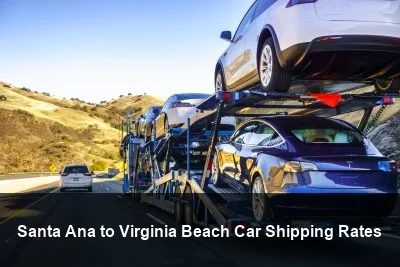
At roughly 2,680 miles, this route falls in the upper tier of long-haul pricing. Base rates typically range from $1,100 to $1,600 for a standard sedan on open transport, with enclosed adding $400 to $700. Military PCS demand in late May through August pushes rates upward on eastbound California-to-Virginia loads. Fuel surcharges affect this corridor more than shorter runs; for current gas-price impacts on your quote, see https://california.auto-transport-shipping.com/articles/how-gas-prices-impact-california-auto-transport-fees.html Booking two to three weeks ahead helps you avoid peak-season rate surges.
What affects the cost of Santa Ana to Virginia Beach car shipping:
- Vehicle type and size — larger vehicles take more carrier space; aftermarket additions like lift kits, oversized mirrors, or roof accessories can add fees
- Open vs. enclosed transport — open is lower cost with stronger carrier availability; enclosed protects against weather, debris, and road conditions
- Standard vs. expedited pickup — expedited prioritizes your vehicle for the next available dispatch, typically at a $100–$300 premium
- Time of year — peak demand seasons drive rates higher; off-peak windows offer the most competitive pricing
- Fuel costs — diesel prices affect carrier rates; longer routes are more sensitive to fuel price swings
- Vehicle condition — non-running vehicles require special loading equipment and cost more to ship
| Vehicle Type | Open Car Shipping (Est.) | Enclosed Car Shipping (Est.) |
|---|---|---|
| Sedan | $1,100 – $1,600 | $1,900 – $2,700 |
| SUV / Crossover | $1,300 – $1,900 | $2,200 – $3,100 |
| Pickup Truck | $1,300 – $1,950 | $2,200 – $3,150 |
| Minivan | $1,300 – $1,900 | $2,200 – $3,100 |
| Luxury / Classic Car | $1,550 – $2,200 | $2,600 – $3,600 |
| Non-Running Vehicle | Add $200–400 | Add $200–400 |
* Estimated ranges based on recent Santa Ana to Virginia Beach shipments. Actual rate depends on vehicle, locations, booking date, and current fuel costs. Use the form on this page to compare real quotes from licensed carriers.
Open or Enclosed: What This Corridor Actually Requires
Open transport handles the vast majority of Santa Ana to Virginia Beach shipments without issue. The I-40 desert crossing involves dust and occasional gravel, but it is a well-traveled carrier route with no exceptional road hazard. Enclosed makes sense if you are shipping a collector car, a high-value luxury or exotic vehicle, or a low-clearance sports car sensitive to debris. The Appalachian section via I-81 carries heavier truck traffic that can kick up road debris. For daily drivers, standard sedans, and pickup trucks, open is the practical and cost-effective choice on this route.
How Long Does Santa Ana to Virginia Beach Car Shipping Take?
Santa Ana to Virginia Beach typically takes seven to ten business days on standard transport. The raw driving distance of 2,680 miles requires a carrier roughly four to five days of road time, but carriers run multi-stop loads and comply with federal HOS rest regulations, which adds days. Santa Ana benefits from strong Orange County outbound volume, so carrier matching usually happens within one to three business days after booking. If your window is tight due to a PCS report date or a lease start, expedited options exist. Review them at https://california.auto-transport-shipping.com/articles/california-expedited-car-shipping-fast-cost.html
| Service Type | Typical Transit | Pickup Window | Best For |
|---|---|---|---|
| Open — Standard | 7–10 days | 2–5 business days | Best value; most common choice on this route |
| Open — Expedited | 5–7 days | 1–2 business days | Firm arrival date; faster dispatch window |
| Enclosed — Standard | 7–10 days | 4–8 business days | Luxury, classic, or modified vehicles |
| Enclosed — Expedited | 5–7 days | 2–4 business days | High-value vehicles on a firm delivery deadline |
** Winter weather across Tennessee, southwestern Virginia, and the I-81 corridor can add one to three days between December and March. Ice and snow at elevation on the Appalachian ridges cause carriers to hold position or reroute. If your delivery date is firm during those months, build in buffer or discuss expedited options upfront.
Santa Ana to Virginia Beach — Route & Logistics
Carriers depart Orange County via SR-55 north to SR-22 west to I-5 south, or use SR-55 directly to I-405 south to I-10 east. From I-10, most runs continue to I-40 east at Barstow. The corridor then crosses Arizona, New Mexico, and Texas before transitioning to I-40 east to I-81 south in Tennessee, then I-64 east into Hampton Roads and Virginia Beach.
Key Corridor Waypoints
- Barstow, CA Barstow sits at the I-15 and I-40 junction, roughly 110 miles northeast of Santa Ana. Carriers leaving Orange County typically reach Barstow within two hours and use it as a first fuel and inspection stop. This is where desert running begins in earnest. Summer temperatures regularly exceed 105°F here, which carriers account for in load planning and tire pressure checks.
- Albuquerque, NM Albuquerque is a major mid-route staging point at the I-40 and I-25 interchange, sitting at 5,312 feet elevation. Carriers frequently overnight here or pick up additional loads heading east. The elevation shift from sea level is notable and temperatures drop sharply at night even in summer. Winter snow is possible from November through March, occasionally slowing passage through the Rio Grande corridor.
- Amarillo, TX Amarillo marks the Texas Panhandle crossing on I-40, roughly 1,100 miles from Santa Ana. Carriers often refuel and log rest time here. The High Plains crossing between Albuquerque and Amarillo is prone to high crosswinds, particularly in spring, which affects multi-car haulers. Amarillo also serves as a relay point for some carriers transferring loads to East Coast-specific rigs.
- Nashville, TN Most carriers transition from I-40 east to I-24 southeast or continue I-40 to Knoxville before picking up I-81 south. Nashville sits at a major interstate junction and is a common second or third overnight stop depending on load schedule. Relay carriers operating east of the Mississippi sometimes meet California-origin drivers here to complete the final leg to Hampton Roads.
- Roanoke, VA Roanoke sits on I-81 at approximately 1,175 feet in the Shenandoah Valley. This is the last significant mountain segment before the I-64 east turn toward the coast. Winter ice and fog are common from December through February. Carriers watch this segment closely in cold weather. From Roanoke, it is approximately 230 miles east on I-64 to Virginia Beach.
- Virginia Beach, VA I-64 delivers carriers into Hampton Roads, where they navigate surface roads to reach Virginia Beach delivery addresses. The downtown Resort Area and oceanfront neighborhoods involve tighter streets. Military base deliveries at JEB Little Creek or access roads near Naval Station Norfolk require advance coordination. Carriers serving this metro regularly know which neighborhoods allow 75-foot rigs and which require passenger vehicle staging.
Pickup & Delivery Access
- Pickup Access in Santa Ana Santa Ana's street grid is generally accessible for multi-car haulers via major arterials including Bristol Street, MacArthur Boulevard, and Main Street. The South Coast Plaza area and nearby shopping center lots along Bristol provide practical staging for carriers who cannot access residential streets. Tustin and Orange to the north and east are also accessible within the carrier's pickup radius. Narrow residential blocks in older Santa Ana neighborhoods may require you to meet the carrier at a nearby commercial block.
- Delivery Access in Virginia Beach Virginia Beach is largely accessible for standard car haulers across its suburban grid. The Resort Area oceanfront and Croatan neighborhoods have narrower streets where 75-foot rigs cannot always complete delivery curbside. Carriers will stage at Virginia Beach Town Center, the Pembroke commercial area, or oceanfront surface lots in those cases. Military housing near Little Creek and Dam Neck is accessible but requires gate coordination if delivery is on-base.
- Nearby Pickup Locations Carriers picking up in Santa Ana regularly extend service to Garden Grove, Orange, and Tustin. Call 1‑800‑590‑6492 to confirm door-to-door availability at your address.
Open vs. Enclosed Car Shipping: Santa Ana to Virginia Beach
Both options use licensed, insured carriers and deliver door to door. For a full breakdown, read the pros and cons of open vs. enclosed car shipping.
Open Car Shipping
Most Popular- Lower cost — the practical choice for most vehicles
- More carriers available on this corridor
- Faster dispatch from booking to pickup
- Works well for sedans, SUVs, trucks, and minivans
- Vehicle rides on an open multi-car carrier
- Cargo insurance required on all licensed carriers
Estimated cost: $1,100 – $1,950
Enclosed Car Shipping
Premium Protection- Full protection from weather, debris, and road grime
- Best for luxury, exotic, and classic vehicles
- Recommended for low-clearance and custom-built cars
- Wheel-net or soft-tie systems prevent contact damage
- Higher cargo coverage — commonly $500,000 per load
- White-glove handling by experienced operators
Estimated cost: $1,900 – $3,150
Not sure which is right for your vehicle? Call 1-800-590-6492 and we'll point you in the right direction. Also worth reading: the top 10 questions to ask any car shipping company before you commit.
How to Prepare Your Car for Shipping to Virginia Beach
A little prep before pickup protects you if there's ever a dispute about your vehicle's condition. This checklist is from our full guide on preparing your car for transport:
- Remove all personal belongings from the interior and trunk
- Leave only a quarter tank of fuel — enough to load and unload
- Take date-stamped photos of the full exterior and interior
- Remove or disable toll transponders (FasTrak, E-ZPass, etc.)
- Retract or remove roof racks, spoilers, antennas, and bike mounts
- Make sure the battery is charged and tires are properly inflated
- Tell the carrier about any existing leaks or mechanical issues
- Deactivate the car alarm before the carrier arrives
- Write down the mileage on the Bill of Lading at pickup
- Fold in side mirrors if the vehicle is wider than standard
Personal items: Most carriers won't cover belongings left in the car. Read the full rules on shipping personal items in your vehicle. Also review our Bill of Lading guide so you know exactly what to check at pickup and delivery.
When to Ship Your Car from Santa Ana to Virginia Beach
This corridor sees its strongest demand from May through August, driven primarily by military PCS season at Naval Station Norfolk and JEB Little Creek. Booking during this window without lead time can mean higher rates and tighter carrier availability. Winter months from December through February are slower on civilian demand but still carry military volume. Cold weather across the I-81 Appalachian segment is a real transit factor in winter months; see https://california.auto-transport-shipping.com/articles/auto-transport-challenges-during-the-winter.html for a full breakdown of winter shipping considerations.
Spring PCS Season (March–May)
Military PCS orders releasing in spring push Virginia Beach-bound demand up sharply from March onward. Service members receiving orders to Naval Station Norfolk, JEB Little Creek, or Dam Neck Annex begin booking transport as early as January for March and April report dates. Rates trend upward as capacity fills. If you have a spring PCS, booking eight to ten weeks ahead is strongly advisable on this corridor.
Peak Summer Demand (June–August)
Summer is the highest-demand window for California-to-Virginia Beach shipments. PCS volume peaks, college students relocating to Old Dominion University and Regent University add load, and civilian job movers time transitions to summer. Rates are at their annual high. The desert Southwest crossing also hits peak heat in July and August, which carriers account for in scheduling. Book at least three weeks out and expect rates at the top of the annual range.
Fall Student Moves (August–September)
Old Dominion University's fall semester start in late August generates a secondary demand spike distinct from PCS season. Students relocating from Southern California to Norfolk and Virginia Beach ship vehicles in late July through mid-August. This partially overlaps with the PCS peak, keeping rates elevated into early September. After Labor Day, demand softens noticeably and rates typically begin declining toward fall baseline levels.
Winter Corridor (December–February)
Winter is the lowest-demand period for this route, and rates reflect it. However, the I-81 corridor through southwestern Virginia is susceptible to ice and snow events that can delay transit by one to three days. Carriers with regular Hampton Roads experience know to monitor the Roanoke and Christiansburg mountain segments. If your delivery date is firm in winter, discuss timing buffers or expedited options when booking.
Military PCS Fall Cycle (September–October)
A secondary PCS wave occurs in September and October as some service members receive late-cycle orders or transition out of service at Hampton Roads commands. This creates a modest demand bump after the summer peak subsides. Eastbound California loads moving in October often find reasonable carrier availability and rates below summer highs, making this one of the better windows to ship if your timeline allows flexibility.
How to Choose a Santa Ana to Virginia Beach Car Shipping Company
Getting multiple quotes is step one — knowing what to look for in those quotes matters just as much. Our guide on how to select a car shipping company covers the full process. Here are the six things that matter most:
FMCSA Registration
Every carrier or broker must hold a valid MC number. Verify any company at FMCSA SAFER before you book.
Proof of Insurance
Ask for a current certificate of insurance. Open carriers typically carry $100,000–$250,000 per load; enclosed commonly $500,000 or more. Learn what auto transport insurance covers.
All-In Pricing
Your quote should be a final number with no fees added after booking. Know the difference between brokers and carriers and confirm what the quote covers before you agree.
Bill of Lading
A complete Bill of Lading is filled out at pickup and delivery. Our Bill of Lading guide explains what to check. Never sign an incomplete one.
Real Reviews
Check Google and the BBB. Look at how they handled complaints and damage claims — that tells you more than a five-star average from happy customers.
Route Experience
A carrier who runs the Santa Ana to Virginia Beach corridor regularly knows details that matter. They know the South Coast Plaza staging area on Bristol Street works better than trying to fit a 75-foot rig into older Santa Ana residential blocks. They know the Barstow fuel stop timing, that Albuquerque is the reliable overnight, and that the Amarillo crossing needs a wind check in March and April. They know the I-81 Roanoke segment in winter and which weather apps to trust for the Appalachian ridge. On the delivery end, they know Virginia Beach Town Center as the staging fallback when oceanfront neighborhoods won't clear the rig, and they know the difference between civilian address delivery and coordinating with a Little Creek gate. That route familiarity cuts a day off your transit and eliminates most surprises.
Santa Ana to Virginia Beach Car Shipping — FAQ
How much does it cost to ship a car from Santa Ana to Virginia Beach?
Shipping a standard sedan from Santa Ana to Virginia Beach on open transport typically runs between $1,100 and $1,600 depending on the time of year and current fuel costs. SUVs and trucks add $100 to $250 due to size and weight. Enclosed transport adds $400 to $700 on top of open pricing. Rates peak from May through August when military PCS demand at Naval Station Norfolk and JEB Little Creek is highest. Booking two to three weeks ahead of your target pickup date gives you access to the best available pricing on this corridor.
How long does Santa Ana to Virginia Beach car shipping take?
Standard transit on this route is seven to ten business days. The 2,680-mile distance requires four to five days of actual driving time, but carriers run multi-stop loads and must comply with federal hours-of-service rest regulations, which extends total time in transit. Carrier matching from Santa Ana typically takes one to three business days given Orange County's solid outbound volume. If you have a firm PCS report date or a lease start deadline, expedited single-driver or team-driver options can compress delivery windows. See https://california.auto-transport-shipping.com/articles/california-expedited-car-shipping-fast-cost.html for expedited pricing and lead time details.
Is my car insured during transport from Santa Ana to Virginia Beach?
Every licensed carrier operating in the U.S. is required by federal law to carry cargo insurance covering your vehicle while it is loaded on the truck. Coverage limits vary by carrier but typically run from $100,000 to $250,000 per load. Before booking, confirm the carrier's insurance certificate and understand what their policy covers versus excludes. Your personal auto insurance may also provide supplemental coverage during transport, so check your policy. For a full explanation of how auto transport insurance works, see https://california.auto-transport-shipping.com/articles/understanding-auto-transport-insurance.html. If damage does occur, the process for filing a claim is outlined at https://california.auto-transport-shipping.com/articles/how-to-file-a-claim-for-vehicle-damage-during-transport.html
Should I choose open or enclosed transport for this route?
Open transport is appropriate for the large majority of Santa Ana to Virginia Beach shipments. The I-40 desert crossing and the I-81 Appalachian section are both well-traveled routes with no exceptional road hazard that would rule out open carriers. Enclosed transport makes sense if you are shipping a collector car, a vehicle with an original or custom paint finish, a high-value exotic, or a low-clearance sports car where road debris is a concern. The I-81 corridor carries dense commercial truck traffic that generates more road debris than open Western highways. For a full comparison of open versus enclosed trade-offs on long-haul routes, see https://california.auto-transport-shipping.com/articles/open-vs-enclosed-auto-transport-pros-and-cons.html
Do I have to be present at pickup and delivery?
You or an authorized representative must be present at both pickup and delivery to sign the bill of lading. The bill of lading documents your vehicle's condition before it is loaded and again when it is delivered. Any pre-existing damage noted at pickup, and any new damage identified at delivery, is recorded on this document. If you cannot be present personally, you can designate a trusted adult to sign on your behalf at either or both ends. Do not skip the inspection at delivery regardless of who is present — it is the foundation of any damage claim. Full details on what the bill of lading covers are at https://california.auto-transport-shipping.com/articles/california-auto-transport-bill-of-lading-information.html
How does military PCS affect shipping availability and rates to Virginia Beach?
Naval Station Norfolk is the largest naval installation in the world by personnel, and JEB Little Creek handles significant special operations and amphibious force personnel. Together they generate more PCS vehicle shipments than almost any other East Coast metro. PCS season runs hard from March through August, with June and July as the peak. During this window, eastbound California-to-Virginia Beach loads fill quickly and rates rise. If you have orders to any Hampton Roads command, submit your quote request as early as your orders allow — ideally eight to ten weeks out. Waiting until two weeks before your report date in summer is the single fastest way to pay a premium or face limited carrier availability.
What weather should I plan around when shipping in winter on this route?
The section of I-81 running through southwestern Virginia between Roanoke and the I-64 junction is the primary weather risk on this corridor from December through February. Ice storms and snow events in the Appalachian foothills can force carriers to hold position for 24 to 48 hours before roads are safely passable with a loaded multi-car hauler. Separately, the I-40 desert crossing through New Mexico and the Texas Panhandle can see freezing conditions and high winds in January and February. Plan for one to three extra days on your transit window if you are shipping between December and March. Details on winter transport planning are at https://california.auto-transport-shipping.com/articles/auto-transport-challenges-during-the-winter.html
Can carriers deliver directly to my address in Virginia Beach, or will I need to meet them nearby?
Most Virginia Beach addresses are accessible for standard multi-car haulers. The city's suburban street grid handles 75-foot rigs in the majority of neighborhoods. Exceptions include the Resort Area oceanfront blocks, parts of the Croatan neighborhood, and some older sections of the city with mature tree canopy and tight turning radii. If your address is in a restricted area, your carrier will contact you to arrange a nearby staging meet point. Virginia Beach Town Center and the Pembroke commercial area are the most commonly used alternatives. Your carrier will confirm access when they call to schedule delivery, typically 12 to 24 hours in advance.
Ready to Ship Your Car from Santa Ana to Virginia Beach?
One form gets you up to 10 free quotes from licensed, insured carriers. Compare costs and transit times and book the best deal for your schedule.