

Fremont to Atlanta Car Shipping Route
Fremont to Atlanta covers approximately 2,137 miles by road. Carriers access the route via I-880 south through Fremont, picking up I-680 northbound to connect with I-580 east, then merging onto I-205 and eventually I-5 or I-80 depending on the carrier's preferred transcontinental path. Most runs cross Nevada and Arizona before dropping onto I-40 east through Albuquerque, Amarillo, and Oklahoma City, then continuing into Tennessee and Georgia. The drive takes a solo driver four to five days minimum. Shipping your vehicle saves that wear, those miles, and the cost of fuel, lodging, and meals — detailed in full at https://california.auto-transport-shipping.com/articles/benefits-of-auto-transport-service-vs-driving-yourself.html.
Atlanta draws consistent inbound shipments driven by several specific demand engines. Georgia Tech's engineering and graduate programs generate student vehicle moves every August and January. Emory University and the Centers for Disease Control and Prevention campus nearby add professional relocation traffic year-round. Dobbins Air Reserve Base in Marietta and Fort Gillem in Forest Park contribute PCS-cycle demand that peaks in early summer. Major employers including Delta Air Lines, Coca-Cola, and NCR Corporation relocate employees into the metro continuously. Winter weather is generally mild in Atlanta but ice events can briefly close I-40 through North Carolina and Tennessee, occasionally extending transit by a day. Review https://california.auto-transport-shipping.com/articles/auto-transport-mistakes-to-avoid.html before booking to avoid common scheduling errors.
Fremont to Atlanta Car Shipping Rates
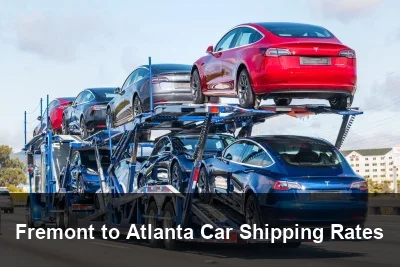
At 2,137 miles, Fremont-to-Atlanta sits firmly in the long-haul pricing tier, typically ranging from $1,050 to $1,500 for a standard sedan on an open carrier. Rates shift with diesel prices, which directly affect carrier bids on cross-country runs — see https://california.auto-transport-shipping.com/articles/how-gas-prices-impact-california-auto-transport-fees.html for how fuel costs translate to your quote. Demand spikes in May through July as summer relocation peaks. January and February are generally the softest pricing months on this corridor.
What affects the cost of Fremont to Atlanta car shipping:
- Vehicle type and size — larger vehicles take more carrier space; aftermarket additions like lift kits, oversized mirrors, or roof accessories can add fees
- Open vs. enclosed transport — open is lower cost with stronger carrier availability; enclosed protects against weather, debris, and road conditions
- Standard vs. expedited pickup — expedited prioritizes your vehicle for the next available dispatch, typically at a $100–$300 premium
- Time of year — peak demand seasons drive rates higher; off-peak windows offer the most competitive pricing
- Fuel costs — diesel prices affect carrier rates; longer routes are more sensitive to fuel price swings
- Vehicle condition — non-running vehicles require special loading equipment and cost more to ship
| Vehicle Type | Open Car Shipping (Est.) | Enclosed Car Shipping (Est.) |
|---|---|---|
| Sedan | $1,100 – $1,600 | $1,900 – $2,700 |
| SUV / Crossover | $1,300 – $1,900 | $2,200 – $3,100 |
| Pickup Truck | $1,300 – $1,950 | $2,200 – $3,150 |
| Minivan | $1,300 – $1,900 | $2,200 – $3,100 |
| Luxury / Classic Car | $1,550 – $2,200 | $2,600 – $3,600 |
| Non-Running Vehicle | Add $200–400 | Add $200–400 |
* Estimated ranges based on recent Fremont to Atlanta shipments. Actual rate depends on vehicle, locations, booking date, and current fuel costs. Use the form on this page to compare real quotes from licensed carriers.
Open or Enclosed: The Right Call for This 2,137-Mile Run
Open transport handles the vast majority of Fremont-to-Atlanta shipments without issue. The I-40 corridor through the desert Southwest is dry and relatively gentle on finishes. If you're shipping a leased vehicle, a collector car, or a high-value SUV where paint protection matters, enclosed adds roughly $400 to $600 on this distance. Winter months introduce some road grime through Oklahoma and Tennessee, so enclosed makes more sense November through February if your vehicle has a fresh paint job or aftermarket bodywork worth protecting.
How Long Does Fremont to Atlanta Car Shipping Take?
Standard transit from Fremont to Atlanta runs seven to ten business days under normal conditions. Carriers don't drive the full 2,137 miles solo — federal Hours of Service regulations require daily rest, which is the primary time variable. Fremont benefits from frequent carrier availability on the I-880 corridor, so dispatch-to-pickup lag is typically two to four days rather than the week-plus you might see from less-served origins. If your window is tight, expedited options exist — reviewed at https://california.auto-transport-shipping.com/articles/california-expedited-car-shipping-fast-cost.html.
| Service Type | Typical Transit | Pickup Window | Best For |
|---|---|---|---|
| Open — Standard | 7–10 days | 2–5 business days | Best value; most common choice on this route |
| Open — Expedited | 5–7 days | 1–2 business days | Firm arrival date; faster dispatch window |
| Enclosed — Standard | 7–10 days | 4–8 business days | Luxury, classic, or modified vehicles |
| Enclosed — Expedited | 5–7 days | 2–4 business days | High-value vehicles on a firm delivery deadline |
** Ice events on I-40 through the Tennessee and North Carolina high terrain, or along the Oklahoma panhandle in January and February, can halt carriers for 12 to 36 hours. Summer monsoon storms in New Mexico occasionally cause short delays near Albuquerque. Build a two-day buffer into any hard-deadline delivery.
Fremont to Atlanta — Route & Logistics
Carriers depart Fremont via I-880 or I-680, connecting to I-580 east toward the Central Valley, then picking up I-5 south or I-205 to I-580 east toward I-80. The dominant transcontinental path follows I-80 east to I-15, then I-40 east across Arizona, New Mexico, Texas, Oklahoma, Arkansas, and Tennessee before entering Georgia on I-20 east into Atlanta.
Key Corridor Waypoints
- Tracy, CA Tracy sits at the I-205/I-580 interchange east of the Bay Area, roughly 50 miles from Fremont. This is where carriers departing the East Bay consolidate with loads from Stockton and the Central Valley before heading east. It's a common first staging point and fuel stop. Carriers may add a Central Valley pickup here before continuing east on I-205 toward I-5 or cutting north to I-80.
- Barstow, CA Barstow marks the junction of I-15 and I-40 in the Mojave Desert, approximately 340 miles from Fremont. Carriers running the southern I-40 route diverge here from traffic heading to Las Vegas. It's a major truck stop cluster and a natural overnight or driver-change point. Summer heat in the Mojave peaks above 110°F, which carriers factor into scheduling to avoid extended idling with vehicles loaded.
- Albuquerque, NM Albuquerque sits at roughly 5,300 feet elevation on I-40 and is the largest city between Barstow and Oklahoma City. Carriers often stop here for mandatory rest breaks and fuel. The city also serves as a secondary load consolidation point for Southwest-to-Southeast runs. Monsoon season, July through September, can produce sudden heavy rain and flash flood closures on I-40 east of the city — a documented cause of transit delays.
- Oklahoma City, OK Oklahoma City is the midpoint junction where I-40 intersects I-35, one of the country's busiest freight corridors. Carriers frequently swap drivers or overnight here. It's also a dispatch checkpoint where brokers often receive updated ETAs. Winter ice storms originating in the Southern Plains hit this section of I-40 hardest, and carriers may hold here rather than push east into a Texas or Oklahoma ice event.
- Nashville, TN Nashville sits just north of the I-40 mainline and serves as a staging city for Southeast-bound carriers splitting loads between Atlanta, Charlotte, and Florida. Some carriers detour briefly onto I-24 south toward Chattanooga before connecting to I-75 south into Atlanta. The stretch from Nashville through Chattanooga includes grades and curves in the Cumberland Plateau that slow heavily loaded car haulers noticeably in winter conditions.
- Atlanta, GA (I-20 / I-285 interchange) Atlanta carriers typically enter on I-20 west from the Tennessee corridor or I-75 south from Chattanooga, then route deliveries using the I-285 perimeter. Inner-city streets in Midtown and Buckhead require carriers to stage on wider commercial corridors for final delivery. Suburban deliveries in Alpharetta, Marietta, and Decatur are straightforward. Carriers familiar with Atlanta know to avoid downtown during Falcons or Braves game-day traffic on I-75 and I-85.
Pickup & Delivery Access
- Pickup Access in Fremont Fremont's East Bay grid is carrier-accessible throughout. Standard residential streets accommodate most car haulers. The area near Tesla's Kato Road facility has wide, truck-rated access. Carriers working I-880 pick up in Fremont regularly, so terminal-to-door service is available in most neighborhoods. If your street has tight turns or low overhangs, arrange a meet point at a nearby commercial parking lot or retail strip — your dispatcher can identify the closest viable option.
- Delivery Access in Atlanta Atlanta deliveries work smoothly in most suburban areas — Marietta, Decatur, Alpharetta, and Sandy Springs all have carrier-accessible streets. Midtown and Buckhead high-rise zones often require staging on adjacent commercial streets, with final delivery on foot or in a secondary vehicle. The Beltline corridor has parking restrictions that can complicate delivery windows. Confirm your delivery street's clearance and parking availability with the carrier 24 hours ahead, especially for enclosed units.
- Nearby Pickup Locations Carriers picking up in Fremont regularly extend service to Newark, Union City, and Milpitas. Call 1‑800‑590‑6492 to confirm door-to-door availability at your address.
Open vs. Enclosed Car Shipping: Fremont to Atlanta
Both options use licensed, insured carriers and deliver door to door. For a full breakdown, read the pros and cons of open vs. enclosed car shipping.
Open Car Shipping
Most Popular- Lower cost — the practical choice for most vehicles
- More carriers available on this corridor
- Faster dispatch from booking to pickup
- Works well for sedans, SUVs, trucks, and minivans
- Vehicle rides on an open multi-car carrier
- Cargo insurance required on all licensed carriers
Estimated cost: $1,100 – $1,950
Enclosed Car Shipping
Premium Protection- Full protection from weather, debris, and road grime
- Best for luxury, exotic, and classic vehicles
- Recommended for low-clearance and custom-built cars
- Wheel-net or soft-tie systems prevent contact damage
- Higher cargo coverage — commonly $500,000 per load
- White-glove handling by experienced operators
Estimated cost: $1,900 – $3,150
Not sure which is right for your vehicle? Call 1-800-590-6492 and we'll point you in the right direction. Also worth reading: the top 10 questions to ask any car shipping company before you commit.
How to Prepare Your Car for Shipping to Atlanta
A little prep before pickup protects you if there's ever a dispute about your vehicle's condition. This checklist is from our full guide on preparing your car for transport:
- Remove all personal belongings from the interior and trunk
- Leave only a quarter tank of fuel — enough to load and unload
- Take date-stamped photos of the full exterior and interior
- Remove or disable toll transponders (FasTrak, E-ZPass, etc.)
- Retract or remove roof racks, spoilers, antennas, and bike mounts
- Make sure the battery is charged and tires are properly inflated
- Tell the carrier about any existing leaks or mechanical issues
- Deactivate the car alarm before the carrier arrives
- Write down the mileage on the Bill of Lading at pickup
- Fold in side mirrors if the vehicle is wider than standard
Personal items: Most carriers won't cover belongings left in the car. Read the full rules on shipping personal items in your vehicle. Also review our Bill of Lading guide so you know exactly what to check at pickup and delivery.
When to Ship Your Car from Fremont to Atlanta
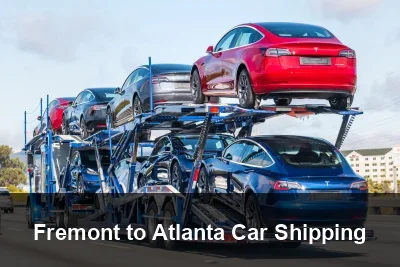
This corridor has a defined demand peak from May through August driven by summer relocations, military PCS orders, and student moves tied to Georgia Tech and Emory. Pricing is firmest during this window. January through March offers the lowest rates but carries the highest weather-delay risk on I-40 through Oklahoma and Tennessee. Fall is a reliable middle ground — moderate pricing and stable weather. For winter-specific delay risks, review https://california.auto-transport-shipping.com/articles/auto-transport-challenges-during-the-winter.html.
Spring Relocation Window (March–April)
Corporate relocation cycles tied to Atlanta's major employers — Delta, Coca-Cola, NCR — begin generating inbound shipments in March. Rates are still moderate before summer peaks. This is also when California residents heading east beat the summer rush and find carrier availability easier than June. Book three to four weeks ahead to lock in spring pricing before demand firms up in May.
Summer Peak Season (May–August)
The highest-demand period on this corridor. Military PCS orders tied to Dobbins Air Reserve Base and Fort Gillem activate in June and July. Georgia Tech and Emory student arrivals add volume in August. Carriers fill quickly and rates run $100 to $200 above off-peak. Book four to six weeks ahead during this window. Pickup slots in Fremont book fast as carriers prioritize full loads east.
Back-to-School Rush (July–August)
Georgia Tech's fall semester draws engineering and graduate students from California relocating to Atlanta. Emory University and Georgia State University generate similar inbound demand. Vehicle shipments from the Bay Area into Atlanta spike noticeably in late July and early August. If you're moving for school, get your booking in by early July. Late requests in August compete with peak summer relocation demand and may face a two-week dispatch lag.
Fall Shoulder Season (September–November)
September through November is the most predictable period on this route — demand has eased from summer, I-40 weather is stable, and carriers are still running full transcontinental loads before winter. Rates drop back to baseline and dispatch times improve. If your move date is flexible, early October is historically a reliable window for both price and transit time on the Fremont-to-Atlanta corridor.
Winter Weather Risk (December–February)
Atlanta's occasional ice events and I-40 closures through Tennessee and Oklahoma present the main transit risk on this corridor December through February. Carriers may hold at staging points in Oklahoma City or Nashville rather than push into an ice storm. Budget an extra two to three days into your transit expectation. Rates are at their annual low, which offsets the inconvenience. Review winter transport challenges at https://california.auto-transport-shipping.com/articles/auto-transport-challenges-during-the-winter.html before committing to a tight winter deadline.
Military PCS Cycle (May–July)
Dobbins Air Reserve Base in Marietta and Fort Gillem in Forest Park generate concentrated PCS-related vehicle shipments between May and July. Service members relocating from California installations — including NAS Lemoore, Travis AFB, and Beale AFB — frequently route vehicles into the Atlanta metro during this cycle. This PCS volume tightens carrier availability on the Fremont end specifically. Military shippers should book no less than three weeks ahead of their report date.
How to Choose a Fremont to Atlanta Car Shipping Company
Getting multiple quotes is step one — knowing what to look for in those quotes matters just as much. Our guide on how to select a car shipping company covers the full process. Here are the six things that matter most:
FMCSA Registration
Every carrier or broker must hold a valid MC number. Verify any company at FMCSA SAFER before you book.
Proof of Insurance
Ask for a current certificate of insurance. Open carriers typically carry $100,000–$250,000 per load; enclosed commonly $500,000 or more. Learn what auto transport insurance covers.
All-In Pricing
Your quote should be a final number with no fees added after booking. Know the difference between brokers and carriers and confirm what the quote covers before you agree.
Bill of Lading
A complete Bill of Lading is filled out at pickup and delivery. Our Bill of Lading guide explains what to check. Never sign an incomplete one.
Real Reviews
Check Google and the BBB. Look at how they handled complaints and damage claims — that tells you more than a five-star average from happy customers.
Route Experience
A carrier who runs Fremont to Atlanta regularly knows that East Bay pickups are most efficient when they load in the late morning to avoid the I-880 commute compression near the Dumbarton Bridge approach. They know the Mojave segment requires early starts in July and August to clear Barstow before midday heat reaches 115°F. On the back half, experienced carriers avoid the I-40 stretch through the Oklahoma panhandle after a Plains cold front without checking ODOT road conditions first — that 70-mile section ices fast and melts slowly. Atlanta delivery timing accounts for I-285 freight congestion between 3 PM and 6 PM. Carriers familiar with this pair also know that the Tesla facility zone near Kato Road and Fremont Boulevard consistently offers safe, wide staging for multi-car haulers loading in residential Fremont.
Fremont to Atlanta Car Shipping — FAQ
How much does it cost to ship a car from Fremont to Atlanta?
Shipping a standard sedan from Fremont to Atlanta on an open carrier typically runs $1,050 to $1,400 under normal market conditions. SUVs and trucks add $100 to $200 due to size. Enclosed transport runs $1,450 to $1,900 for the same distance. Rates are highest May through August during peak relocation season and lowest January through March. Diesel prices directly affect carrier bids on a 2,137-mile run — see https://california.auto-transport-shipping.com/articles/how-gas-prices-impact-california-auto-transport-fees.html for how fuel costs are factored. Get a quote specific to your vehicle and dates using the form on this page.
How long does Fremont to Atlanta car shipping take?
Standard transit from Fremont to Atlanta runs seven to ten business days. That includes two to four days for carrier dispatch and pickup in Fremont, followed by five to seven days of driving time across 2,137 miles, accounting for federally required driver rest periods. Carriers on the I-880 corridor pick up in Fremont regularly, which keeps dispatch times shorter than at less-served origins. Weather delays on I-40 through Oklahoma or Tennessee can add one to two days in winter. If you're working with a hard deadline, expedited shipping options are covered at https://california.auto-transport-shipping.com/articles/california-expedited-car-shipping-fast-cost.html.
Is my car insured during transport from Fremont to Atlanta?
Yes. Every licensed carrier is required by federal law to carry cargo insurance, which covers your vehicle while it's on the truck. Coverage limits and deductible terms vary by carrier, and your personal auto insurance may or may not extend to transport — check your policy before shipping. The bill of lading you sign at pickup documents your vehicle's pre-transport condition and is the baseline for any claim. For a detailed breakdown of how coverage works, read https://california.auto-transport-shipping.com/articles/understanding-auto-transport-insurance.html. If damage occurs, the process for filing a claim is explained at https://california.auto-transport-shipping.com/articles/how-to-file-a-claim-for-vehicle-damage-during-transport.html.
Should I choose open or enclosed transport for this route?
Open transport is appropriate for the majority of Fremont-to-Atlanta shipments. The I-40 corridor through the Southwest is dry and the route doesn't expose vehicles to unusual road hazard risk under normal conditions. Enclosed makes sense if you're shipping a collector car, a leased vehicle where any paint damage triggers a return penalty, or a luxury vehicle in winter when road spray from Oklahoma and Tennessee adds grime risk. The price difference on this corridor is typically $400 to $600. A full comparison of both options is available at https://california.auto-transport-shipping.com/articles/open-vs-enclosed-auto-transport-pros-and-cons.html.
Do I have to be present at pickup and delivery?
You or a designated representative must be present at both pickup and delivery to sign the bill of lading, which is the legal inspection record for your vehicle's condition. You don't have to be the owner — a family member, friend, or property manager can serve as your representative. At pickup in Fremont, the carrier walks the vehicle with you and notes any pre-existing damage. At delivery in Atlanta, you inspect the vehicle again before signing. Never sign a blank or incomplete bill of lading. Details on what the bill of lading covers and what to look for are at https://california.auto-transport-shipping.com/articles/california-auto-transport-bill-of-lading-information.html.
Does winter weather affect Fremont-to-Atlanta shipments, and when is it riskiest?
Winter is the main variable on this corridor. The Fremont end has minimal weather risk — Bay Area winters don't produce snow or ice. The risk is concentrated on I-40 through the Oklahoma panhandle and on I-40 and I-75 through Tennessee, where ice storms can shut down sections of highway for 24 to 48 hours. Atlanta itself occasionally freezes, which can delay final delivery. December through February is when this risk is highest. If you're shipping in winter, build a two-day buffer into your delivery expectation and review https://california.auto-transport-shipping.com/articles/auto-transport-challenges-during-the-winter.html for additional guidance.
Are there specific considerations for military PCS moves from Fremont to Atlanta?
Yes. Service members PCSing to Dobbins Air Reserve Base in Marietta or Fort Gillem in Forest Park should book no less than three weeks before their report date. The May-through-July PCS cycle tightens carrier availability on the Fremont and East Bay end significantly, because multiple California installations are generating outbound shipments simultaneously. Military shippers often qualify for specific rate structures — ask about this when you request a quote. Document your vehicle's condition thoroughly before shipping, and confirm your delivery address allows carrier access, as some on-base locations require coordination with base logistics offices.
Can I ship a vehicle from Fremont to Atlanta if I'm relocating for a job or university?
This is one of the most common use cases on this corridor. Corporate relocations tied to Atlanta employers like Delta Air Lines, Coca-Cola, and NCR, as well as student moves to Georgia Tech, Emory University, and Georgia State, represent a large share of the inbound volume. If your employer is covering relocation costs, get an itemized invoice from your transport broker — most HR departments require one for reimbursement. For student moves in late July and August, book early because carrier availability tightens quickly as the semester start date approaches. The quote form on this page handles both residential and university delivery addresses.
Ready to Ship Your Car from Fremont to Atlanta?
One form gets you up to 10 free quotes from licensed, insured carriers. Compare costs and transit times and book the best deal for your schedule.