
Fremont to Fort Worth Car Shipping Route
The Fremont to Fort Worth route covers approximately 1,653 miles. Carriers access the highway network via I-880 southbound toward San Jose, then pick up I-5 south or head east on SR-152 to connect to I-5 before transitioning to I-10 east through the Mojave Desert and into Texas. Alternatively, some carriers use I-40 through Barstow and Amarillo depending on load positioning. The route crosses the Mojave, the Texas Panhandle approaches, and the rolling plains of Central Texas. Shipping your vehicle avoids 1,600-plus miles of freeway driving and the wear, fuel cost, and time that comes with it — see a detailed breakdown at https://california.auto-transport-shipping.com/articles/benefits-of-auto-transport-service-vs-driving-yourself.html
Fort Worth's inbound vehicle demand is driven by several anchors. Naval Air Station Joint Reserve Base Fort Worth (NAS JRB) generates PCS military moves throughout the year, with peak windows in summer. Texas Christian University and Texas Wesleyan University bring student vehicle moves in August and January. Major employers including Lockheed Martin, American Airlines Group headquarters, and BNSF Railway's main campus attract corporate relocations. Weather is a real factor: I-10 through the Sonoran Desert runs extreme heat in June through August, and North Texas ice storms can disrupt delivery windows December through February. Plan around those windows and avoid common missteps by reviewing https://california.auto-transport-shipping.com/articles/auto-transport-mistakes-to-avoid.html before you book.
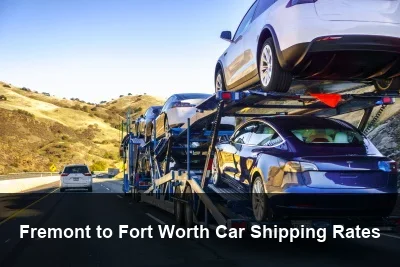
Fremont to Fort Worth Car Shipping Rates
At 1,653 miles, this route falls into the long-haul tier where per-mile rates decrease but total cost still reflects fuel exposure across the Mojave and West Texas. Summer heat in the desert corridor can push fuel surcharges up, and peak military PCS season in May through July tightens carrier availability into Fort Worth. Gas price movement directly affects what carriers quote on cross-desert runs — understand how that works at https://california.auto-transport-shipping.com/articles/how-gas-prices-impact-california-auto-transport-fees.html before comparing quotes.
What affects the cost of Fremont to Fort Worth car shipping:
- Vehicle type and size — larger vehicles take more carrier space; aftermarket additions like lift kits, oversized mirrors, or roof accessories can add fees
- Open vs. enclosed transport — open is lower cost with stronger carrier availability; enclosed protects against weather, debris, and road conditions
- Standard vs. expedited pickup — expedited prioritizes your vehicle for the next available dispatch, typically at a $100–$300 premium
- Time of year — peak demand seasons drive rates higher; off-peak windows offer the most competitive pricing
- Fuel costs — diesel prices affect carrier rates; longer routes are more sensitive to fuel price swings
- Vehicle condition — non-running vehicles require special loading equipment and cost more to ship
| Vehicle Type | Open Car Shipping (Est.) | Enclosed Car Shipping (Est.) |
|---|---|---|
| Sedan | $950 – $1,350 | $1,700 – $2,300 |
| SUV / Crossover | $1,100 – $1,600 | $1,950 – $2,700 |
| Pickup Truck | $1,100 – $1,650 | $1,950 – $2,750 |
| Minivan | $1,100 – $1,600 | $1,950 – $2,700 |
| Luxury / Classic Car | $1,300 – $1,900 | $2,200 – $3,000 |
| Non-Running Vehicle | Add $200–350 | Add $200–350 |
* Estimated ranges based on recent Fremont to Fort Worth shipments. Actual rate depends on vehicle, locations, booking date, and current fuel costs. Use the form on this page to compare real quotes from licensed carriers.
Open or Enclosed: What This Desert Route Actually Demands
Open transport handles this corridor fine for standard vehicles most of the year. The Mojave segment is dry and relatively low-debris, so road grime rather than rock damage is the primary exposure. Enclosed makes sense if you're shipping a luxury vehicle, a classic, or anything with fresh paint — West Texas highway conditions can throw road debris in open stretches near Abilene and Weatherford. If you're shipping during summer, enclosed also protects interiors from extreme heat during staging. Otherwise, open is the practical choice and typically saves $250 to $400 on this distance.
How Long Does Fremont to Fort Worth Car Shipping Take?
Expect 5 to 8 transit days from Fremont to Fort Worth under normal conditions. A driver running this corridor straight through covers it in roughly 23 to 25 hours of driving time, but carriers are running multi-stop loads, observing HOS regulations, and staging at relay points. Fremont sits on an active East Bay pickup corridor, so carrier assignment typically happens within 1 to 3 business days of your first available date. If your timeline is tight, expedited options can compress that window — details at https://california.auto-transport-shipping.com/articles/california-expedited-car-shipping-fast-cost.html
| Service Type | Typical Transit | Pickup Window | Best For |
|---|---|---|---|
| Open — Standard | 4–6 days | 2–5 business days | Best value; most common choice on this route |
| Open — Expedited | 2–4 days | 1–2 business days | Firm arrival date; faster dispatch window |
| Enclosed — Standard | 4–6 days | 3–7 business days | Luxury, classic, or modified vehicles |
| Enclosed — Expedited | 2–4 days | 1–3 business days | High-value vehicles on a firm delivery deadline |
** North Texas winter ice storms are the primary delay risk December through February — carriers will hold rather than run on iced I-20 or I-30 approaches into Fort Worth. Summer desert heat occasionally forces overnight-only driving through the Mojave, which can add a day to timing. Build a 2-day buffer into firm delivery deadlines.
Fremont to Fort Worth — Route & Logistics
Carriers pick up in Fremont via I-880 or I-680, merge onto I-5 south or SR-152 east to I-5, then transition east. The two primary line-haul paths are I-5 to I-10 east through Los Angeles and the desert, or I-5 to I-40 east through Barstow and Amarillo. Both converge toward the DFW metroplex before splitting to Fort Worth.
Key Corridor Waypoints
- Fremont, CA / I-880 on-ramp Carriers enter the highway system via I-880 southbound from the East Bay grid. The Tesla Gigafactory area near Fremont Boulevard provides wide truck-accessible streets for residential pickups. From I-880, carriers connect south to I-237 or continue to I-680 to reach I-5. This is the staging entry point for the full cross-country run.
- Los Angeles Basin, CA / I-10 interchange Carriers coming down I-5 merge onto I-10 east through the Los Angeles Basin. This segment has the highest congestion exposure on the route — carriers time passage through LA to avoid peak hours. The transition onto I-10 east marks the beginning of the desert crossing and is a common load-consolidation staging point for Texas-bound trucks.
- Blythe, CA / Arizona border crossing Blythe sits at the California-Arizona state line on I-10 and is a standard fuel and inspection stop for long-haul carriers. Agricultural inspection checkpoints operate here. Elevation is around 270 feet; temperatures regularly exceed 110°F in summer. Carriers often adjust scheduling to cross this stretch during nighttime hours in peak heat months.
- El Paso, TX / I-10 and I-20 junction El Paso is the major routing decision point on this corridor. Carriers continuing on I-10 northeast enter I-20 toward Midland and Abilene before turning toward Fort Worth. Elevation here is approximately 3,740 feet. El Paso is also a common overnight stop for drivers managing hours-of-service compliance on the full cross-country haul.
- Abilene, TX / I-20 midpoint staging Abilene sits roughly 180 miles west of Fort Worth on I-20 and functions as a practical relay and rest point for carriers on the final approach. Some multi-driver operations swap here. Road surfaces on I-20 through West Texas can be rough in sections — worth noting for low-clearance vehicles that may need enclosed or raised-deck positioning.
- Fort Worth, TX / I-20 and I-30 delivery zone Carriers approach Fort Worth from the west on I-20, transitioning to I-30 or Loop 820 depending on the delivery address. The Alliance corridor in north Fort Worth is easily carrier-accessible with wide industrial streets. Downtown and near-southside neighborhoods have narrower approaches and may require a staging meet point at a nearby parking area or retail lot.
Pickup & Delivery Access
- Pickup Access in Fremont Fremont's street grid accommodates full-size transport trucks without difficulty in most neighborhoods. The Centerville, Irvington, and Warm Springs districts all offer adequate access. The area near the Tesla factory off Fremont Boulevard is truck-familiar. If your street is narrow or residential, a nearby commercial lot on Mowry Avenue or along Auto Mall Parkway works well as a meet point.
- Delivery Access in Fort Worth Fort Worth's north and west sides — including the Alliance, Fossil Creek, and Ridglea areas — are straightforward for carrier delivery. The Cultural District and near-downtown neighborhoods have tighter blocks and may require staging at a nearby commercial parking area. TCU-area streets can be congested during fall and spring semesters. Carriers serving NAS JRB Fort Worth are familiar with base access protocols if on-base delivery is needed.
- Nearby Pickup Locations Carriers picking up in Fremont regularly extend service to Newark, Union City, and Milpitas. Call 1‑800‑590‑6492 to confirm door-to-door availability at your address.
Open vs. Enclosed Car Shipping: Fremont to Fort Worth
Both options use licensed, insured carriers and deliver door to door. For a full breakdown, read the pros and cons of open vs. enclosed car shipping.
Open Car Shipping
Most Popular- Lower cost — the practical choice for most vehicles
- More carriers available on this corridor
- Faster dispatch from booking to pickup
- Works well for sedans, SUVs, trucks, and minivans
- Vehicle rides on an open multi-car carrier
- Cargo insurance required on all licensed carriers
Estimated cost: $950 – $1,650
Enclosed Car Shipping
Premium Protection- Full protection from weather, debris, and road grime
- Best for luxury, exotic, and classic vehicles
- Recommended for low-clearance and custom-built cars
- Wheel-net or soft-tie systems prevent contact damage
- Higher cargo coverage — commonly $500,000 per load
- White-glove handling by experienced operators
Estimated cost: $1,700 – $2,750
Not sure which is right for your vehicle? Call 1-800-590-6492 and we'll point you in the right direction. Also worth reading: the top 10 questions to ask any car shipping company before you commit.
How to Prepare Your Car for Shipping to Fort Worth
A little prep before pickup protects you if there's ever a dispute about your vehicle's condition. This checklist is from our full guide on preparing your car for transport:
- Remove all personal belongings from the interior and trunk
- Leave only a quarter tank of fuel — enough to load and unload
- Take date-stamped photos of the full exterior and interior
- Remove or disable toll transponders (FasTrak, E-ZPass, etc.)
- Retract or remove roof racks, spoilers, antennas, and bike mounts
- Make sure the battery is charged and tires are properly inflated
- Tell the carrier about any existing leaks or mechanical issues
- Deactivate the car alarm before the carrier arrives
- Write down the mileage on the Bill of Lading at pickup
- Fold in side mirrors if the vehicle is wider than standard
Personal items: Most carriers won't cover belongings left in the car. Read the full rules on shipping personal items in your vehicle. Also review our Bill of Lading guide so you know exactly what to check at pickup and delivery.
When to Ship Your Car from Fremont to Fort Worth
This corridor has two distinct demand peaks: summer military PCS season peaking in June and July, and the general spring relocation window in April and May. Winter brings lower demand but higher weather risk in North Texas. Summer desert heat through the Mojave can also push carrier operating costs up. For a full picture of how winter conditions affect this type of route, see https://california.auto-transport-shipping.com/articles/auto-transport-challenges-during-the-winter.html
Spring Relocation Season (March–May)
Spring is the highest-demand booking window on this corridor. Corporate relocations tied to Fort Worth's major employers and general household moves converge in March through May. Carrier availability tightens and rates trend up 10 to 15 percent compared to fall baseline. Book 2 to 3 weeks ahead of your target pickup date during this window to secure competitive pricing and preferred scheduling.
Summer Military PCS Window (June–July)
NAS JRB Fort Worth and surrounding bases generate concentrated PCS move orders in June and July as military families relocate before the school year. This is the single largest demand driver unique to the Fort Worth destination on this route. Carrier slots into the DFW area fill faster than average during this window. Submit your quote request at least 3 weeks out and confirm your first available date as early as possible.
Student Move Season (Late July–August)
Texas Christian University and Texas Wesleyan University both draw vehicle moves in late July and August as students arrive for fall semester. The areas around TCU and the near-west side of Fort Worth see concentrated delivery requests during this window. If you're shipping a student vehicle, schedule pickup no later than the second week of August to allow buffer time before orientation dates.
Winter Caution Period (December–February)
North Texas ice storms are the primary transit risk on the Fort Worth end of this route. I-20 and I-30 approaches into Fort Worth can freeze with little warning, and carriers will hold loads rather than operate on iced roads. The Mojave and West Texas segments are generally dry in winter but see occasional cold snaps. Build extra buffer days into any delivery deadline during this window.
Fall Off-Peak Window (September–November)
September through November is the most cost-efficient booking window on this corridor. Military PCS volume has cleared, student moves are complete, and carrier supply is relatively balanced against demand. Rates typically run at or below annual average. Weather through the desert and into Texas is more moderate than summer. If your move date is flexible, targeting this window can save meaningfully on a long-haul route of this distance.
How to Choose a Fremont to Fort Worth Car Shipping Company
Getting multiple quotes is step one — knowing what to look for in those quotes matters just as much. Our guide on how to select a car shipping company covers the full process. Here are the six things that matter most:
FMCSA Registration
Every carrier or broker must hold a valid MC number. Verify any company at FMCSA SAFER before you book.
Proof of Insurance
Ask for a current certificate of insurance. Open carriers typically carry $100,000–$250,000 per load; enclosed commonly $500,000 or more. Learn what auto transport insurance covers.
All-In Pricing
Your quote should be a final number with no fees added after booking. Know the difference between brokers and carriers and confirm what the quote covers before you agree.
Bill of Lading
A complete Bill of Lading is filled out at pickup and delivery. Our Bill of Lading guide explains what to check. Never sign an incomplete one.
Real Reviews
Check Google and the BBB. Look at how they handled complaints and damage claims — that tells you more than a five-star average from happy customers.
Route Experience
A carrier who runs Fremont to Fort Worth regularly knows that the I-10 Mojave crossing requires scheduling through the night in July and August — daytime temps near Blythe and Quartzsite push equipment heat stress and reduce driver comfort enough to affect timing. They know that El Paso is the practical overnight stop on this run, not Tucson or Midland, and that the I-20 stretch through Midland and Odessa can run heavy with oilfield equipment traffic that creates passing delays. They know that Fort Worth delivery windows before 9 AM avoid the worst of the downtown and TCU district congestion. They know which truck stops between Abilene and Fort Worth have room for a full 9-car hauler, and which fuel stops on the California side of the desert are priced to avoid. That operational knowledge translates to fewer delays and more accurate delivery windows for your vehicle.
Fremont to Fort Worth Car Shipping — FAQ
How much does it cost to ship a car from Fremont to Fort Worth?
On this 1,653-mile corridor, open transport for a standard sedan typically runs between $950 and $1,350 depending on the season and current carrier availability. SUVs and trucks run $1,050 to $1,450. Enclosed transport adds $400 to $600 to those baselines. Rates are highest during the summer military PCS window in June and July and during the spring relocation peak in April and May. Booking 2 to 3 weeks ahead of your target date gives you the best chance at the lower end of the range. Fuel price movement on the desert crossing also affects what carriers quote — see how that works at https://california.auto-transport-shipping.com/articles/how-gas-prices-impact-california-auto-transport-fees.html
How long does Fremont to Fort Worth car shipping take?
Plan for 5 to 8 transit days from pickup to delivery under normal conditions. The driving distance is approximately 1,653 miles, which a solo driver could cover in about 23 to 24 hours, but carriers are running multi-stop loads and complying with federal hours-of-service rules. Carrier assignment in Fremont typically takes 1 to 3 business days from your first available date since the East Bay is an active pickup corridor. Winter ice delays in North Texas and summer overnight-only desert crossings are the two conditions most likely to add a day to the estimate. If you have a hard deadline, review expedited options at https://california.auto-transport-shipping.com/articles/california-expedited-car-shipping-fast-cost.html
Is my car insured during transport from Fremont to Fort Worth?
Yes. Every licensed carrier operating on this route is required by federal law to carry cargo liability insurance. That coverage applies to your vehicle while it is loaded on the truck. However, carrier policies vary in their deductibles and coverage limits, and your personal auto insurance may or may not extend to transport. Review the carrier's certificate of insurance before you sign anything. For a full explanation of how transport insurance works and what it does and doesn't cover, read https://california.auto-transport-shipping.com/articles/understanding-auto-transport-insurance.html. If a damage situation arises, the process for filing a claim is outlined at https://california.auto-transport-shipping.com/articles/how-to-file-a-claim-for-vehicle-damage-during-transport.html
Should I choose open or enclosed transport for this route?
Open transport is the right call for most standard vehicles on this corridor. The desert stretches through California and Arizona are dry and low-debris relative to rain-heavy routes, so grime exposure is manageable. Enclosed makes practical sense for luxury vehicles, classics, vehicles with fresh bodywork, or anything where minor road debris would be a financial concern. The I-20 stretch through West Texas does kick up road debris in stretches near Abilene and Weatherford, which is worth factoring if your vehicle has a low front end. For a side-by-side breakdown of what each option actually covers, see https://california.auto-transport-shipping.com/articles/open-vs-enclosed-auto-transport-pros-and-cons.html
Do I have to be present at pickup in Fremont and delivery in Fort Worth?
You or a designated representative must be present at both ends to sign the bill of lading and conduct the vehicle inspection. The pre-transport inspection at pickup documents your vehicle's existing condition and is your primary protection if a damage claim arises later. The delivery inspection confirms condition at drop-off. If you cannot be present yourself, you can designate someone — a family member, friend, or property manager — to act on your behalf. That person needs to be able to compare the delivery condition against the pickup report and sign off accordingly. Full bill of lading guidance is available at https://california.auto-transport-shipping.com/articles/california-auto-transport-bill-of-lading-information.html
I'm doing a military PCS move to NAS JRB Fort Worth — what should I know about timing?
NAS JRB Fort Worth is one of the primary demand drivers on this corridor, and PCS move orders clustering in June and July create real carrier tightness into the Fort Worth area. If your reporting date is in that window, submit your transport request as early as your orders allow — ideally 3 to 4 weeks out. On-base delivery requires the carrier to have base access clearance, which not all carriers carry. Confirm base access capability when you book. If the carrier cannot deliver on-base, the gate area or a nearby commercial lot off Blue Mound Road can serve as a practical meet point.
Will summer heat through the Mojave Desert affect my vehicle during transport?
It can, primarily through interior heat buildup during staging stops. If your vehicle is sitting on an open carrier in direct sun at a rest stop near Blythe or Quartzsite in July, interior temps can reach damaging levels for electronics, leather, or any fluids left inside. Remove anything heat-sensitive from the interior before transport. Some carriers adjust their desert schedules to run overnight during peak summer, which reduces but doesn't eliminate heat exposure. If you have a temperature-sensitive vehicle — an EV with battery concerns or a classic with original rubber and seals — enclosed transport is the more conservative choice on this corridor in summer.
Are there any route-specific issues I should know about if I'm shipping from Newark, Union City, or Milpitas instead of Fremont itself?
Newark, Union City, and Milpitas are all within the active East Bay carrier pickup zone and are served by the same carriers who route through Fremont. Newark and Union City sit right on or near I-880, so pickup access is comparable to Fremont. Milpitas is slightly further east on I-680 and I-880 approaches, but still well within the carrier grid. In practice, carriers consolidating loads in this part of the Bay Area treat all four cities as the same origin cluster. You shouldn't see a meaningful rate difference between them, though your exact street access may affect whether a carrier comes to your door or asks for a nearby meet point.
Ready to Ship Your Car from Fremont to Fort Worth?
One form gets you up to 10 free quotes from licensed, insured carriers. Compare costs and transit times and book the best deal for your schedule.