

Rancho Cucamonga to Tucson Car Shipping Route
From Rancho Cucamonga, carriers access the I-10 East corridor via I-15 South or SR-210 East through Fontana and Ontario, both of which funnel cleanly onto I-10 near the Los Angeles basin. The total drive distance to Tucson is approximately 416 miles. Carriers clear the Coachella Valley through Palm Springs, cross into Arizona past Blythe, and transit Phoenix before continuing south on I-10 to Tucson. The route gains and loses significant elevation through desert terrain, with summer heat across the Sonoran Desert being the primary environmental variable. Shipping rather than driving saves you fuel, mileage, and wear on your vehicle across a demanding desert corridor. Learn more at https://california.auto-transport-shipping.com/articles/benefits-of-auto-transport-service-vs-driving-yourself.html
Tucson's demand drivers are specific and consistent. Davis-Monthan Air Force Base, home to the 355th Wing and the Aerospace Maintenance and Regeneration Group, produces steady military PCS orders throughout the year. The University of Arizona, with roughly 47,000 enrolled students, creates August move-in and May move-out shipping spikes. Raytheon Missiles and Defense, one of Tucson's largest employers, generates ongoing corporate relocation volume. Seasonally, the reverse snowbird flow — Tucson residents heading back to California in late spring — keeps carriers interested in loading from Arizona westbound. Summer monsoon season in Tucson, typically July through September, can affect delivery scheduling. Before you book, review common pitfalls at https://california.auto-transport-shipping.com/articles/auto-transport-mistakes-to-avoid.html
Rancho Cucamonga to Tucson Car Shipping Rates
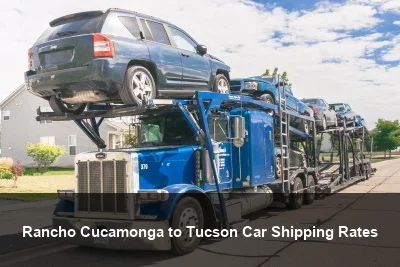
At 416 miles, this route falls into a mid-distance pricing tier — far enough that fuel cost is a real variable, close enough that carriers don't need multi-day layovers. Gas prices along the I-10 corridor directly affect carrier bids; California diesel prices in particular move what you'll pay at origin. Snowbird seasons in October and March push demand sharply, raising rates by 10–20% on short notice. See how fuel pricing affects your quote at https://california.auto-transport-shipping.com/articles/how-gas-prices-impact-california-auto-transport-fees.html
What affects the cost of Rancho Cucamonga to Tucson car shipping:
- Vehicle type and size — larger vehicles take more carrier space; aftermarket additions like lift kits, oversized mirrors, or roof accessories can add fees
- Open vs. enclosed transport — open is lower cost with stronger carrier availability; enclosed protects against weather, debris, and road conditions
- Standard vs. expedited pickup — expedited prioritizes your vehicle for the next available dispatch, typically at a $100–$300 premium
- Time of year — peak demand seasons drive rates higher; off-peak windows offer the most competitive pricing
- Fuel costs — diesel prices affect carrier rates; longer routes are more sensitive to fuel price swings
- Vehicle condition — non-running vehicles require special loading equipment and cost more to ship
| Vehicle Type | Open Car Shipping (Est.) | Enclosed Car Shipping (Est.) |
|---|---|---|
| Sedan | $650 – $900 | $1,200 – $1,600 |
| SUV / Crossover | $800 – $1,050 | $1,400 – $1,850 |
| Pickup Truck | $800 – $1,050 | $1,400 – $1,850 |
| Minivan | $800 – $1,050 | $1,400 – $1,850 |
| Luxury / Classic Car | $900 – $1,200 | $1,500 – $2,000 |
| Non-Running Vehicle | Add $150–250 | Add $150–250 |
* Estimated ranges based on recent Rancho Cucamonga to Tucson shipments. Actual rate depends on vehicle, locations, booking date, and current fuel costs. Use the form on this page to compare real quotes from licensed carriers.
Open vs. Enclosed Transport on the Rancho Cucamonga–Tucson Desert Run
Open transport is the right call for most vehicles on this route. The I-10 corridor is well-paved through the Coachella Valley and Sonoran Desert, carrier frequency is high, and open carriers make economic sense for standard sedans, trucks, and SUVs. Enclosed transport is worth the premium if you're shipping a collector car, exotic, or low-clearance vehicle — desert road debris and the occasional sandstorm near the Salton Sea area are real considerations. Summer heat doesn't differentiate meaningfully between open and enclosed; either way, your vehicle should have the gas tank kept to a quarter.
How Long Does Rancho Cucamonga to Tucson Car Shipping Take?
Standard transit on this route runs 2 to 3 days from carrier assignment. The 416-mile drive is manageable in a single push for an experienced driver, but carriers run multi-stop loads, so they don't always deliver sequentially. Rancho Cucamonga's position in the Inland Empire means dispatch is fast — carriers staging in Ontario and Fontana are often assigned within 24 to 48 hours of booking. If your timeline is tight, expedited options can reduce that window. Review expedited shipping costs and tradeoffs at https://california.auto-transport-shipping.com/articles/california-expedited-car-shipping-fast-cost.html
| Service Type | Typical Transit | Pickup Window | Best For |
|---|---|---|---|
| Open — Standard | 2–4 days | 2–4 business days | Best value; most common choice on this route |
| Open — Expedited | 1–2 days | 1–2 business days | Firm arrival date; faster dispatch window |
| Enclosed — Standard | 2–4 days | 3–6 business days | Luxury, classic, or modified vehicles |
| Enclosed — Expedited | 1–2 days | 1–3 business days | High-value vehicles on a firm delivery deadline |
** Tucson's monsoon season — July through mid-September — can introduce same-day delivery delays if storms move through the metro. The I-10 near Picacho Peak is also subject to dust storms that close lanes temporarily. Budget an extra half-day buffer for summer deliveries rather than scheduling your vehicle arrival the day you need it.
Rancho Cucamonga to Tucson — Route & Logistics
Carriers pick up in Rancho Cucamonga via I-15 South or SR-210 East, merging onto I-10 East near the Ontario interchange. From there, the route is a single interstate push: I-10 East through the Coachella Valley, across the California-Arizona border at Blythe, through the Phoenix metro, and south to Tucson. No significant interchange changes are required.
Key Corridor Waypoints
- Ontario, CA Carriers staging in Rancho Cucamonga commonly use Ontario as a final loading checkpoint given its proximity to Ontario International Airport and the I-10/I-15 interchange. Transporter marshaling yards near the airport allow multi-vehicle loads to consolidate before departure. This is where your vehicle joins an eastbound load heading toward Arizona.
- Palm Springs, CA The route descends into the Coachella Valley through the San Gorgonio Pass at roughly 2,600 feet before dropping to near sea level at Palm Springs. Wind turbines along SR-62 mark the transition into open desert. Carriers often note this stretch for high crosswinds that affect open trailer handling, particularly during fall and winter months.
- Blythe, CA / Arizona State Line The California-Arizona border crossing at Blythe sits at approximately 270 feet elevation along the Colorado River. Carriers cross here without a weigh station stop in most cases. Summer temperatures regularly exceed 115°F in this corridor — experienced drivers plan fuel and coolant checks here before pushing into the Arizona desert toward Phoenix.
- Phoenix, AZ (I-10 / I-17 Junction) The Phoenix metro is the primary staging and overnight point on this corridor. Carriers running multi-city loads may drop or pick up vehicles here. The I-10 and I-17 interchange is a major logistics node. If your vehicle is on a Phoenix-shared load, transit through the metro can add four to six hours depending on scheduling.
- Picacho Peak, AZ Picacho Peak, elevation 3,374 feet, marks the midpoint between Phoenix and Tucson at roughly the 70-mile mark south of the city. This stretch of I-10 is known for haboob dust storms in summer that can result in temporary road closures. Carriers familiar with this corridor monitor the ADOT traffic alerts before committing to this leg in monsoon season.
- Tucson, AZ (I-10 / I-19 Junction) The delivery zone begins at the I-10 and I-19 interchange on Tucson's south side. Carriers serving Davis-Monthan AFB typically use exits near Golf Links Road. University of Arizona deliveries route through the Campbell Avenue corridor. Wide arterial streets in most Tucson neighborhoods allow full-size transporters to reach most residential drop points without staging.
Pickup & Delivery Access
- Pickup Access in Rancho Cucamonga Rancho Cucamonga's grid streets and commercial arterials — Foothill Boulevard, Haven Avenue, and Milliken Avenue — are fully accessible to full-size car carriers. The area near Ontario Mills and the I-10/I-15 interchange is a preferred carrier meet point due to large parking areas. Residential streets in Alta Loma and Etiwanda are accessible but may require curbside pickup rather than driveway loading. Coordinate exact coordinates with your driver at assignment.
- Delivery Access in Tucson Most Tucson neighborhoods outside the downtown core are carrier-accessible. The University of Arizona main campus area has restricted street access near the mall; plan to meet your driver on University Boulevard or at a surface lot on the perimeter. Davis-Monthan AFB deliveries require gate coordination — your driver will need your sponsor information in advance. Newer subdivisions in Marana and Sahuarita on Tucson's outskirts are fully accessible.
- Nearby Pickup Locations Carriers picking up in Rancho Cucamonga regularly extend service to Ontario, Fontana, and Upland. Call 1‑800‑590‑6492 to confirm door-to-door availability at your address.
Open vs. Enclosed Car Shipping: Rancho Cucamonga to Tucson
Both options use licensed, insured carriers and deliver door to door. For a full breakdown, read the pros and cons of open vs. enclosed car shipping.
Open Car Shipping
Most Popular- Lower cost — the practical choice for most vehicles
- More carriers available on this corridor
- Faster dispatch from booking to pickup
- Works well for sedans, SUVs, trucks, and minivans
- Vehicle rides on an open multi-car carrier
- Cargo insurance required on all licensed carriers
Estimated cost: $650 – $1,050
Enclosed Car Shipping
Premium Protection- Full protection from weather, debris, and road grime
- Best for luxury, exotic, and classic vehicles
- Recommended for low-clearance and custom-built cars
- Wheel-net or soft-tie systems prevent contact damage
- Higher cargo coverage — commonly $500,000 per load
- White-glove handling by experienced operators
Estimated cost: $1,200 – $1,850
Not sure which is right for your vehicle? Call 1-800-590-6492 and we'll point you in the right direction. Also worth reading: the top 10 questions to ask any car shipping company before you commit.
How to Prepare Your Car for Shipping to Tucson
A little prep before pickup protects you if there's ever a dispute about your vehicle's condition. This checklist is from our full guide on preparing your car for transport:
- Remove all personal belongings from the interior and trunk
- Leave only a quarter tank of fuel — enough to load and unload
- Take date-stamped photos of the full exterior and interior
- Remove or disable toll transponders (FasTrak, E-ZPass, etc.)
- Retract or remove roof racks, spoilers, antennas, and bike mounts
- Make sure the battery is charged and tires are properly inflated
- Tell the carrier about any existing leaks or mechanical issues
- Deactivate the car alarm before the carrier arrives
- Write down the mileage on the Bill of Lading at pickup
- Fold in side mirrors if the vehicle is wider than standard
Personal items: Most carriers won't cover belongings left in the car. Read the full rules on shipping personal items in your vehicle. Also review our Bill of Lading guide so you know exactly what to check at pickup and delivery.
When to Ship Your Car from Rancho Cucamonga to Tucson
This corridor has two pronounced demand peaks: October through November as snowbirds move from California to Arizona for winter, and March through April as that flow reverses. Both windows tighten carrier availability and push rates up. Summer adds a heat-related complexity — not in terms of carrier reluctance, but in transit logistics across the Sonoran Desert. Winter on this specific route is mild and rarely causes delay. See winter transport considerations at https://california.auto-transport-shipping.com/articles/auto-transport-challenges-during-the-winter.html
Summer Heat Window (June–September)
Desert heat on I-10 between Blythe and Phoenix regularly peaks above 115°F. Carriers experienced on this route time their Arizona legs to early morning or late evening runs to reduce mechanical stress. Your vehicle is secured on the trailer and not running, so engine heat is not a concern — but tire pressure and trailer components are. Book early in summer as available carrier slots fill faster than you'd expect.
Snowbird Season — Southbound (October–November)
The highest-demand window on this corridor runs October through mid-November. California retirees and seasonal residents moving vehicles to Tucson for winter flood the market simultaneously. Carrier slots book out 7 to 14 days ahead during peak weeks. Rates can climb 15 to 20 percent compared to summer. If your move date is flexible, aim for mid-November after the initial rush or book six to eight weeks in advance to lock a competitive rate.
Snowbird Return — Northbound (March–April)
The reverse snowbird migration pushes Arizona-to-California demand sharply upward in March and April. If you're shipping Rancho Cucamonga to Tucson during this window, you benefit — carriers are eager to reload California-bound after delivering westbound. That means faster dispatch and occasionally better pricing. University of Arizona's spring semester end in May adds a secondary student-move spike that extends elevated demand through late May.
University of Arizona Move-In (Late July–August)
The University of Arizona welcomes roughly 47,000 students, many arriving from Southern California. Late July through the first week of August is the peak student shipping window. If you're shipping a vehicle to Tucson for a student, book at least three weeks ahead. Delivery coordination near the UA campus requires attention — meet your driver at a designated surface lot rather than attempting a dorm drop directly. Confirm parking details with your driver at assignment.
Military PCS Cycles (Year-Round, Peaks in Summer)
Davis-Monthan AFB PCS orders generate shipping demand every month, but the largest waves arrive in June and July when the military's primary transfer season peaks. Government-rate shipping may be available to active-duty personnel; confirm with your transportation office. Civilian brokers can also book around the same calendar — summer military demand tightens availability, so off-peak PCS orders (November through February) move faster and at more competitive rates.
Mild Winter Advantage (December–February)
Unlike northern California corridors, the Rancho Cucamonga to Tucson route sees no meaningful winter weather delays. I-10 through the Sonoran Desert stays clear of snow and ice. This makes December through February an underrated shipping window — lower demand means faster dispatch, more carrier options, and pricing that's 10 to 15 percent below peak-season rates. If your schedule allows, winter is the most efficient time to ship on this corridor.
How to Choose a Rancho Cucamonga to Tucson Car Shipping Company
Getting multiple quotes is step one — knowing what to look for in those quotes matters just as much. Our guide on how to select a car shipping company covers the full process. Here are the six things that matter most:
FMCSA Registration
Every carrier or broker must hold a valid MC number. Verify any company at FMCSA SAFER before you book.
Proof of Insurance
Ask for a current certificate of insurance. Open carriers typically carry $100,000–$250,000 per load; enclosed commonly $500,000 or more. Learn what auto transport insurance covers.
All-In Pricing
Your quote should be a final number with no fees added after booking. Know the difference between brokers and carriers and confirm what the quote covers before you agree.
Bill of Lading
A complete Bill of Lading is filled out at pickup and delivery. Our Bill of Lading guide explains what to check. Never sign an incomplete one.
Real Reviews
Check Google and the BBB. Look at how they handled complaints and damage claims — that tells you more than a five-star average from happy customers.
Route Experience
A carrier who runs Rancho Cucamonga to Tucson regularly knows the I-10 corridor the way a local knows back roads. They know to stage multi-vehicle loads at the Ontario area transporter lots before heading east, and that the Coachella Valley wind corridor near Palm Springs requires speed and lane adjustments for open trailers. They know Picacho Peak as a decision point — a haboob moving in from the south means holding in the Eloy area, not pressing into it. They know Golf Links Road as the preferred approach to Davis-Monthan. They know the University of Arizona perimeter lots by name. That route knowledge shortens your transit, reduces handling risk, and means your vehicle isn't being figured out on the fly.
Rancho Cucamonga to Tucson Car Shipping — FAQ
How much does it cost to ship a car from Rancho Cucamonga to Tucson?
On the Rancho Cucamonga to Tucson corridor — 416 miles — open transport typically runs between $550 and $850 for a standard sedan or SUV under normal market conditions. Enclosed transport runs $950 to $1,400 depending on vehicle size and carrier availability. Rates increase 10 to 20 percent during snowbird season (October–November and March–April) and during the University of Arizona move-in period in late July and August. Fuel prices along the I-10 corridor directly affect what carriers bid — when California diesel prices spike, quotes follow. Book early during peak windows and lock a rate rather than waiting for prices to drop.
How long does Rancho Cucamonga to Tucson car shipping take?
Once a carrier is assigned, standard transit on this route is 2 to 3 days. The 416-mile drive is a manageable single-day run, but carriers operate multi-stop loads, which affects the sequencing of your delivery. Dispatch from Rancho Cucamonga is typically fast — the Inland Empire's carrier density means assignment often happens within 24 to 48 hours of booking. If you need your vehicle sooner, expedited options exist that prioritize your load. Review what expedited shipping costs and requires at https://california.auto-transport-shipping.com/articles/california-expedited-car-shipping-fast-cost.html before committing to a standard timeline.
Is my car insured during transport from Rancho Cucamonga to Tucson?
Every licensed carrier operating on this route is required by federal law to carry cargo insurance, which covers your vehicle while it is on the transporter. Coverage limits and deductible structures vary by carrier. Before your vehicle is loaded in Rancho Cucamonga, a Bill of Lading is completed documenting existing condition — this is your baseline for any claim. Inspect your vehicle at delivery in Tucson before signing off. For a full explanation of how coverage works, read https://california.auto-transport-shipping.com/articles/understanding-auto-transport-insurance.html. If damage occurs, the claims process is outlined at https://california.auto-transport-shipping.com/articles/how-to-file-a-claim-for-vehicle-damage-during-transport.html.
Should I choose open or enclosed transport for this route?
Open transport is the correct choice for most vehicles on this corridor. The I-10 is a well-maintained interstate, carrier frequency is high, and the route doesn't expose your vehicle to unusual hazards that would justify the enclosed premium for standard vehicles. Enclosed transport makes sense if you're shipping a classic car, a vehicle with an exceptionally high market value, or a low-clearance exotic where road debris risk matters. Desert dust near the Salton Sea and occasional sand near Blythe are factors some owners consider. Full comparison of both options is available at https://california.auto-transport-shipping.com/articles/open-vs-enclosed-auto-transport-pros-and-cons.html.
Do I have to be present at pickup in Rancho Cucamonga and delivery in Tucson?
You do not need to be physically present, but someone you designate must be available to inspect the vehicle, sign the Bill of Lading at pickup, and complete the same inspection at delivery. The Bill of Lading is the legal record of your vehicle's condition at both ends of the transport — do not skip or rush this inspection. If you're shipping a vehicle for a student arriving in Tucson or a family member handling a military PCS at Davis-Monthan, make sure the designated person understands what to look for and what to sign. Details on the BOL process are at https://california.auto-transport-shipping.com/articles/california-auto-transport-bill-of-lading-information.html.
How does military PCS shipping work for Davis-Monthan AFB in Tucson?
Davis-Monthan Air Force Base is one of the primary demand drivers on this corridor, and carriers are familiar with the base's access requirements. If you're on PCS orders, your transportation office may authorize government-rate shipping through approved carriers — confirm what your orders cover before booking privately. If you're booking independently, notify your broker that delivery is to or near Davis-Monthan so the assigned carrier coordinates gate access requirements in advance. PCS demand peaks June through July; if your orders fall in that window, dispatch can take slightly longer. Off-peak PCS moves — fall and winter — often move faster and at lower rates.
Does the summer monsoon season in Tucson affect delivery timing?
Tucson's monsoon season runs roughly July through mid-September and brings afternoon and evening thunderstorms, occasional flash flooding, and haboob dust storms on I-10 north of the city near Picacho Peak. Carriers experienced on this corridor monitor ADOT advisories and will hold a load in the Eloy or Casa Grande area rather than drive into a closed highway. This can add 4 to 12 hours to your delivery window on affected days. If you're scheduling delivery during monsoon season, avoid booking your vehicle arrival for the same day you need it — build a one-day buffer into your plan.
When is the best time to book a Rancho Cucamonga to Tucson shipment to get the lowest rate?
The lowest-rate windows on this corridor are December through February and June through early July — outside the snowbird peaks and before the full heat of summer tightens scheduling. The October–November snowbird rush and the March–April return are the most expensive periods, with rates 15 to 20 percent above baseline and dispatch times stretching to 5 to 10 days. University of Arizona move-in in late July and early August adds a secondary demand spike. If your move falls in any of those windows, book 4 to 6 weeks ahead and secure a rate rather than waiting for the market to ease — it typically doesn't until the season passes.
Ready to Ship Your Car from Rancho Cucamonga to Tucson?
One form gets you up to 10 free quotes from licensed, insured carriers. Compare costs and transit times and book the best deal for your schedule.