

Moreno Valley to Jacksonville Car Shipping Route
Moreno Valley sits at roughly 1,630 feet elevation in the Inland Empire, and carriers access the SR-60 westbound on-ramp to connect with I-10 East — the primary artery for this entire route. From there, it's a straight shot through the Coachella Valley, across the Sonoran Desert, through Texas via El Paso and San Antonio, then east through Louisiana and the Florida Panhandle before dropping south to Jacksonville on I-95. Total driving distance is approximately 2,580 miles. A driver covering that alone would need four to five days minimum. Shipping eliminates fuel costs, mileage wear, and the physical toll of the drive. See a detailed breakdown of those savings at https://california.auto-transport-shipping.com/articles/benefits-of-auto-transport-service-vs-driving-yourself.html.
Jacksonville's demand profile is unusually consistent for a Florida city because it's not purely seasonal. Naval Station Mayport — one of the Navy's busiest homeports on the East Coast — and Naval Air Station Jacksonville together drive military PCS shipments throughout the year, with peaks in early summer. The University of North Florida and Jacksonville University contribute student moves in August and January. Fidelity National Financial, EverBank, and a growing logistics sector add corporate relocation volume. Weather-wise, this route crosses I-10 through West Texas and the Gulf Coast, where summer heat affects open-carrier scheduling and late-summer hurricanes can complicate Florida delivery windows. Before you book, review common booking errors at https://california.auto-transport-shipping.com/articles/auto-transport-mistakes-to-avoid.html.
Moreno Valley to Jacksonville Car Shipping Rates
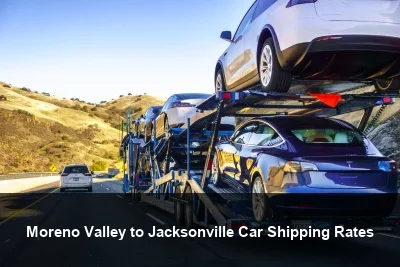
At 2,580 miles, this route falls into the long-haul tier where per-mile rates decrease but base costs are higher. Summer PCS season — May through August — pushes rates up from both ends: demand spikes in the Inland Empire and at Jacksonville's military bases simultaneously. Fuel surcharges on this corridor are meaningful; the I-10 crossing through Texas is one of the longer fuel legs in continental US transport. Current fuel price impacts on your quote are explained at https://california.auto-transport-shipping.com/articles/how-gas-prices-impact-california-auto-transport-fees.html.
What affects the cost of Moreno Valley to Jacksonville car shipping:
- Vehicle type and size — larger vehicles take more carrier space; aftermarket additions like lift kits, oversized mirrors, or roof accessories can add fees
- Open vs. enclosed transport — open is lower cost with stronger carrier availability; enclosed protects against weather, debris, and road conditions
- Standard vs. expedited pickup — expedited prioritizes your vehicle for the next available dispatch, typically at a $100–$300 premium
- Time of year — peak demand seasons drive rates higher; off-peak windows offer the most competitive pricing
- Fuel costs — diesel prices affect carrier rates; longer routes are more sensitive to fuel price swings
- Vehicle condition — non-running vehicles require special loading equipment and cost more to ship
| Vehicle Type | Open Car Shipping (Est.) | Enclosed Car Shipping (Est.) |
|---|---|---|
| Sedan | $1,100 – $1,600 | $1,900 – $2,700 |
| SUV / Crossover | $1,300 – $1,900 | $2,200 – $3,100 |
| Pickup Truck | $1,300 – $1,950 | $2,200 – $3,150 |
| Minivan | $1,300 – $1,900 | $2,200 – $3,100 |
| Luxury / Classic Car | $1,550 – $2,200 | $2,600 – $3,600 |
| Non-Running Vehicle | Add $200–400 | Add $200–400 |
* Estimated ranges based on recent Moreno Valley to Jacksonville shipments. Actual rate depends on vehicle, locations, booking date, and current fuel costs. Use the form on this page to compare real quotes from licensed carriers.
Open vs. Enclosed: What This 2,580-Mile Route Actually Needs
Most vehicles shipping from Moreno Valley to Jacksonville move on open carriers without issue. The I-10 corridor through the Sonoran Desert and West Texas is dry and predictable the majority of the year. Enclosed transport makes sense if you're moving a classic, exotic, or high-value vehicle — particularly during summer months when blowing desert sand and gravel debris increase exposure risk. If you're shipping during hurricane season (June through November) and your delivery window falls in late summer, enclosed adds a meaningful layer of protection for the Florida arrival leg.
How Long Does Moreno Valley to Jacksonville Car Shipping Take?
Standard transit on this route runs 7 to 10 business days from Moreno Valley to Jacksonville. Carrier frequency out of the Inland Empire is strong — SR-60's connection to the LA metro carrier pool means dispatch windows are typically 2 to 4 days after booking confirmation. The driving leg itself covers roughly 2,580 miles, and carriers running I-10 east typically stage overnight in Tucson, El Paso, or San Antonio before completing the Gulf Coast run. If your timeline is tighter, expedited options are available — see https://california.auto-transport-shipping.com/articles/california-expedited-car-shipping-fast-cost.html for specifics on cost and availability.
| Service Type | Typical Transit | Pickup Window | Best For |
|---|---|---|---|
| Open — Standard | 7–10 days | 2–5 business days | Best value; most common choice on this route |
| Open — Expedited | 5–7 days | 1–2 business days | Firm arrival date; faster dispatch window |
| Enclosed — Standard | 7–10 days | 4–8 business days | Luxury, classic, or modified vehicles |
| Enclosed — Expedited | 5–7 days | 2–4 business days | High-value vehicles on a firm delivery deadline |
** Late summer hurricane activity in the Gulf Coast and Florida can add 2 to 4 days to delivery if I-10 routing near Pensacola or the I-95 approach to Jacksonville is affected. West Texas dust storms occasionally cause short carrier holds near El Paso between June and September. Build buffer time into your schedule if you're booking between July and October.
Moreno Valley to Jacksonville — Route & Logistics
Carriers depart Moreno Valley via SR-60 West or East to connect with I-215, then merge onto I-10 East at the Redlands interchange. I-10 carries the route all the way from the Inland Empire through Phoenix, Tucson, El Paso, San Antonio, Houston, Baton Rouge, and Pensacola before connecting to I-95 South into Jacksonville — approximately 2,580 miles of predominantly freeway driving.
Key Corridor Waypoints
- Moreno Valley to Beaumont, CA Carriers exit Moreno Valley on SR-60 East, climbing through the Badlands pass at roughly 2,600 feet before descending into the Beaumont/Banning corridor where SR-60 merges with I-10. This interchange is the primary on-ramp to the continental route. Beaumont is a common early staging check for drivers confirming load security before the long desert crossing.
- Indio / Coachella Valley, CA I-10 drops below sea level near Salton Sea before leveling through Indio at approximately 22 feet below sea level. Summer temperatures here regularly exceed 115°F, which affects tire pressure and carrier scheduling — most operators time this segment for overnight or early morning runs during June through September to reduce heat-related equipment stress.
- El Paso, TX El Paso sits at 3,740 feet and is the first major overnight staging point for carriers on this corridor, approximately 780 miles from Moreno Valley. The I-10 and I-25 interchange here is a key dispatch hub. Carriers often swap loads or coordinate co-drivers here. Border inspection infrastructure is active in this zone, and occasional commercial vehicle weight station checks apply.
- San Antonio, TX At roughly 1,370 miles into the route, San Antonio is a second major staging and fuel stop. The I-10 and I-35 interchange here is one of the busiest truck corridors in the country. Carriers heading to Florida often pick up additional loads here, and dispatchers use San Antonio as a re-routing decision point if Gulf Coast weather is building.
- Baton Rouge / New Orleans, LA The I-10 corridor through Baton Rouge and the Lake Pontchartrain Causeway area is the most weather-sensitive segment of this route. Flooding, tropical storm closures, and bridge restrictions during hurricane season can force detours north onto I-12. Carriers experienced on this lane know the I-12 bypass and factor it into their schedule between July and October.
- Jacksonville, FL Carriers arrive via I-10 East directly into Jacksonville, transitioning to I-95 South or surface roads for final delivery. Naval Station Mayport on the east side and NAS Jacksonville on the south side are both accessible from I-295. Most residential neighborhoods and storage facilities for final delivery are within 20 minutes of the I-10/I-95 interchange in the urban core.
Pickup & Delivery Access
- Pickup Access in Moreno Valley Moreno Valley's street grid is carrier-accessible across most of the city. The March Business Center area near the former March Air Reserve Base, the Sunnymead Boulevard corridor, and the Alessandro Boulevard commercial zone all offer wide turn radii for 75-foot transport rigs. Residential cul-de-sacs in Moreno Highlands or Rancho Belago may require meeting the carrier at a nearby shopping center or church parking lot.
- Delivery Access in Jacksonville Jacksonville's carrier accessibility is above average for a major Florida city. The Southside, Mandarin, and Orange Park areas handle standard transport rigs without staging issues. Downtown Jacksonville has some narrow historic streets and parking permit zones — if your delivery address is in San Marco or Riverside, plan to meet the carrier at a nearby commercial lot like a Home Depot or Walmart to avoid access delays.
- Nearby Pickup Locations Carriers picking up in Moreno Valley regularly extend service to Riverside, Perris, and Hemet. Call 1‑800‑590‑6492 to confirm door-to-door availability at your address.
Open vs. Enclosed Car Shipping: Moreno Valley to Jacksonville
Both options use licensed, insured carriers and deliver door to door. For a full breakdown, read the pros and cons of open vs. enclosed car shipping.
Open Car Shipping
Most Popular- Lower cost — the practical choice for most vehicles
- More carriers available on this corridor
- Faster dispatch from booking to pickup
- Works well for sedans, SUVs, trucks, and minivans
- Vehicle rides on an open multi-car carrier
- Cargo insurance required on all licensed carriers
Estimated cost: $1,100 – $1,950
Enclosed Car Shipping
Premium Protection- Full protection from weather, debris, and road grime
- Best for luxury, exotic, and classic vehicles
- Recommended for low-clearance and custom-built cars
- Wheel-net or soft-tie systems prevent contact damage
- Higher cargo coverage — commonly $500,000 per load
- White-glove handling by experienced operators
Estimated cost: $1,900 – $3,150
Not sure which is right for your vehicle? Call 1-800-590-6492 and we'll point you in the right direction. Also worth reading: the top 10 questions to ask any car shipping company before you commit.
How to Prepare Your Car for Shipping to Jacksonville
A little prep before pickup protects you if there's ever a dispute about your vehicle's condition. This checklist is from our full guide on preparing your car for transport:
- Remove all personal belongings from the interior and trunk
- Leave only a quarter tank of fuel — enough to load and unload
- Take date-stamped photos of the full exterior and interior
- Remove or disable toll transponders (FasTrak, E-ZPass, etc.)
- Retract or remove roof racks, spoilers, antennas, and bike mounts
- Make sure the battery is charged and tires are properly inflated
- Tell the carrier about any existing leaks or mechanical issues
- Deactivate the car alarm before the carrier arrives
- Write down the mileage on the Bill of Lading at pickup
- Fold in side mirrors if the vehicle is wider than standard
Personal items: Most carriers won't cover belongings left in the car. Read the full rules on shipping personal items in your vehicle. Also review our Bill of Lading guide so you know exactly what to check at pickup and delivery.
When to Ship Your Car from Moreno Valley to Jacksonville
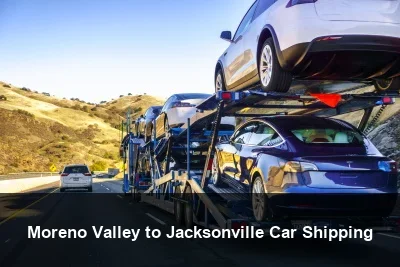
This route has two distinct demand peaks: summer PCS season (May through August), driven by military relocations at both the Inland Empire's March Air Reserve Base side and Jacksonville's naval installations, and a secondary snowbird wave in October through November when California residents move vehicles to Florida for winter. Both windows compress carrier availability and push rates up. Booking 2 to 3 weeks ahead of either peak is strongly advisable. Winter weather on the I-10 corridor is generally mild, but see https://california.auto-transport-shipping.com/articles/auto-transport-challenges-during-the-winter.html for Gulf Coast-specific cold-weather considerations.
Military PCS Season (May–August)
Naval Station Mayport and NAS Jacksonville are among the Navy's most active PCS posting locations, and summer is peak transfer season. This simultaneously increases Jacksonville-bound demand from California and tightens carrier availability across the I-10 corridor. If you have military transfer orders dated June or July, submit your quote request in April or early May. Rates during this window can run 10 to 18 percent above the annual average, and dispatch lead times stretch to 5 to 7 days.
Summer Heat Window (June–September)
The I-10 crossing through the Coachella Valley, Sonoran Desert, and West Texas regularly sees ambient temperatures above 110°F in this window. Most carriers time desert segments for overnight runs, which can add a calendar day to transit. For high-value or exotic vehicles, enclosed shipping is worth the premium during these months — desert road debris and radiant heat off asphalt are real exposure factors on open trailers at this time of year.
Snowbird Season (October–November)
October and November see a measurable volume increase on California-to-Florida lanes as seasonal residents move vehicles ahead of winter. This is a softer demand spike than PCS season but still affects carrier availability on the I-10 corridor. Booking in September for October-November delivery gives you the best rate positioning. Return loads — Florida to California — are abundant in this window, which tends to keep westbound pricing stable if you're planning a round trip.
University Move-In (August, January)
The University of North Florida and Jacksonville University both draw out-of-state students, and late July through mid-August is their peak arrival window. January sees a smaller secondary move for spring semester. These periods tighten Jacksonville delivery scheduling modestly — not as severely as PCS season — but if your delivery window falls in the first two weeks of August, build in a 1 to 2 day buffer for local congestion near campus-adjacent delivery zones.
Winter Mild Season (December–February)
This is one of the better windows to ship on this corridor. Military PCS activity slows, snowbird demand has largely cleared, and the I-10 route through the desert Southwest stays dry and passable. Rates typically dip 8 to 12 percent below summer peaks. The only caveat is occasional Gulf Coast rain and fog near Pensacola and Tallahassee, which can cause minor carrier delays. For most vehicles, open transport in this window is straightforward and cost-effective.
Hurricane Season Caveat (August–October)
The Florida delivery leg runs along the I-95 corridor just south of Jacksonville, and late-season hurricane activity can affect dispatch timing and route availability near the Gulf Coast. Carriers with experience on this lane know the I-12 bypass through Louisiana and the alternate north Florida routing via I-75. If you're booking a late-September or October delivery, ask your dispatcher explicitly about current Gulf Coast weather holds and whether the carrier runs the Baton Rouge bypass.
How to Choose a Moreno Valley to Jacksonville Car Shipping Company
Getting multiple quotes is step one — knowing what to look for in those quotes matters just as much. Our guide on how to select a car shipping company covers the full process. Here are the six things that matter most:
FMCSA Registration
Every carrier or broker must hold a valid MC number. Verify any company at FMCSA SAFER before you book.
Proof of Insurance
Ask for a current certificate of insurance. Open carriers typically carry $100,000–$250,000 per load; enclosed commonly $500,000 or more. Learn what auto transport insurance covers.
All-In Pricing
Your quote should be a final number with no fees added after booking. Know the difference between brokers and carriers and confirm what the quote covers before you agree.
Bill of Lading
A complete Bill of Lading is filled out at pickup and delivery. Our Bill of Lading guide explains what to check. Never sign an incomplete one.
Real Reviews
Check Google and the BBB. Look at how they handled complaints and damage claims — that tells you more than a five-star average from happy customers.
Route Experience
A carrier who runs the Moreno Valley–Jacksonville lane regularly knows things a general freight driver doesn't. They know to stage overnight at a truck stop east of El Paso rather than inside the city limits, where overnight commercial parking is limited. They know the I-10 bridge weight restrictions near Lake Charles, Louisiana, that affect certain multi-car trailer configurations. They know that Jacksonville's Mayport Naval Station access road requires civilian carriers to stage at Gate Road rather than attempting base entry. They time the Coachella Valley crossing before 6 AM in July. They have contacts at the San Antonio dispatch hub for load coordination on the Texas-to-Florida leg. That local knowledge cuts days off transit and prevents the avoidable delays that show up in generic carrier reviews.
Moreno Valley to Jacksonville Car Shipping — FAQ
How much does it cost to ship a car from Moreno Valley to Jacksonville?
On this 2,580-mile corridor, most standard sedans and small SUVs move for $1,050 to $1,450 on open transport. Larger vehicles — full-size trucks, minivans, lifted SUVs — typically run $1,250 to $1,700. Enclosed transport adds $400 to $700 depending on vehicle size and carrier availability. Rates are highest during May through August due to military PCS demand at both ends of the route. If you're booking outside that window, expect pricing at the lower end of these ranges. Fuel surcharges on I-10's long Texas crossing can affect quotes when diesel prices spike — see https://california.auto-transport-shipping.com/articles/how-gas-prices-impact-california-auto-transport-fees.html for how that's calculated.
How long does Moreno Valley to Jacksonville car shipping take?
Standard transit on this route is 7 to 10 business days from the time a carrier picks up your vehicle in Moreno Valley. Dispatch after booking confirmation typically takes 2 to 4 days given the Inland Empire's carrier pool depth. The drive itself covers roughly 2,580 miles via I-10 East and I-95 South. Carriers generally stage overnight in El Paso and San Antonio before completing the Gulf Coast leg. Summer heat in the Sonoran Desert occasionally extends transit by a day if carriers time their segments for cooler overnight hours. If you need faster delivery, expedited options are covered at https://california.auto-transport-shipping.com/articles/california-expedited-car-shipping-fast-cost.html.
Is my car insured during transport from Moreno Valley to Jacksonville?
Yes. Every licensed carrier operating in the US is required by FMCSA to carry cargo insurance, which covers your vehicle while it's on the transport trailer. Coverage limits and deductible structures vary by carrier, so ask for the insurance certificate before you confirm your booking. It's also worth checking whether your personal auto policy provides supplemental coverage during transport — some do. Document your vehicle's condition with timestamped photos before pickup and again at delivery. If damage occurs, the process matters. A full explanation of coverage is at https://california.auto-transport-shipping.com/articles/understanding-auto-transport-insurance.html and the claims process is detailed at https://california.auto-transport-shipping.com/articles/how-to-file-a-claim-for-vehicle-damage-during-transport.html.
Should I choose open or enclosed transport for the Moreno Valley to Jacksonville route?
Open transport is the right call for most vehicles on this corridor. The I-10 route through the Southwest is predominantly dry, and carrier quality on this well-traveled lane is generally solid. Enclosed makes sense if you're shipping a classic, exotic, or high-value vehicle — or if your delivery window falls in July or August when desert road debris and radiant heat increase exposure risk for paint and convertible tops. Enclosed also provides meaningful protection if you're delivering into Jacksonville during hurricane season and can't fully control the timing. A detailed comparison is at https://california.auto-transport-shipping.com/articles/open-vs-enclosed-auto-transport-pros-and-cons.html.
Do I have to be present at pickup in Moreno Valley and delivery in Jacksonville?
You or an authorized representative must be present at both pickup and delivery to sign the Bill of Lading, which documents your vehicle's condition at both transfer points. This is not optional — it's your primary legal protection if a damage dispute arises. You can designate a family member, neighbor, or local contact to handle either end if you're relocating and won't be physically present. Make sure that person understands the inspection process and has a camera ready. Full Bill of Lading requirements and what to look for are explained at https://california.auto-transport-shipping.com/articles/california-auto-transport-bill-of-lading-information.html.
Does military PCS status affect my shipping options or pricing on this route?
Military PCS orders do affect this corridor significantly, primarily because Jacksonville is home to both Naval Station Mayport and Naval Air Station Jacksonville — two of the Navy's busiest duty stations on the East Coast. If you're PCSing, your orders may qualify you for government transportation allowances through your branch's personal property office. Even if you're arranging transport privately, book as early as possible — ideally 3 to 4 weeks before your report date. Summer PCS windows (May through August) see the highest demand on this exact I-10 corridor, and dispatch lead times and rates both increase during that period.
How does hurricane season in Florida affect delivery timing for this route?
Hurricane season runs June 1 through November 30, with the most active window being August through October. For Jacksonville-bound shipments, the most significant risk is on the Gulf Coast leg of I-10 near Pensacola and the approach on I-95 through northeast Florida. Active storms or post-storm road closures can add 2 to 4 days to delivery. Carriers experienced on this lane know the I-12 bypass through Louisiana as an alternate when I-10 near New Orleans is affected. If you're booking a late-summer or fall delivery, build buffer days into your schedule and ask your dispatcher specifically about current Gulf Coast weather holds at the time of booking.
Can I ship personal items inside my vehicle from Moreno Valley to Jacksonville?
Technically, carriers are not licensed to transport household goods — only the vehicle itself. Most carriers permit a small amount of personal items in the trunk, generally under 100 pounds, but this is a carrier-by-carrier policy and not guaranteed. Items left in the vehicle are not covered by the carrier's cargo insurance — only the vehicle itself is insured during transport. Do not leave valuables, electronics, or irreplaceable items in the car. If the carrier inspects the load at a weigh station and finds significant personal property in the vehicle, they may require removal or charge an additional fee.
Ready to Ship Your Car from Moreno Valley to Jacksonville?
One form gets you up to 10 free quotes from licensed, insured carriers. Compare costs and transit times and book the best deal for your schedule.