

Moreno Valley to Houston Car Shipping Route
The drive from Moreno Valley, CA to Houston, TX covers approximately 1,557 miles. Carriers depart via SR-60 east, merging onto I-10 near Banning, then run I-10 continuously through the Coachella Valley, across the Arizona and New Mexico state lines, through El Paso, and into Texas toward San Antonio before cutting northeast to Houston on I-10. Access from Moreno Valley's surface streets is straightforward — SR-60 feeds directly into the I-10 on-ramp system with no significant urban bottleneck. Compared to driving that distance yourself, professional transport eliminates fuel cost, wear, lodging, and personal time. See a full breakdown at https://california.auto-transport-shipping.com/articles/benefits-of-auto-transport-service-vs-driving-yourself.html.
Houston anchors this route's demand. The city hosts three significant military installations: Ellington Field Joint Reserve Base, Camp Mabry is in Austin but the broader Texas corridor includes Fort Sam Houston. Houston proper draws heavy PCS traffic through Ellington. The University of Houston, Rice University, Texas Southern University, and Houston Baptist University collectively move thousands of student vehicles annually. Major employers including ExxonMobil, Chevron Phillips, Shell, and the Texas Medical Center generate corporate relocation volume throughout the year. Extreme summer heat across the Arizona and West Texas desert stretch — sustained temperatures above 110°F — is a route-specific consideration. Read about avoidable booking mistakes at https://california.auto-transport-shipping.com/articles/auto-transport-mistakes-to-avoid.html.
Moreno Valley to Houston Car Shipping Rates
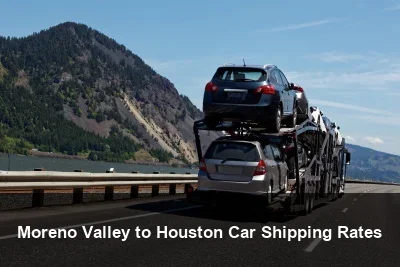
At 1,557 miles, this route falls in the long-haul tier where per-mile rates compress slightly versus mid-distance corridors, but total cost is still meaningful. Summer months push rates up — both because of high relocation demand into Texas and because desert heat between Banning and El Paso adds wear considerations for carriers. Diesel prices along I-10 through Arizona and New Mexico directly affect carrier pricing. Track how fuel costs influence your quote at https://california.auto-transport-shipping.com/articles/how-gas-prices-impact-california-auto-transport-fees.html. Booking 10 to 14 days ahead typically returns better rates than last-minute requests on this lane.
What affects the cost of Moreno Valley to Houston car shipping:
- Vehicle type and size — larger vehicles take more carrier space; aftermarket additions like lift kits, oversized mirrors, or roof accessories can add fees
- Open vs. enclosed transport — open is lower cost with stronger carrier availability; enclosed protects against weather, debris, and road conditions
- Standard vs. expedited pickup — expedited prioritizes your vehicle for the next available dispatch, typically at a $100–$300 premium
- Time of year — peak demand seasons drive rates higher; off-peak windows offer the most competitive pricing
- Fuel costs — diesel prices affect carrier rates; longer routes are more sensitive to fuel price swings
- Vehicle condition — non-running vehicles require special loading equipment and cost more to ship
| Vehicle Type | Open Car Shipping (Est.) | Enclosed Car Shipping (Est.) |
|---|---|---|
| Sedan | $950 – $1,350 | $1,700 – $2,300 |
| SUV / Crossover | $1,100 – $1,600 | $1,950 – $2,700 |
| Pickup Truck | $1,100 – $1,650 | $1,950 – $2,750 |
| Minivan | $1,100 – $1,600 | $1,950 – $2,700 |
| Luxury / Classic Car | $1,300 – $1,900 | $2,200 – $3,000 |
| Non-Running Vehicle | Add $200–350 | Add $200–350 |
* Estimated ranges based on recent Moreno Valley to Houston shipments. Actual rate depends on vehicle, locations, booking date, and current fuel costs. Use the form on this page to compare real quotes from licensed carriers.
Open vs. Enclosed: What This Desert Route Actually Demands
Open transport is appropriate for most standard vehicles on this corridor. The majority of the route runs I-10 through arid desert with minimal precipitation outside of monsoon season in Arizona and New Mexico, roughly July through September. If you're shipping a luxury vehicle, classic car, or anything with a finished paint job you want protected from gravel and monsoon grit, enclosed is the correct choice. The price premium for enclosed on a 1,557-mile haul is proportionally smaller than on shorter routes and buys real protection during the desert monsoon window.
How Long Does Moreno Valley to Houston Car Shipping Take?
Moreno Valley to Houston typically takes 4 to 7 days from carrier pickup to delivery under normal conditions. The I-10 corridor is a primary long-haul trucking artery with high carrier frequency out of the Inland Empire, so dispatch is rarely the delay — most vehicles are assigned a driver within 24 to 48 hours of booking. The driving time for 1,557 miles under federal hours-of-service rules spans roughly 3 to 4 driving days. For time-sensitive moves, expedited options can tighten that window — see https://california.auto-transport-shipping.com/articles/california-expedited-car-shipping-fast-cost.html for details on how expedited dispatch works.
| Service Type | Typical Transit | Pickup Window | Best For |
|---|---|---|---|
| Open — Standard | 4–6 days | 2–5 business days | Best value; most common choice on this route |
| Open — Expedited | 2–4 days | 1–2 business days | Firm arrival date; faster dispatch window |
| Enclosed — Standard | 4–6 days | 3–7 business days | Luxury, classic, or modified vehicles |
| Enclosed — Expedited | 2–4 days | 1–3 business days | High-value vehicles on a firm delivery deadline |
** Arizona and New Mexico monsoon storms in July through September can produce flash flooding on I-10, forcing brief reroutes or mandatory holds. West Texas wildfire smoke occasionally reduces visibility near Van Horn and Ozona. Either condition can add one to two days to an otherwise standard transit schedule.
Moreno Valley to Houston — Route & Logistics
Carriers access the route via SR-60 east from Moreno Valley, connecting to I-10 near Banning at approximately 2,600 feet elevation. I-10 runs continuously for the full corridor through Indio, Tucson, Las Cruces, El Paso, San Antonio, and into Houston — no major interstate changes required. Total driving distance is approximately 1,557 miles along a single primary artery.
Key Corridor Waypoints
- Banning, CA / I-10 On-Ramp Carriers from Moreno Valley merge onto I-10 at Banning, elevation approximately 2,400 feet. This is the effective start of the interstate run. The Banning Pass between the San Gorgonio and San Jacinto mountains can produce strong crosswinds exceeding 50 mph, a known delay point for high-profile carriers that occasionally requires a brief hold.
- Indio / Coachella Valley, CA The route descends into the Coachella Valley, dropping below sea level near Salton Sea. Summer temperatures here regularly exceed 115°F, which affects tire pressure and requires carriers to monitor loads. Some carriers time this section to cross during cooler overnight hours in peak summer months rather than midday.
- Tucson, AZ Tucson sits roughly 450 miles from Moreno Valley and functions as a natural first overnight or rest stop for drivers. It is also a carrier staging hub where multi-stop loads are occasionally reorganized. The I-10 and I-19 interchange here is a common inspection and weigh station checkpoint for commercial carriers heading east.
- El Paso, TX / Las Cruces, NM Junction El Paso marks the Texas state line and the I-10 / I-25 interchange at approximately 3,700 feet elevation. This is a critical waypoint — carriers crossing into Texas are subject to Texas DOT weight and safety inspections. The Franklin Mountains create a brief grade change. Many carriers use El Paso for a driver change or fuel stop on this corridor.
- San Antonio, TX San Antonio sits roughly 1,200 miles from Moreno Valley and is a significant demand hub in its own right, home to Fort Sam Houston and Lackland Air Force Base. Carriers with multi-vehicle loads frequently make a delivery stop here before continuing the final 200 miles to Houston. The I-10 and I-35 interchange is a high-volume merge point requiring careful timing.
- Houston, TX (I-10 / I-610 Loop) Carriers enter Houston on I-10 east and navigate either to the I-610 inner loop or use the I-69 / US-59 corridor depending on the delivery neighborhood. The Houston Ship Channel area and inner Montrose or Midtown districts involve narrow streets where a 75-foot carrier cannot always reach the front door, sometimes requiring a staging handoff at a nearby parking area.
Pickup & Delivery Access
- Pickup Access in Moreno Valley Moreno Valley's street grid handles standard 75-foot carrier rigs without significant restriction in most residential and commercial zones. The SR-60 corridor through the March Business Center area and along Alessandro Boulevard provides accessible staging options. Carriers often coordinate meet points at large commercial parking areas near the Moreno Valley Mall or the March Air Reserve Base perimeter road to avoid tight residential cul-de-sacs.
- Delivery Access in Houston Houston is carrier-accessible across most major zones — Memorial, Sugar Land, Katy, and The Woodlands present no significant access issues. Inner loop neighborhoods like Montrose, the Heights, and EaDo have narrower streets where a standard 10-car hauler cannot always deliver curbside. In those areas, carriers typically coordinate a meet point at a nearby shopping center or church parking lot within a short drive of the final address.
- Nearby Pickup Locations Carriers picking up in Moreno Valley regularly extend service to Riverside, Perris, and Hemet. Call 1‑800‑590‑6492 to confirm door-to-door availability at your address.
Open vs. Enclosed Car Shipping: Moreno Valley to Houston
Both options use licensed, insured carriers and deliver door to door. For a full breakdown, read the pros and cons of open vs. enclosed car shipping.
Open Car Shipping
Most Popular- Lower cost — the practical choice for most vehicles
- More carriers available on this corridor
- Faster dispatch from booking to pickup
- Works well for sedans, SUVs, trucks, and minivans
- Vehicle rides on an open multi-car carrier
- Cargo insurance required on all licensed carriers
Estimated cost: $950 – $1,650
Enclosed Car Shipping
Premium Protection- Full protection from weather, debris, and road grime
- Best for luxury, exotic, and classic vehicles
- Recommended for low-clearance and custom-built cars
- Wheel-net or soft-tie systems prevent contact damage
- Higher cargo coverage — commonly $500,000 per load
- White-glove handling by experienced operators
Estimated cost: $1,700 – $2,750
Not sure which is right for your vehicle? Call 1-800-590-6492 and we'll point you in the right direction. Also worth reading: the top 10 questions to ask any car shipping company before you commit.
How to Prepare Your Car for Shipping to Houston
A little prep before pickup protects you if there's ever a dispute about your vehicle's condition. This checklist is from our full guide on preparing your car for transport:
- Remove all personal belongings from the interior and trunk
- Leave only a quarter tank of fuel — enough to load and unload
- Take date-stamped photos of the full exterior and interior
- Remove or disable toll transponders (FasTrak, E-ZPass, etc.)
- Retract or remove roof racks, spoilers, antennas, and bike mounts
- Make sure the battery is charged and tires are properly inflated
- Tell the carrier about any existing leaks or mechanical issues
- Deactivate the car alarm before the carrier arrives
- Write down the mileage on the Bill of Lading at pickup
- Fold in side mirrors if the vehicle is wider than standard
Personal items: Most carriers won't cover belongings left in the car. Read the full rules on shipping personal items in your vehicle. Also review our Bill of Lading guide so you know exactly what to check at pickup and delivery.
When to Ship Your Car from Moreno Valley to Houston
This route does not have a true off-season. Relocation demand into Houston from California runs consistently across all twelve months due to the energy sector and military PCS cycles. Rates peak in May through August when summer moving season and Texas heat combine to tighten available carrier capacity. Winter is mild on the southern I-10 corridor compared to northern routes, though monsoon season in Arizona and New Mexico from July through September introduces transit risk. Review specific winter transport considerations at https://california.auto-transport-shipping.com/articles/auto-transport-challenges-during-the-winter.html.
Spring Relocation Season (March – May)
Spring triggers the first major surge in bookings on this lane as corporate transferees, university students completing the academic year, and military personnel with spring PCS orders all move simultaneously. Carrier capacity tightens in April and May. Book at least two weeks ahead if your pickup window falls in this period. Rates trend 10 to 15 percent above winter floor pricing as demand outpaces available trucks on the Inland Empire to Texas corridor.
Summer Peak (June – August)
Summer is the highest-demand, highest-rate window on this route. Texas heat, school-year transitions, and peak military PCS season all converge. Desert temperatures between Indio and El Paso can exceed 115°F, which some carriers manage by running the segment overnight. If your vehicle has a convertible top or any heat-sensitive components, discuss enclosed transport with your broker for this specific window. Expect longer dispatch lead times and peak-season pricing.
Monsoon Window (July – September)
Arizona and New Mexico monsoon activity peaks in July through early September. Flash flooding along I-10 between Tucson and Lordsburg is a documented annual hazard. Carriers may detour or hold for 12 to 24 hours during severe storm events. This does not cancel your shipment but can extend the transit window. Factor one to two additional buffer days into your delivery expectation if your pickup falls inside this weather window.
Winter Mild Season (December – February)
The I-10 southern corridor stays largely free of snow and ice, making this one of the more reliable winter long-haul routes in the country. Occasional winter storms at elevation near El Paso can cause brief delays, but they are infrequent. Winter is generally the lowest-rate season on this lane. If your schedule is flexible and your move is not urgent, booking in January or February offers the best pricing with reliable transit times.
Student Shipping (August and January)
The University of Houston, Rice University, Texas Southern University, and Houston Baptist University all draw student vehicle shipments in late August before fall semester and in January before spring semester. Volume from California's UC and CSU campuses — particularly UC Riverside, which is close to Moreno Valley — adds to this surge. If you're a student or shipping for one, book four to five weeks ahead of move-in dates to secure pickup availability at your preferred rate.
Military PCS Cycles (Year-Round, Peaks Spring and Summer)
Ellington Field Joint Reserve Base in Houston generates steady PCS shipping demand all year, with concentration in the April through July window when most military orders are issued. Service members shipping from the Inland Empire — which has its own substantial military population near March Air Reserve Base — represent a reliable slice of volume on this specific corridor. Military customers should confirm whether their orders qualify for government reimbursement before choosing a carrier type and booking.
How to Choose a Moreno Valley to Houston Car Shipping Company
Getting multiple quotes is step one — knowing what to look for in those quotes matters just as much. Our guide on how to select a car shipping company covers the full process. Here are the six things that matter most:
FMCSA Registration
Every carrier or broker must hold a valid MC number. Verify any company at FMCSA SAFER before you book.
Proof of Insurance
Ask for a current certificate of insurance. Open carriers typically carry $100,000–$250,000 per load; enclosed commonly $500,000 or more. Learn what auto transport insurance covers.
All-In Pricing
Your quote should be a final number with no fees added after booking. Know the difference between brokers and carriers and confirm what the quote covers before you agree.
Bill of Lading
A complete Bill of Lading is filled out at pickup and delivery. Our Bill of Lading guide explains what to check. Never sign an incomplete one.
Real Reviews
Check Google and the BBB. Look at how they handled complaints and damage claims — that tells you more than a five-star average from happy customers.
Route Experience
A carrier who runs the Moreno Valley to Houston lane regularly knows that the Banning Pass crosswind window is worst between 10 a.m. and 4 p.m. — experienced drivers stage in Beaumont or Palm Springs and move through early morning. They know to fuel before the Indio to Tucson stretch because diesel price spikes at desert off-ramp stations. They know El Paso DOT inspections run slower on Monday mornings and that the I-10 / I-610 merge in Houston backs up predictably from 7 to 9 a.m. and 4 to 6:30 p.m. They also know that Houston's Katy and Sugar Land suburbs handle large carrier rigs with no staging issues, while Midtown and Montrose deliveries almost always need a parking lot handoff. That route-specific knowledge keeps your vehicle moving on schedule and prevents the kind of avoidable delays a carrier unfamiliar with this lane would not anticipate.
Moreno Valley to Houston Car Shipping — FAQ
How much does it cost to ship a car from Moreno Valley to Houston?
Most standard sedans and small SUVs on the Moreno Valley to Houston route ship for roughly $900 to $1,300 on open transport under normal market conditions. Larger vehicles like trucks, vans, and full-size SUVs typically run $1,100 to $1,500. Enclosed transport adds $400 to $600 on top of the open rate for this corridor. Prices move with fuel costs, seasonal demand, and your specific pickup window. Summer months — June through August — are consistently the most expensive period on this lane due to peak relocation demand into Texas. Booking 10 to 14 days in advance locks in better rates than requesting same-week pickup.
How long does Moreno Valley to Houston car shipping take?
Transit on this route typically runs 4 to 7 days from carrier pickup to delivery. The 1,557-mile drive takes a carrier roughly 3 to 4 driving days under federal hours-of-service regulations, and the remaining time accounts for dispatch lead time after booking — usually 1 to 2 business days on this active corridor. The Inland Empire to Texas lane runs with solid carrier frequency, so dispatch delays are uncommon. Arizona and New Mexico monsoon activity from July through September is the main wildcard that can add 1 to 2 days. If your delivery deadline is firm, ask about expedited options at https://california.auto-transport-shipping.com/articles/california-expedited-car-shipping-fast-cost.html.
Is my car insured during transport from Moreno Valley to Houston?
Every licensed carrier operating on this route is required by federal law to carry cargo insurance covering your vehicle during transport. The carrier's policy covers damage caused by the carrier — road debris impact, accident, or loading incidents. It does not cover pre-existing damage, which is exactly why the Bill of Lading condition report at pickup and delivery matters. Document every scratch before the carrier loads your vehicle and confirm the report matches at delivery. For a full explanation of how coverage works and what to do if something goes wrong, read https://california.auto-transport-shipping.com/articles/understanding-auto-transport-insurance.html and https://california.auto-transport-shipping.com/articles/how-to-file-a-claim-for-vehicle-damage-during-transport.html.
Should I choose open or enclosed transport for this route?
Open transport is the right call for most standard vehicles on the Moreno Valley to Houston corridor. The I-10 route is arid and well-paved, and the majority of shipments arrive without incident on open carriers. Enclosed transport is worth the premium if you're moving a classic car, luxury vehicle, or any vehicle where protecting the paint from desert road grit and monsoon debris is a priority — particularly if you're shipping between July and September during Arizona and New Mexico monsoon season. For a detailed breakdown of the tradeoffs on both carrier types, see https://california.auto-transport-shipping.com/articles/open-vs-enclosed-auto-transport-pros-and-cons.html.
Do I have to be present at pickup and delivery?
You or a designated representative must be present at both pickup and delivery to sign the Bill of Lading — the official condition report that documents your vehicle's state before and after transport. This document is critical if you ever need to file a damage claim. You do not have to be the vehicle's owner; a trusted adult can sign on your behalf. Just make sure whoever signs at pickup walks the vehicle carefully with the driver and notes any existing damage accurately. Learn more about the Bill of Lading process at https://california.auto-transport-shipping.com/articles/california-auto-transport-bill-of-lading-information.html.
Does extreme heat along the I-10 desert route affect my vehicle during shipping?
Heat between the Coachella Valley and El Paso is a legitimate consideration, particularly from June through August when temperatures regularly exceed 115°F. Vehicles on open carriers are exposed to ambient heat during transit. For most modern production vehicles this presents no issue — they are engineered to sit in hot environments. Where it matters: convertible tops, certain vinyl wraps, and aftermarket adhesive products can be affected by sustained extreme heat. If your vehicle has heat-sensitive aftermarket components, discuss enclosed transport with your broker before booking the summer window specifically.
I'm doing a military PCS from the Inland Empire to Houston — what should I know?
The Moreno Valley and Riverside area has a significant military population connected to March Air Reserve Base, and Ellington Field Joint Reserve Base in Houston is a common receiving installation. Carriers on this corridor are experienced with military PCS shipments. If your orders qualify for a Personally Procured Move, retain all receipts and confirm your reimbursement ceiling with your transportation office before booking. PCS season peaks April through July — book as early as your orders allow, ideally four to six weeks ahead, to avoid dispatch delays during the highest-demand window on this lane.
Can I ship personal items inside my car from Moreno Valley to Houston?
Carriers are not licensed to transport household goods, so personal items left in the vehicle are technically not covered by cargo insurance and are officially discouraged. In practice, most carriers permit a small amount of soft goods — clothing, light bedding — in the trunk only, kept under 100 pounds. Do not leave valuables, electronics, documents, or anything fragile in the vehicle. Items packed in the cabin add visible weight and can shift during loading. If a carrier spots prohibited items at pickup they can decline the load or require removal, which delays your schedule.
Ready to Ship Your Car from Moreno Valley to Houston?
One form gets you up to 10 free quotes from licensed, insured carriers. Compare costs and transit times and book the best deal for your schedule.