
Moreno Valley to Atlanta Car Shipping Route
Moreno Valley sits at roughly 1,600 feet in the Inland Empire, served by SR-60 west toward the I-10 interchange and I-215 north toward Riverside. Carriers access both corridors without entering central Los Angeles, staging from the Inland Empire freight grid. The route east runs I-10 through the Coachella Valley, across the Arizona desert, through New Mexico and Texas, then picks up I-20 into Louisiana and across to Atlanta — approximately 1,870 miles of mostly flat, high-capacity interstate. Driving this yourself takes 27 to 30 hours minimum over multiple days. Professional transport eliminates that wear. See why shipping beats driving: https://california.auto-transport-shipping.com/articles/benefits-of-auto-transport-service-vs-driving-yourself.html
Atlanta's inbound demand is structural, not seasonal. Fort Gillem and the broader Atlanta military corridor generate steady PCS-related shipments year-round. Georgia Tech, Emory University, Morehouse College, and Georgia State produce tens of thousands of students relocating annually. Major employers including Delta Air Lines headquarters, Coca-Cola, and NCR Voyix draw corporate relocations. The I-20 approach into Atlanta is well-traveled by carriers who know the metro's delivery zones. Summer heat across the Arizona and Texas stretch of this route can affect scheduling for temperature-sensitive vehicles. Before you book, review common booking errors at https://california.auto-transport-shipping.com/articles/auto-transport-mistakes-to-avoid.html to avoid them on this corridor.
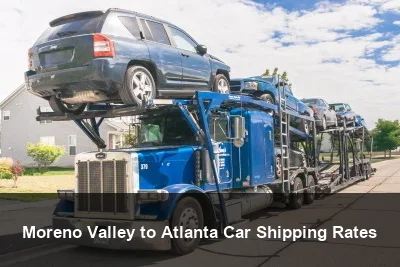
Moreno Valley to Atlanta Car Shipping Rates
At 1,870 miles, this route sits in the long-haul pricing tier where fuel costs carry significant weight. The I-10 desert crossing through Arizona and west Texas is high-mileage and fuel-intensive, so rate sensitivity to diesel prices is real on this corridor. Check how fuel affects your quote at https://california.auto-transport-shipping.com/articles/how-gas-prices-impact-california-auto-transport-fees.html. Summer demand spikes from May through August as PCS moves and student relocations peak simultaneously. Winter rates are generally softer, though weather delays through the Texas panhandle or along I-20 can add indirect costs.
What affects the cost of Moreno Valley to Atlanta car shipping:
- Vehicle type and size — larger vehicles take more carrier space; aftermarket additions like lift kits, oversized mirrors, or roof accessories can add fees
- Open vs. enclosed transport — open is lower cost with stronger carrier availability; enclosed protects against weather, debris, and road conditions
- Standard vs. expedited pickup — expedited prioritizes your vehicle for the next available dispatch, typically at a $100–$300 premium
- Time of year — peak demand seasons drive rates higher; off-peak windows offer the most competitive pricing
- Fuel costs — diesel prices affect carrier rates; longer routes are more sensitive to fuel price swings
- Vehicle condition — non-running vehicles require special loading equipment and cost more to ship
| Vehicle Type | Open Car Shipping (Est.) | Enclosed Car Shipping (Est.) |
|---|---|---|
| Sedan | $1,100 – $1,600 | $1,900 – $2,700 |
| SUV / Crossover | $1,300 – $1,900 | $2,200 – $3,100 |
| Pickup Truck | $1,300 – $1,950 | $2,200 – $3,150 |
| Minivan | $1,300 – $1,900 | $2,200 – $3,100 |
| Luxury / Classic Car | $1,550 – $2,200 | $2,600 – $3,600 |
| Non-Running Vehicle | Add $200–400 | Add $200–400 |
* Estimated ranges based on recent Moreno Valley to Atlanta shipments. Actual rate depends on vehicle, locations, booking date, and current fuel costs. Use the form on this page to compare real quotes from licensed carriers.
Open vs. Enclosed: What This Route Actually Requires
The I-10 corridor through the Sonoran Desert and west Texas exposes vehicles to road debris, blowing sand, and intense UV. For standard daily drivers, open transport handles this route fine — carriers run it constantly and the exposure risk is modest. Enclosed transport is the right call for exotics, classics, or vehicles with fresh paint or custom bodywork. The Arizona and New Mexico stretch in particular generates windshield chips on open loads occasionally. If your vehicle's value exceeds $60,000 or it's irreplaceable, the enclosed premium on this distance is worth it.
How Long Does Moreno Valley to Atlanta Car Shipping Take?
Standard transit from Moreno Valley to Atlanta runs 7 to 10 business days. Carriers departing the Inland Empire on I-10 eastbound cover the 1,870-mile route with mandatory rest stops and multi-vehicle coordination factored in. Carrier frequency out of Southern California on this corridor is high — you're not waiting weeks for a truck. First available pickup typically runs 1 to 3 business days after booking. If your timeline is compressed, expedited options exist: https://california.auto-transport-shipping.com/articles/california-expedited-car-shipping-fast-cost.html. Atlanta delivery staging is generally smooth given the market's carrier familiarity.
| Service Type | Typical Transit | Pickup Window | Best For |
|---|---|---|---|
| Open — Standard | 7–10 days | 2–5 business days | Best value; most common choice on this route |
| Open — Expedited | 5–7 days | 1–2 business days | Firm arrival date; faster dispatch window |
| Enclosed — Standard | 7–10 days | 4–8 business days | Luxury, classic, or modified vehicles |
| Enclosed — Expedited | 5–7 days | 2–4 business days | High-value vehicles on a firm delivery deadline |
** Summer thunderstorms through the Louisiana stretch of I-20 and Atlanta's own storm season can add 24 to 48 hours. Rare winter ice events across the Texas panhandle or I-20 through Mississippi occasionally force carrier holds. Build a 2-day buffer into your delivery window if your move-in date is firm.
Moreno Valley to Atlanta — Route & Logistics
Carriers access this route from Moreno Valley via SR-60 westbound to the I-10 interchange near Beaumont, California, or via I-215 north to I-10 east. The primary corridor runs I-10 east through Palm Springs, Phoenix, Tucson, El Paso, San Antonio, and Houston, then transitions to I-20 east through Shreveport, Jackson, Meridian, and into Atlanta. Total interstate distance is approximately 1,870 miles.
Key Corridor Waypoints
- Beaumont, CA — I-10 On-Ramp Junction Carriers from Moreno Valley merge onto I-10 eastbound near Beaumont at roughly 2,600 feet elevation. This is the formal start of the transcontinental run. The SR-60/I-10 interchange here connects Inland Empire pickup zones to the main eastbound freight corridor without touching downtown Los Angeles traffic.
- Phoenix, AZ — Carrier Staging Hub Phoenix sits approximately 370 miles east of the Beaumont junction and serves as the first major overnight and driver rest stop on this route. Carriers sometimes consolidate loads here from Arizona pickups. The metro's flat grid and abundant truck-accessible lots make it a reliable staging point. Elevation drops to roughly 1,100 feet.
- El Paso, TX — State Line and Inspection Point El Paso at approximately 3,800 feet is the Texas entry point and a common agricultural inspection checkpoint. Carriers confirm load integrity here and often refuel before the long west Texas stretch. I-10 continues east into San Antonio. This is the midpoint of the desert crossing and a standard carrier check-in location.
- San Antonio, TX — Route Junction San Antonio is where some carriers branch north toward I-20 via I-10 east or continue on the southern I-10 arc through Houston before meeting I-20 near Beaumont, Texas. The Houston routing adds mileage but offers more carrier consolidation opportunities. Most loads on this corridor take the Houston path before joining I-20 eastbound.
- Shreveport, LA — I-20 Corridor Midpoint Shreveport marks the Louisiana entry and the eastern midpoint of the I-20 run. Carriers often log their second overnight stop in the Shreveport area. The stretch east toward Jackson, Mississippi involves no significant elevation changes but can produce heavy rain and fog, particularly in fall and winter months.
- Atlanta, GA — Metro Delivery Zone Carriers enter Atlanta from the west on I-20 east, transitioning to I-285 for suburb deliveries or continuing into Midtown and Buckhead zones. Urban density within I-285 may require door-to-door coordination or staging at a nearby parking area. Carriers familiar with this market know which zip codes allow curbside delivery and which need alternatives.
Pickup & Delivery Access
- Pickup Access in Moreno Valley Moreno Valley's street grid is wide and carrier-friendly. Residential pickups in areas like TownGate, Sunnymead Ranch, and Moreno Valley Ranch work without issue for standard 10-car haulers. March Air Reserve Base personnel should coordinate pickup near the base's civilian-accessible perimeter. SR-60 frontage roads near the Day Street and Frederick Street corridors offer easy carrier pull-over access for load staging.
- Delivery Access in Atlanta Atlanta delivery access varies sharply by neighborhood. Buckhead, Midtown, and intown neighborhoods like Virginia-Highland have narrower residential streets that may require the driver to stage at a nearby parking lot or commercial area. Suburbs along I-285 — including Marietta, Smyrna, Dunwoody, and Alpharetta — accommodate large carriers without issue. Confirm your specific delivery address with the driver at booking to avoid day-of surprises.
- Nearby Pickup Locations Carriers picking up in Moreno Valley regularly extend service to Riverside, Perris, and Hemet. Call 1‑800‑590‑6492 to confirm door-to-door availability at your address.
Open vs. Enclosed Car Shipping: Moreno Valley to Atlanta
Both options use licensed, insured carriers and deliver door to door. For a full breakdown, read the pros and cons of open vs. enclosed car shipping.
Open Car Shipping
Most Popular- Lower cost — the practical choice for most vehicles
- More carriers available on this corridor
- Faster dispatch from booking to pickup
- Works well for sedans, SUVs, trucks, and minivans
- Vehicle rides on an open multi-car carrier
- Cargo insurance required on all licensed carriers
Estimated cost: $1,100 – $1,950
Enclosed Car Shipping
Premium Protection- Full protection from weather, debris, and road grime
- Best for luxury, exotic, and classic vehicles
- Recommended for low-clearance and custom-built cars
- Wheel-net or soft-tie systems prevent contact damage
- Higher cargo coverage — commonly $500,000 per load
- White-glove handling by experienced operators
Estimated cost: $1,900 – $3,150
Not sure which is right for your vehicle? Call 1-800-590-6492 and we'll point you in the right direction. Also worth reading: the top 10 questions to ask any car shipping company before you commit.
How to Prepare Your Car for Shipping to Atlanta
A little prep before pickup protects you if there's ever a dispute about your vehicle's condition. This checklist is from our full guide on preparing your car for transport:
- Remove all personal belongings from the interior and trunk
- Leave only a quarter tank of fuel — enough to load and unload
- Take date-stamped photos of the full exterior and interior
- Remove or disable toll transponders (FasTrak, E-ZPass, etc.)
- Retract or remove roof racks, spoilers, antennas, and bike mounts
- Make sure the battery is charged and tires are properly inflated
- Tell the carrier about any existing leaks or mechanical issues
- Deactivate the car alarm before the carrier arrives
- Write down the mileage on the Bill of Lading at pickup
- Fold in side mirrors if the vehicle is wider than standard
Personal items: Most carriers won't cover belongings left in the car. Read the full rules on shipping personal items in your vehicle. Also review our Bill of Lading guide so you know exactly what to check at pickup and delivery.
When to Ship Your Car from Moreno Valley to Atlanta
This corridor runs year-round, but pricing and timing shift with seasons. Peak demand hits May through August, driven by military PCS orders out of March Air Reserve Base, student relocations to Georgia's universities, and general summer moving volume. Rates soften in November through February, though winter weather events on the Texas and Mississippi stretch of I-20 can introduce delays. For a full picture of winter transport risks on southern routes, see: https://california.auto-transport-shipping.com/articles/auto-transport-challenges-during-the-winter.html
Spring PCS Season (March–May)
Military PCS orders tied to March Air Reserve Base in Moreno Valley spike in late March through May as service members receive summer assignments. This increases competition for eastbound carrier slots on the I-10/I-20 corridor. Book 2 to 3 weeks ahead during this window. Rates begin climbing in April as demand outpaces available carrier supply heading toward Georgia installations.
Summer Peak (June–August)
The busiest period on this route by volume. Student moves to Georgia Tech, Emory, and Georgia State combine with corporate relocations to Atlanta's large employer base. Desert heat through Arizona and west Texas is at its peak — open transport remains standard, but vehicle inspection at pickup should note any pre-existing heat-related wear. Book early and confirm pickup windows in writing.
Fall Shoulder Season (September–October)
Demand softens after the summer peak, and carrier availability improves. Rates typically drop 10 to 15 percent from summer highs. Weather along the full corridor is favorable — desert heat eases and the Gulf states are generally clear. This is a reliable window for a cost-effective, on-schedule shipment with minimal weather risk on either end.
Winter Caution (December–February)
Rates are at their lowest, but weather risk is real. Ice storms in north Texas and the I-20 corridor through Mississippi occasionally force carrier holds of 24 to 48 hours. The Moreno Valley and Atlanta ends of this route rarely see weather disruption, but the middle stretch carries genuine winter delay potential. Build schedule buffer and review risks at https://california.auto-transport-shipping.com/articles/auto-transport-challenges-during-the-winter.html
College Move-In (Late July–August)
Georgia's flagship universities — Georgia Tech, Emory, University of Georgia, and Georgia State — all open in late August. Students and families shipping vehicles from Southern California generate a concentrated demand surge in late July and early August. Carriers on this corridor fill quickly during this window. If you're a student or family shipping for a fall semester, book no later than early July.
How to Choose a Moreno Valley to Atlanta Car Shipping Company
Getting multiple quotes is step one — knowing what to look for in those quotes matters just as much. Our guide on how to select a car shipping company covers the full process. Here are the six things that matter most:
FMCSA Registration
Every carrier or broker must hold a valid MC number. Verify any company at FMCSA SAFER before you book.
Proof of Insurance
Ask for a current certificate of insurance. Open carriers typically carry $100,000–$250,000 per load; enclosed commonly $500,000 or more. Learn what auto transport insurance covers.
All-In Pricing
Your quote should be a final number with no fees added after booking. Know the difference between brokers and carriers and confirm what the quote covers before you agree.
Bill of Lading
A complete Bill of Lading is filled out at pickup and delivery. Our Bill of Lading guide explains what to check. Never sign an incomplete one.
Real Reviews
Check Google and the BBB. Look at how they handled complaints and damage claims — that tells you more than a five-star average from happy customers.
Route Experience
A carrier who runs Moreno Valley to Atlanta regularly knows that the I-10 interchange near Beaumont is a cleaner staging entry than trying to load in Riverside proper. They know the Phoenix overnight lots that accept wide loads without permits. They know the El Paso inspection routine and build it into their schedule. On the Atlanta end, experienced drivers know that Midtown deliveries on a Friday afternoon require a staging call — they'll park at a commercial lot off I-20 and coordinate last-mile rather than sitting in intown traffic. They know the Shreveport fuel pricing patterns and time their fill-ups accordingly. This route-specific operational knowledge is what separates a carrier who's run this pair fifty times from one positioning from a different corridor.
Moreno Valley to Atlanta Car Shipping — FAQ
How much does it cost to ship a car from Moreno Valley to Atlanta?
Shipping a standard sedan from Moreno Valley to Atlanta on an open carrier typically runs $1,050 to $1,400 depending on season, fuel prices, and how quickly you need pickup. SUVs and trucks run $1,150 to $1,550. Enclosed transport adds 40 to 60 percent over open rates on this distance. Summer peak months — June through August — and the spring PCS season around March Air Reserve Base push rates toward the top of those ranges. Winter months generally see softer pricing. Fuel costs on the 1,870-mile I-10/I-20 corridor are a meaningful rate component; see how diesel prices affect quotes at https://california.auto-transport-shipping.com/articles/how-gas-prices-impact-california-auto-transport-fees.html.
How long does Moreno Valley to Atlanta car shipping take?
Standard transit is 7 to 10 business days from first available pickup. Carriers departing the Inland Empire on I-10 eastbound cover the 1,870 miles with mandatory rest periods and multi-stop load coordination. First available pickup in Moreno Valley is typically 1 to 3 business days after booking confirmation. Atlanta is a high-volume destination market, so delivery scheduling is generally efficient once the carrier is in the metro. If your timeline is tight, expedited options can compress both pickup and transit windows — details at https://california.auto-transport-shipping.com/articles/california-expedited-car-shipping-fast-cost.html. Always build a 2-day buffer if your delivery date is tied to a move-in or lease start.
Is my car insured during transport from Moreno Valley to Atlanta?
Yes. Every carrier legally operating in the U.S. is required by FMCSA to carry cargo insurance, and that coverage applies to your vehicle while it's loaded on the truck for the full 1,870-mile run. Coverage limits vary by carrier, typically ranging from $100,000 to $250,000 per load. Before transport, photograph your vehicle thoroughly from all angles and note any existing damage on the Bill of Lading at pickup — this is your protection if a claim becomes necessary. For a full explanation of how transport insurance works, see https://california.auto-transport-shipping.com/articles/understanding-auto-transport-insurance.html. If damage does occur, the claims process is documented at https://california.auto-transport-shipping.com/articles/how-to-file-a-claim-for-vehicle-damage-during-transport.html.
Should I choose open or enclosed transport for this route?
Open transport is appropriate for the majority of vehicles on this corridor. The I-10 desert crossing through Arizona and west Texas does expose vehicles to road debris and blowing sand, but this is standard exposure that open carriers manage routinely on this route. Enclosed transport is the right choice if your vehicle is a classic, exotic, has custom paintwork, or has a replacement value above $60,000. The premium for enclosed on a 1,870-mile haul is meaningful but justified for high-value vehicles given the desert and I-20 stretch conditions. For a full comparison of both options, see https://california.auto-transport-shipping.com/articles/open-vs-enclosed-auto-transport-pros-and-cons.html.
Do I have to be present at pickup in Moreno Valley and delivery in Atlanta?
You or a designated representative must be present at both pickup and delivery to sign the Bill of Lading, which is the legal condition report for your vehicle. You don't have to be the registered owner — a trusted adult can sign on your behalf if you're already in Atlanta or traveling separately. This document is critical: any damage noted at delivery that wasn't on the pickup report is the basis for a cargo claim. Don't sign a blank or incomplete Bill of Lading. Full details on what this document covers and why it matters are at https://california.auto-transport-shipping.com/articles/california-auto-transport-bill-of-lading-information.html.
Does the desert section of this route pose any risk to my vehicle?
The I-10 corridor through the Sonoran Desert between Palm Springs and El Paso is the highest-risk stretch for road debris and windshield chips on open loads. Carriers run this section routinely, and most vehicles arrive without incident. That said, if your vehicle has a fresh windshield replacement or newly painted body panels, the enclosed carrier option eliminates this exposure entirely. Extreme summer heat does not damage vehicles in transport on open carriers — modern vehicles handle ambient heat well. Internally, don't leave items in the vehicle that can off-gas or expand in 110-degree temperatures during the Arizona crossing.
I'm doing a military PCS move from March Air Reserve Base. How does that affect my shipment?
Military PCS orders from March Air Reserve Base are one of the consistent demand drivers on this exact corridor, so carriers are familiar with the process. Your PCS orders don't change how the transport is booked, but military members are often eligible for reimbursement of vehicle shipping costs — confirm this with your installation's transportation office before booking. The spring PCS surge from March through May compresses carrier availability, so book 2 to 3 weeks ahead of your report date rather than the week before. We can coordinate pickup near the base perimeter for convenience. Bring your orders documentation as reference when coordinating with the carrier.
What weather should I expect to affect my shipment on the I-20 corridor in winter?
The I-20 stretch from east Texas through Mississippi and into Atlanta carries real winter weather risk, unlike the relatively stable I-10 desert section. Ice storms in north Texas and freezing rain events across Louisiana and Mississippi occur several times each winter and can force carrier holds of 24 to 48 hours. Atlanta itself occasionally experiences ice events that shut down surface streets temporarily. If you're shipping between December and February, build at least a 2-day buffer into your expected delivery window. Rates are lower in winter, which partially offsets the scheduling uncertainty. Review winter transport specifics at https://california.auto-transport-shipping.com/articles/auto-transport-challenges-during-the-winter.html.
Ready to Ship Your Car from Moreno Valley to Atlanta?
One form gets you up to 10 free quotes from licensed, insured carriers. Compare costs and transit times and book the best deal for your schedule.