

Los Angeles to Santa Ana Car Shipping Route
Los Angeles to Santa Ana covers approximately 35 miles, almost entirely via either I-5 South through the downtown LA interchange or I-405 South through the South Bay and into Orange County. Carriers typically pick up from any LA quadrant, merge onto I-405 near Inglewood or I-5 near downtown, and reach Santa Ana in under an hour of drive time under normal conditions. The route is flat, freeway-dominant, and well-lit, with no mountain grades or high-elevation segments. For a short move like this, auto transport still saves meaningful mileage and wear on your vehicle compared to driving it yourself — see the full breakdown at https://california.auto-transport-shipping.com/articles/benefits-of-auto-transport-service-vs-driving-yourself.html
Santa Ana anchors central Orange County and generates strong inbound transport demand from several sectors. Orange County Sheriff's Department headquarters, the Santa Ana Federal Building, and multiple state agency offices draw government employee relocations. Chapman University in adjacent Orange and Santa Ana College both generate student vehicle moves at semester start and end. Major employers including Western Digital's regional offices, Behr Process Corporation, and the large healthcare cluster around CHOC Children's and Fountain Valley Regional Hospital bring professional relocations consistently. Weather along this route is mild year-round, so no weather premiums typically apply, but the I-5 and I-405 interchange zones near downtown LA can cause carrier scheduling delays during peak commute hours. Before you book, review https://california.auto-transport-shipping.com/articles/auto-transport-mistakes-to-avoid.html to avoid common booking errors.
Los Angeles to Santa Ana Car Shipping Rates
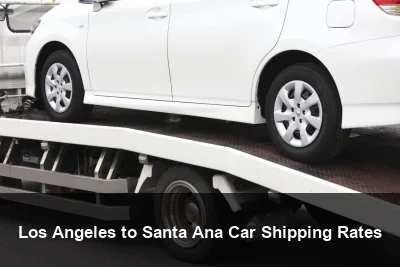
At 35 miles, this is a short-haul corridor, and rate-per-mile on short distances runs higher than on 500-plus-mile runs because carriers recover fixed costs over fewer miles. Expect base rates to reflect that dynamic. Demand stays relatively flat year-round given the route's mix of commercial, student, and residential traffic, though summer months see a modest spike tied to student and residential moves. Fuel costs on this short corridor are minimal, but any regional fuel price movement still flows through to quotes — see https://california.auto-transport-shipping.com/articles/how-gas-prices-impact-california-auto-transport-fees.html for context.
What affects the cost of Los Angeles to Santa Ana car shipping:
- Vehicle type and size — larger vehicles take more carrier space; aftermarket additions like lift kits, oversized mirrors, or roof accessories can add fees
- Open vs. enclosed transport — open is lower cost with stronger carrier availability; enclosed protects against weather, debris, and road conditions
- Standard vs. expedited pickup — expedited prioritizes your vehicle for the next available dispatch, typically at a $100–$300 premium
- Time of year — peak demand seasons drive rates higher; off-peak windows offer the most competitive pricing
- Fuel costs — diesel prices affect carrier rates; longer routes are more sensitive to fuel price swings
- Vehicle condition — non-running vehicles require special loading equipment and cost more to ship
| Vehicle Type | Open Car Shipping (Est.) | Enclosed Car Shipping (Est.) |
|---|---|---|
| Sedan | $350 – $500 | $700 – $950 |
| SUV / Crossover | $400 – $600 | $800 – $1,100 |
| Pickup Truck | $400 – $600 | $800 – $1,100 |
| Minivan | $400 – $600 | $800 – $1,100 |
| Luxury / Classic Car | $500 – $700 | $950 – $1,300 |
| Non-Running Vehicle | Add $100–200 | Add $100–200 |
* Estimated ranges based on recent Los Angeles to Santa Ana shipments. Actual rate depends on vehicle, locations, booking date, and current fuel costs. Use the form on this page to compare real quotes from licensed carriers.
Open vs. Enclosed on the LA to Santa Ana Run
Open transport is the right call for the overwhelming majority of vehicles on this route. The drive is short, freeway-controlled, and the weather is consistently dry. Road debris exposure is minimal on I-5 and I-405. Enclosed makes sense if you're moving a classic, a high-value exotic, or a freshly detailed show car where even minor dust accumulation matters. For a standard daily driver, crossover, or pickup truck, open transport is how most carriers run this corridor and the price difference rarely justifies the upgrade.
How Long Does Los Angeles to Santa Ana Car Shipping Take?
Standard transit on this route is one to two days from pickup confirmation to delivery. The driving distance is under 40 miles, so once a carrier is assigned and your vehicle is loaded, delivery to Santa Ana often happens same-day or the following morning. Carrier assignment is the variable — on a busy corridor like this, it typically takes 24 to 48 hours to match a truck. If you have a hard deadline, expedited options can compress that window significantly: https://california.auto-transport-shipping.com/articles/california-expedited-car-shipping-fast-cost.html
| Service Type | Typical Transit | Pickup Window | Best For |
|---|---|---|---|
| Open — Standard | 1–2 days | 1–3 business days | Best value; most common choice on this route |
| Open — Expedited | Same–1 day | Next day–1 business day | Firm arrival date; faster dispatch window |
| Enclosed — Standard | 2–3 days | 2–5 business days | Luxury, classic, or modified vehicles |
| Enclosed — Expedited | 1–2 days | 1–2 business days | High-value vehicles on a firm delivery deadline |
** The primary delay risk on this route is not weather but traffic logistics. The I-5 and I-405 interchange near downtown LA and the I-405/I-605 merge in the south can back up carriers during morning and evening commute windows, occasionally pushing a same-day delivery to the following morning.
Los Angeles to Santa Ana — Route & Logistics
Carriers depart LA on either I-5 South through downtown and past the East LA interchange, or I-405 South through the South Bay, merging onto I-5 at the El Toro Y near Lake Forest before reaching Santa Ana. Both approaches are freeway-continuous with no grade changes. The total haul is approximately 35 miles.
Key Corridor Waypoints
- Los Angeles, CA — Origin Staging Carriers pick up from all LA quadrants. Vehicles originating in West LA or the South Bay stage onto I-405 South near Inglewood. Downtown and East LA pickups access I-5 South directly. Wide street access exists across most of the city, though dense neighborhoods like Silver Lake or Echo Park may require a nearby parking lot meet point.
- Norwalk, CA — I-5 / I-605 Junction The I-5 and I-605 interchange in Norwalk is a key routing decision point. Carriers heading directly to central Santa Ana continue south on I-5. Those delivering to western Santa Ana or connecting to Costa Mesa may briefly use I-605 to reach I-405 South. The interchange runs smoothly outside peak hours but backs up during late afternoon commutes.
- Buena Park, CA — LA County / Orange County Line Crossing into Orange County near Buena Park marks the transition from LA County congestion patterns to Orange County freeway flow. Traffic volume on I-5 typically eases here outside of Disneyland-area event days. Carriers note the county line as a pace change and often make final delivery window calls from this point based on traffic conditions ahead.
- Anaheim, CA — I-5 / SR-57 Split Near Anaheim Stadium and the SR-57 junction, carriers targeting northern Santa Ana exit toward Bristol Street or First Street approaches. The SR-57 southbound option connects to central Orange County surface streets. This interchange is a regular staging reference for carriers managing multiple Orange County drops on a single run, with Santa Ana often the first or second stop.
- Santa Ana, CA — Delivery Zone Santa Ana's street grid is dense in its historic core near downtown and along Fourth Street. Residential neighborhoods north of McFadden Avenue and the areas near South Coast Metro generally allow 75-foot carrier access without issues. Narrower blocks near downtown or the Logan neighborhood may require a staging meet at a nearby commercial parking lot or wide street.
Pickup & Delivery Access
- Pickup Access in Los Angeles Los Angeles offers carrier-accessible streets across most neighborhoods. West LA, the South Bay, San Fernando Valley, and the SGV all have straightforward large-truck access. In denser areas — downtown LA, Silver Lake, Echo Park, or Koreatown — carriers typically request a meet point at a nearby shopping center, parking structure, or wide arterial to safely maneuver an 80-foot transport rig.
- Delivery Access in Santa Ana Most of Santa Ana is carrier-accessible via its wide arterial grid, including Bristol Street, Harbor Boulevard, and 17th Street. The historic downtown core and parts of the Logan and Artesia Pilar neighborhoods have narrower blocks that can restrict large carrier turns. In those areas, your driver will typically coordinate a nearby staging meet point, often a commercial lot on a main corridor, at no additional cost.
- Nearby Pickup Locations Carriers picking up in Los Angeles regularly extend service to Burbank, Glendale, Pasadena, El Monte, and Torrance. Call 1‑800‑590‑6492 to confirm door-to-door availability at your address.
Open vs. Enclosed Car Shipping: Los Angeles to Santa Ana
Both options use licensed, insured carriers and deliver door to door. For a full breakdown, read the pros and cons of open vs. enclosed car shipping.
Open Car Shipping
Most Popular- Lower cost — the practical choice for most vehicles
- More carriers available on this corridor
- Faster dispatch from booking to pickup
- Works well for sedans, SUVs, trucks, and minivans
- Vehicle rides on an open multi-car carrier
- Cargo insurance required on all licensed carriers
Estimated cost: $350 – $600
Enclosed Car Shipping
Premium Protection- Full protection from weather, debris, and road grime
- Best for luxury, exotic, and classic vehicles
- Recommended for low-clearance and custom-built cars
- Wheel-net or soft-tie systems prevent contact damage
- Higher cargo coverage — commonly $500,000 per load
- White-glove handling by experienced operators
Estimated cost: $700 – $1,100
Not sure which is right for your vehicle? Call 1-800-590-6492 and we'll point you in the right direction. Also worth reading: the top 10 questions to ask any car shipping company before you commit.
How to Prepare Your Car for Shipping to Santa Ana
A little prep before pickup protects you if there's ever a dispute about your vehicle's condition. This checklist is from our full guide on preparing your car for transport:
- Remove all personal belongings from the interior and trunk
- Leave only a quarter tank of fuel — enough to load and unload
- Take date-stamped photos of the full exterior and interior
- Remove or disable toll transponders (FasTrak, E-ZPass, etc.)
- Retract or remove roof racks, spoilers, antennas, and bike mounts
- Make sure the battery is charged and tires are properly inflated
- Tell the carrier about any existing leaks or mechanical issues
- Deactivate the car alarm before the carrier arrives
- Write down the mileage on the Bill of Lading at pickup
- Fold in side mirrors if the vehicle is wider than standard
Personal items: Most carriers won't cover belongings left in the car. Read the full rules on shipping personal items in your vehicle. Also review our Bill of Lading guide so you know exactly what to check at pickup and delivery.
When to Ship Your Car from Los Angeles to Santa Ana
This route runs steadily year-round with no true off-season. Summer brings a moderate volume spike driven by residential moves and student relocations tied to Chapman University, Santa Ana College, and nearby UC Irvine. Weather is not a pricing variable here — Southern California's dry climate means no winter weather premiums apply on this corridor. Booking two to three weeks out in June, July, and August is advisable to secure preferred pickup windows.
Student Move Season (May–June, Aug–Sep)
Chapman University in Orange, Santa Ana College, and UC Irvine nearby all drive student vehicle moves at semester transitions. May through June and late August through mid-September see the highest volume spikes on this corridor. Carriers fill quickly during these windows. If you're relocating for school or moving a student's vehicle, book at least two weeks ahead to avoid schedule compression and rate increases tied to peak demand.
Summer Peak (June–August)
Summer is the single busiest window on this route, driven by residential relocations, corporate transfers into Orange County's healthcare and tech sectors, and student moves. Rates tick up modestly as carrier capacity tightens. Transit times remain short given route frequency, but pickup wait times can stretch to three to four days if you book without lead time. Early June bookings consistently see better rates than mid-July.
Spring Corporate Transfer Window (Mar–May)
Spring brings a steady wave of professional relocations into the South Coast Metro employment corridor and Santa Ana's government and legal sectors. Volume is moderate but consistent. Rates are typically at their most competitive in March and April before summer demand builds. If your move date has flexibility, targeting late March through April can offer both good carrier availability and favorable pricing on this short-haul corridor.
Fall Shoulder Season (Oct–Nov)
October and November represent the quietest booking window on this route, with student moves complete and summer corporate transfers settled. Carrier availability is high and rates are at their seasonal low. If your move timeline allows flexibility into fall, this is the easiest window to secure a pickup within 24 to 48 hours of your preferred date with no premium pressure.
Winter Stability (Dec–Feb)
Unlike mountain or northern California routes, this corridor sees no meaningful weather disruption in winter. Demand dips slightly in December around the holidays but recovers in January with post-holiday corporate transfers and new-semester student arrivals. No winter weather surcharges apply. January can be a good booking window with moderate demand and stable pricing. Review https://california.auto-transport-shipping.com/articles/auto-transport-challenges-during-the-winter.html for general winter transport context.
How to Choose a Los Angeles to Santa Ana Car Shipping Company
Getting multiple quotes is step one — knowing what to look for in those quotes matters just as much. Our guide on how to select a car shipping company covers the full process. Here are the six things that matter most:
FMCSA Registration
Every carrier or broker must hold a valid MC number. Verify any company at FMCSA SAFER before you book.
Proof of Insurance
Ask for a current certificate of insurance. Open carriers typically carry $100,000–$250,000 per load; enclosed commonly $500,000 or more. Learn what auto transport insurance covers.
All-In Pricing
Your quote should be a final number with no fees added after booking. Know the difference between brokers and carriers and confirm what the quote covers before you agree.
Bill of Lading
A complete Bill of Lading is filled out at pickup and delivery. Our Bill of Lading guide explains what to check. Never sign an incomplete one.
Real Reviews
Check Google and the BBB. Look at how they handled complaints and damage claims — that tells you more than a five-star average from happy customers.
Route Experience
A carrier who regularly runs the LA to Santa Ana corridor knows that the I-5 and I-405 through downtown LA are manageable before 7 a.m. and after 7 p.m. but can add 45 to 90 minutes to a delivery window during peak commute hours. Experienced drivers on this run typically stage pickups in the late morning after the morning rush clears and target Santa Ana deliveries by mid-afternoon before the southbound I-5 backs up at the 22 Freeway junction. They also know that Santa Ana's Bristol Street and Main Street corridors offer reliable staging spots for final delivery coordination, and that the South Coast Metro cluster near the 405/73 interchange is carrier-truck-friendly with wide commercial lots for unloading. That route familiarity is what separates a clean same-day delivery from a next-morning reschedule.
Los Angeles to Santa Ana Car Shipping — FAQ
How much does it cost to ship a car from Los Angeles to Santa Ana?
On a 35-mile short-haul corridor like this, rates typically fall in the range of $200 to $375 for open transport on a standard passenger vehicle, depending on the time of year, vehicle size, and how quickly you need pickup. Short-haul routes carry a higher cost-per-mile than long-distance runs because carriers recover fixed operational costs across fewer miles. Enclosed transport adds a premium, generally 40 to 60 percent above open. Rates trend higher in summer and during semester-change windows in late August and early September. Use the quote form for a current market rate based on your exact vehicle and dates.
How long does Los Angeles to Santa Ana car shipping take?
Total time from booking to delivery is typically one to three days on this route. The drive itself is under 40 miles, so once a carrier is assigned and loaded, your vehicle can reach Santa Ana the same day or the following morning. Carrier assignment — the window between booking confirmation and a driver accepting your load — is usually 24 to 48 hours on this high-frequency corridor. If you have a firm delivery deadline, expedited booking options can reduce that assignment window. See https://california.auto-transport-shipping.com/articles/california-expedited-car-shipping-fast-cost.html for how expedited service works and what it costs.
Is my car insured during transport from Los Angeles to Santa Ana?
Yes. Every federally licensed carrier operating in the U.S. is required to carry cargo insurance, and that coverage applies to your vehicle while it is loaded on the truck. Before your vehicle is picked up, the driver will complete a Bill of Lading documenting its condition. Review that document carefully at pickup and again at delivery, noting any pre-existing damage. If damage occurs during transport, the carrier's cargo policy is the primary claim source. For a full explanation of coverage types and limits, see https://california.auto-transport-shipping.com/articles/understanding-auto-transport-insurance.html. If you ever need to file a claim, the process is outlined at https://california.auto-transport-shipping.com/articles/how-to-file-a-claim-for-vehicle-damage-during-transport.html
Should I choose open or enclosed transport for this route?
Open transport is the right choice for most vehicles on this corridor. The route is entirely freeway, distances are short, and Southern California weather poses no precipitation risk. Road debris exposure on I-5 and I-405 is typical for freeway driving and not elevated compared to other California routes. Enclosed transport makes practical sense if you're moving a collector car, a high-value exotic, or a vehicle where even minor cosmetic exposure would matter. For everyday drivers, SUVs, and trucks, the price premium for enclosed is difficult to justify on a 35-mile run. Full comparison at https://california.auto-transport-shipping.com/articles/open-vs-enclosed-auto-transport-pros-and-cons.html
Do I have to be present at pickup and delivery?
You do not have to be personally present, but someone over 18 must be available at both ends to sign the Bill of Lading, inspect the vehicle, and release or receive the keys. That person can be a family member, colleague, or any authorized representative you designate. This is important: the Bill of Lading is your legal record of the vehicle's condition at pickup and delivery. Make sure whoever handles the handoff takes photos and reads the form carefully before signing. Incomplete or unsigned Bills of Lading can complicate any future damage claims. Full details at https://california.auto-transport-shipping.com/articles/california-auto-transport-bill-of-lading-information.html
Are there any traffic or logistics delays I should plan for on this corridor?
The most consistent delay factor on the LA to Santa Ana route is not weather or distance — it's traffic timing on I-5 and I-405 through the LA basin. The downtown LA interchange and the I-405/I-605 merge in the south are reliably congested during morning and evening peak hours. Carriers experienced on this corridor typically time their runs to avoid those windows, targeting mid-morning or early evening departures. If your delivery window is same-day and the carrier hits unexpected congestion, a next-morning delivery is the most common outcome. Building a one-day buffer into your expected delivery window eliminates most scheduling stress.
Does shipping a car for a Chapman University or Santa Ana College student move make sense on such a short route?
Yes, and it's more practical than many people expect. Student moves to Santa Ana from the LA basin often involve a fully loaded car, a moving van, and one or two drivers already managing logistics. Shipping the vehicle separately removes one driver from that equation and ensures the car arrives without adding miles or wear during an already stressful move. On this corridor, costs are low enough that the convenience trade-off is straightforward. Late August and early September are the busiest windows, so booking two to three weeks before move-in day locks in both availability and better pricing before the semester-start surge hits.
Does this route have any considerations for government or military employees relocating to Santa Ana?
Santa Ana is home to Orange County's major government infrastructure, including the Orange County Sheriff's Department headquarters, the Ronald Reagan Federal Building and U.S. Courthouse, and multiple state and federal agency offices. Government and military employees receiving PCS or agency transfer orders to this area regularly use auto transport to move vehicles as part of a broader household goods shipment. If your move is government-sponsored, confirm with your transportation office what reimbursement documentation is required before booking. Most brokers can provide an itemized quote letter suitable for voucher submission. Book as early as your orders allow, since government move windows in spring and summer compete with peak residential demand.
Ready to Ship Your Car from Los Angeles to Santa Ana?
One form gets you up to 10 free quotes from licensed, insured carriers. Compare costs and transit times and book the best deal for your schedule.