
Hayward to Miami Car Shipping Route
Hayward sits at the intersection of I-880 and I-238, with SR-92 providing cross-bay access — all three feed directly into the regional freight network that carriers use to load vehicles bound for I-10 eastbound. From there, the route runs approximately 2,755 miles through Los Angeles, Phoenix, Tucson, El Paso, San Antonio, Houston, and across the Gulf Coast states before terminating in Miami. That's a cross-country haul most carriers complete in seven to ten days. Driving it yourself would mean four-plus days behind the wheel, fuel costs exceeding $400, and serious vehicle wear. See the full comparison at https://california.auto-transport-shipping.com/articles/benefits-of-auto-transport-service-vs-driving-yourself.html before deciding.
Miami's demand drivers are specific and measurable. Homestead Air Reserve Base, roughly 25 miles southwest of downtown, generates consistent military PCS moves on this corridor. The University of Miami in Coral Gables and Florida International University's multiple campuses create student-driven demand each August and May. Major employers including Baptist Health South Florida, Carnival Corporation, and Lennar Corporation attract executive relocations from the Bay Area. Weather on the I-10 corridor through Texas and Louisiana can introduce delays from April through October during Gulf storm season, and Florida's hurricane season runs June through November. Book early and avoid common mistakes: https://california.auto-transport-shipping.com/articles/auto-transport-mistakes-to-avoid.html
Hayward to Miami Car Shipping Rates
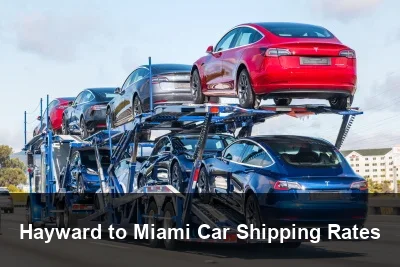
At 2,755 miles, this route sits firmly in the long-haul tier, where base rates typically range from $1,100 to $1,600 for a standard sedan on open transport. Seasonal demand spikes October through January as snowbirds drive prices up from the California side. Fuel costs along the I-10 corridor — particularly through Texas — affect carrier margins directly; see how gas prices factor into your quote at https://california.auto-transport-shipping.com/articles/how-gas-prices-impact-california-auto-transport-fees.html. Hurricane season in Florida can also tighten availability and push rates higher between August and October.
What affects the cost of Hayward to Miami car shipping:
- Vehicle type and size — larger vehicles take more carrier space; aftermarket additions like lift kits, oversized mirrors, or roof accessories can add fees
- Open vs. enclosed transport — open is lower cost with stronger carrier availability; enclosed protects against weather, debris, and road conditions
- Standard vs. expedited pickup — expedited prioritizes your vehicle for the next available dispatch, typically at a $100–$300 premium
- Time of year — peak demand seasons drive rates higher; off-peak windows offer the most competitive pricing
- Fuel costs — diesel prices affect carrier rates; longer routes are more sensitive to fuel price swings
- Vehicle condition — non-running vehicles require special loading equipment and cost more to ship
| Vehicle Type | Open Car Shipping (Est.) | Enclosed Car Shipping (Est.) |
|---|---|---|
| Sedan | $1,100 – $1,600 | $1,900 – $2,700 |
| SUV / Crossover | $1,300 – $1,900 | $2,200 – $3,100 |
| Pickup Truck | $1,300 – $1,950 | $2,200 – $3,150 |
| Minivan | $1,300 – $1,900 | $2,200 – $3,100 |
| Luxury / Classic Car | $1,550 – $2,200 | $2,600 – $3,600 |
| Non-Running Vehicle | Add $200–400 | Add $200–400 |
* Estimated ranges based on recent Hayward to Miami shipments. Actual rate depends on vehicle, locations, booking date, and current fuel costs. Use the form on this page to compare real quotes from licensed carriers.
Open or Enclosed: What This Specific Route Requires
Open transport is the right call for most vehicles on this corridor. I-10 through the desert Southwest is dry and well-maintained, and the Gulf Coast stretch, while occasionally wet, is not the kind of route that justifies a $400–$700 enclosed premium for a standard sedan or SUV. Enclosed transport makes sense if you're shipping a classic, exotic, or high-value vehicle through South Florida's salt-air environment, or if you're moving during hurricane season and want maximum protection. For a daily driver or late-model vehicle, open is reliable and cost-effective on this lane.
How Long Does Hayward to Miami Car Shipping Take?
Hayward to Miami runs seven to ten business days under normal conditions. Carriers on the I-880 corridor load regularly for Southern California, and once a truck clears the LA basin it's on I-10 for the long pull east. The 2,755-mile haul requires driver hours-of-service compliance, so figure three to four driving days minimum with mandatory rest. Dispatch from Hayward can take one to three days depending on season. If your timeline is firm, expedited options exist — see https://california.auto-transport-shipping.com/articles/california-expedited-car-shipping-fast-cost.html for what that costs on a long-haul route.
| Service Type | Typical Transit | Pickup Window | Best For |
|---|---|---|---|
| Open — Standard | 7–10 days | 2–5 business days | Best value; most common choice on this route |
| Open — Expedited | 5–7 days | 1–2 business days | Firm arrival date; faster dispatch window |
| Enclosed — Standard | 7–10 days | 4–8 business days | Luxury, classic, or modified vehicles |
| Enclosed — Expedited | 5–7 days | 2–4 business days | High-value vehicles on a firm delivery deadline |
** Gulf Coast weather between April and October is the primary delay risk. Tropical storms and hurricane activity can shut down I-10 segments in Louisiana, Mississippi, or Florida for 24 to 72 hours. Carriers will hold vehicles at staging points in Houston or Mobile rather than drive into a storm system. Budget an extra two to three days if you're shipping June through October.
Hayward to Miami — Route & Logistics
Carriers access this route from Hayward via I-880 southbound toward I-205 and I-5, or via SR-92 west to I-880 south. Most trucks staging for an I-10 eastbound run will consolidate loads in the Los Angeles basin near Ontario or Pomona before heading east. Total driving distance from Hayward to Miami via I-10 is approximately 2,755 miles.
Key Corridor Waypoints
- Los Angeles Basin, CA (Ontario/Pomona area) This is where most carriers consolidate East Bay pickups with loads from Southern California before heading east on I-10. The Ontario and Pomona terminals are common staging points. Carriers leaving Hayward typically arrive here within six to eight hours and may hold one day to fill the truck before continuing eastbound.
- Phoenix, AZ Phoenix sits roughly 370 miles east of LA and is a standard first overnight stop or driver changeover point. The I-10 and I-17 interchange here is a major logistics hub. Summer temperatures exceed 115°F in this corridor — open transport vehicles parked overnight at Phoenix staging yards can sit in extreme heat, which is worth noting if you're shipping a sensitive vehicle.
- El Paso, TX / Las Cruces, NM At the Texas state line, carriers cross into a new regulatory environment and hit the weigh stations on I-10 east of El Paso. This is roughly the midpoint of the haul. Some carriers use Las Cruces, NM as an overnight stop before crossing into Texas. The terrain here is high desert — elevation around 3,900 feet — before dropping back toward sea level heading into west Texas.
- San Antonio, TX San Antonio is a key hub on this corridor, sitting at the junction of I-10 and I-35. Carriers frequently top off fuel here and may pick up or drop off additional loads. It's also a natural second overnight point. Joint Base San Antonio — one of the largest military installations in the country — drives steady vehicle movement through this interchange year-round.
- Houston, TX Houston is the last major staging city before the Gulf Coast run into Louisiana and Mississippi. If a tropical storm or hurricane is active in the Gulf, carriers will hold here rather than proceed. Houston's I-610 loop and the interchange at I-10 and I-45 are heavily congested during peak hours — experienced carriers time their passage through before 6 AM or after 8 PM.
- Miami, FL Carriers enter South Florida on I-75 or the Florida Turnpike, merging toward Miami-Dade County. Urban density increases significantly once inside the I-836 corridor. Deliveries in Brickell, Downtown Miami, and Miami Beach often require staging in nearby lots due to narrow streets and restricted truck access. Homestead and South Miami suburban areas are generally easier for carrier access.
Pickup & Delivery Access
- Pickup Access in Hayward Hayward's street grid is fully accessible from I-880 via the Winton Avenue, A Street, and Industrial Parkway interchanges. Carriers running the East Bay corridor stop through Hayward regularly. Wide residential streets in the South Hayward and Tennyson Road corridors are truck-accessible. If your address has tight access, use a nearby commercial parking lot or shopping center as a meet point — this is common practice and adds no cost.
- Delivery Access in Miami Miami delivery access varies sharply by neighborhood. Suburban areas like Kendall, Hialeah, Doral, and Homestead are straightforward — wide streets, commercial staging options nearby. Brickell, Downtown Miami, and South Beach involve narrow streets, low clearances, and restricted loading zones. Carriers serving these dense areas often deliver to a nearby parking structure or staging lot. Confirm your delivery address access when booking so the carrier can plan accordingly.
- Nearby Pickup Locations Carriers picking up in Hayward regularly extend service to San Leandro, Castro Valley, and Union City. Call 1‑800‑590‑6492 to confirm door-to-door availability at your address.
Open vs. Enclosed Car Shipping: Hayward to Miami
Both options use licensed, insured carriers and deliver door to door. For a full breakdown, read the pros and cons of open vs. enclosed car shipping.
Open Car Shipping
Most Popular- Lower cost — the practical choice for most vehicles
- More carriers available on this corridor
- Faster dispatch from booking to pickup
- Works well for sedans, SUVs, trucks, and minivans
- Vehicle rides on an open multi-car carrier
- Cargo insurance required on all licensed carriers
Estimated cost: $1,100 – $1,950
Enclosed Car Shipping
Premium Protection- Full protection from weather, debris, and road grime
- Best for luxury, exotic, and classic vehicles
- Recommended for low-clearance and custom-built cars
- Wheel-net or soft-tie systems prevent contact damage
- Higher cargo coverage — commonly $500,000 per load
- White-glove handling by experienced operators
Estimated cost: $1,900 – $3,150
Not sure which is right for your vehicle? Call 1-800-590-6492 and we'll point you in the right direction. Also worth reading: the top 10 questions to ask any car shipping company before you commit.
How to Prepare Your Car for Shipping to Miami
A little prep before pickup protects you if there's ever a dispute about your vehicle's condition. This checklist is from our full guide on preparing your car for transport:
- Remove all personal belongings from the interior and trunk
- Leave only a quarter tank of fuel — enough to load and unload
- Take date-stamped photos of the full exterior and interior
- Remove or disable toll transponders (FasTrak, E-ZPass, etc.)
- Retract or remove roof racks, spoilers, antennas, and bike mounts
- Make sure the battery is charged and tires are properly inflated
- Tell the carrier about any existing leaks or mechanical issues
- Deactivate the car alarm before the carrier arrives
- Write down the mileage on the Bill of Lading at pickup
- Fold in side mirrors if the vehicle is wider than standard
Personal items: Most carriers won't cover belongings left in the car. Read the full rules on shipping personal items in your vehicle. Also review our Bill of Lading guide so you know exactly what to check at pickup and delivery.
When to Ship Your Car from Hayward to Miami
This corridor runs year-round, but pricing and availability shift measurably by season. The snowbird cycle from October through April drives the highest inbound-to-Florida demand, which benefits East Bay shippers with more carrier options and competitive rates heading east. Summer months see softer demand but introduce Gulf storm risk. Winter transport on this route is relatively mild compared to northern corridors — see https://california.auto-transport-shipping.com/articles/auto-transport-challenges-during-the-winter.html for context on how season affects your planning.
Spring Relocation Season (March–May)
Bay Area residents making end-of-fiscal-year relocations to Florida drive solid demand on this lane in spring. University of Miami and FIU students shipping vehicles home in May add to the outbound California load. Carrier availability from Hayward is good in this window and rates are typically stable. Book two to three weeks out to lock pricing before summer fuel volatility sets in.
Summer Heat Window (June–August)
Demand from California to Florida dips slightly in summer as fewer snowbirds are making the move. Rates can soften, but the I-10 corridor through Arizona and Texas hits extreme heat — Phoenix and El Paso staging areas regularly exceed 110°F. If you're shipping a classic or specialty vehicle, enclosed transport is worth considering in this window to avoid interior heat damage during overnight staging.
Hurricane Season Caution (June–November)
Florida's hurricane season overlaps with summer and fall. Active storm systems in the Gulf can delay final delivery by two to four days as carriers hold loads in Houston or Mobile. The risk is highest August through October. If your delivery window is firm, build buffer time into your schedule or consider booking with a two-week lead to avoid being caught mid-transit during a storm event.
Snowbird Peak Season (October–January)
This is the highest-demand window on the Hayward-to-Miami corridor. California retirees and part-year Florida residents move vehicles south in large numbers starting in October. Carrier availability from the East Bay is strong because trucks want to run this lane. Rates rise 10–20% above summer levels. Book three to four weeks in advance to secure your preferred pickup window and avoid dispatch delays.
Student Shipping Windows (August and December–January)
University of Miami and FIU draw students from Northern California who need vehicles shipped rather than driven across the country. The August back-to-school surge and January spring semester start both spike demand on this lane. If you're shipping for a student, book early — late August in particular sees compressed carrier availability as multiple long-haul routes compete for the same trucks out of the Bay Area.
Military PCS Cycles (Year-Round, Peak April–July)
Homestead Air Reserve Base south of Miami generates year-round military PCS moves, with the heaviest cycle running April through July when DOD transfer orders align with the school year. Military families shipping from Hayward — near NAS Alameda's former footprint and close to Travis AFB — find this a well-served lane. Confirm whether your orders qualify for government rate considerations when requesting your quote.
How to Choose a Hayward to Miami Car Shipping Company
Getting multiple quotes is step one — knowing what to look for in those quotes matters just as much. Our guide on how to select a car shipping company covers the full process. Here are the six things that matter most:
FMCSA Registration
Every carrier or broker must hold a valid MC number. Verify any company at FMCSA SAFER before you book.
Proof of Insurance
Ask for a current certificate of insurance. Open carriers typically carry $100,000–$250,000 per load; enclosed commonly $500,000 or more. Learn what auto transport insurance covers.
All-In Pricing
Your quote should be a final number with no fees added after booking. Know the difference between brokers and carriers and confirm what the quote covers before you agree.
Bill of Lading
A complete Bill of Lading is filled out at pickup and delivery. Our Bill of Lading guide explains what to check. Never sign an incomplete one.
Real Reviews
Check Google and the BBB. Look at how they handled complaints and damage claims — that tells you more than a five-star average from happy customers.
Route Experience
A carrier who runs Hayward to Miami regularly knows to time the LA basin passage before 6 AM to avoid I-10 congestion through the San Gabriel Valley. They know the Phoenix staging yards where loads consolidate in summer and which truck stops on I-10 east of El Paso have reliable overnight security. They know to monitor Gulf Coast weather through the NOAA storm center when running June through October, and to bypass New Orleans on the I-12 alternate when I-10 through the causeway is compromised. In Miami, experienced carriers know to route deliveries in Coral Gables and Brickell before 9 AM before urban congestion makes residential delivery impractical. That operational knowledge is the difference between a seven-day delivery and a ten-day one.
Hayward to Miami Car Shipping — FAQ
How much does it cost to ship a car from Hayward to Miami?
On this 2,755-mile corridor, open transport for a standard sedan typically runs $1,100 to $1,600 depending on season, fuel costs, and current carrier availability. SUVs and trucks run $100 to $250 more due to size and weight. Enclosed transport adds $400 to $700 to those figures. Rates are highest October through January during the snowbird season when demand from California to Florida peaks. Fuel surcharges on the I-10 corridor — particularly through Texas — can also push rates up during periods of elevated diesel prices. Get a current quote through the form on this page for live pricing based on your vehicle and pickup window.
How long does Hayward to Miami car shipping take?
Transit time on this route runs seven to ten business days under normal conditions. Carrier dispatch from Hayward typically takes one to three days depending on how quickly a truck with space on this lane is available in the East Bay. Once loaded, the 2,755-mile drive to Miami requires three to four days of actual driving time with federally mandated driver rest periods factored in. Weather delays on the Gulf Coast — particularly during hurricane season from June through November — can add one to three days. If you need guaranteed fast delivery, expedited options are available; see https://california.auto-transport-shipping.com/articles/california-expedited-car-shipping-fast-cost.html for what that looks like on a long-haul corridor like this one.
Is my car insured during transport from Hayward to Miami?
Every carrier licensed to operate in the U.S. is required by FMCSA regulations to carry cargo liability insurance. That coverage applies to your vehicle while it's on the carrier's truck from pickup in Hayward to delivery in Miami. Before your vehicle is loaded, you and the carrier will complete a Bill of Lading documenting the vehicle's existing condition — photograph everything beforehand. If damage occurs in transit, that document is your evidence for a claim. For a detailed breakdown of how coverage works and what it does and doesn't include, see https://california.auto-transport-shipping.com/articles/understanding-auto-transport-insurance.html. If you ever need to file a claim, the step-by-step process is at https://california.auto-transport-shipping.com/articles/how-to-file-a-claim-for-vehicle-damage-during-transport.html.
Should I choose open or enclosed transport for this route?
For most vehicles on the Hayward-to-Miami run, open transport is the practical choice. The I-10 corridor through the Southwest is dry, and while the Gulf Coast stretch can see rain, open carriers handle it routinely. Enclosed transport makes sense if you're shipping a classic car, luxury vehicle, or anything with a value above $80,000 — especially given South Florida's salt-air environment and the potential for storm-related road debris during hurricane season. If your vehicle is a daily driver or late-model sedan, the $400–$700 enclosed premium isn't warranted. For a full breakdown of both options, see https://california.auto-transport-shipping.com/articles/open-vs-enclosed-auto-transport-pros-and-cons.html.
Do I have to be present at pickup in Hayward and delivery in Miami?
You or an authorized representative must be present at both ends to sign the Bill of Lading — the condition report that documents your vehicle before loading and after delivery. You don't have to be the one physically present; a trusted adult — family member, friend, or property manager — can handle it on your behalf. Just make sure they know to do a thorough walkaround inspection and note any existing marks before signing at pickup, and again before signing at delivery in Miami. The Bill of Lading is your legal protection if a dispute arises. Learn more about what it covers at https://california.auto-transport-shipping.com/articles/california-auto-transport-bill-of-lading-information.html.
Does hurricane season in Florida affect my shipment timeline or cost?
Yes, on both counts. Florida's hurricane season runs June 1 through November 30, with the highest activity typically in August, September, and October. If a named storm is threatening the Gulf Coast or South Florida when your vehicle is in transit, carriers will hold loads at staging points in Houston or Mobile rather than drive into the storm's path. That can add two to four days to your transit time. Separately, demand volatility during storm season — when Florida residents sometimes evacuate vehicles westward — can tighten carrier availability on this lane and push rates higher. Book with buffer time and keep communication open with your dispatcher during this window.
Is the Hayward to Miami route busy enough to get good carrier availability?
Yes. This is one of the more active transcontinental corridors in the country. Snowbird demand, military PCS cycles through Homestead Air Reserve Base, student shipments to University of Miami and Florida International University, and general California-to-Florida relocation traffic all keep this lane populated with carriers year-round. Hayward's position on the I-880 corridor means carriers already running the East Bay for Bay Area freight pass through regularly. You're not waiting for a carrier to dead-head out to a rural pickup — trucks are in this market consistently. Availability tightens in October through December during peak snowbird season, so book three to four weeks ahead in that window.
Can I ship from Hayward if I'm near San Leandro, Castro Valley, or Union City?
Yes. San Leandro, Castro Valley, and Union City are all within the Hayward pickup zone and fully accessible to carriers running the I-880 corridor. San Leandro sits just north of Hayward on I-880 and is a straightforward pickup. Castro Valley is accessible via SR-238 connecting to I-880. Union City is south of Hayward on I-880 and is a regular stop for East Bay carriers. If your specific address has tight access — a narrow residential street or restricted driveway — coordinate a nearby meet point such as a shopping center parking lot, which carriers are accustomed to using at no extra charge.
Ready to Ship Your Car from Hayward to Miami?
One form gets you up to 10 free quotes from licensed, insured carriers. Compare costs and transit times and book the best deal for your schedule.