
Hayward to Mesa Car Shipping Route
The Hayward-to-Mesa route covers approximately 735 miles. Carriers access the corridor from Hayward via I-880 south toward Fremont, then connect to I-238 or SR-92 to reach I-680 or US-101, ultimately merging onto I-580 east to I-205 and I-5, or taking the more direct I-580 to I-205 to pick up I-10 east through the Inland Empire toward Arizona. Once on I-10, it's a straight desert run through Palm Springs, Blythe, and the Arizona border into the Phoenix metro. The drive would take a solo driver 10 to 11 hours minimum across harsh desert terrain. Shipping spares you that exposure — see the full breakdown at https://california.auto-transport-shipping.com/articles/benefits-of-auto-transport-service-vs-driving-yourself.html
Mesa's growth is driven by several large employers and institutions that consistently bring new residents from California. Boeing's Mesa facility supports defense manufacturing. Banner Health operates major hospitals drawing medical professionals. Eastmark and other master-planned communities attract Bay Area families. Mesa Community College and Arizona State University's Polytechnic campus generate student relocations every August and January. Williams Field area — formerly Williams Air Force Base — now supports Mesa Gateway Airport and adjacent aerospace employers, still drawing some military-adjacent personnel. Summer heat between Blythe and Phoenix can exceed 115°F, which affects vehicle conditions during loading and unloading. Before you book, review https://california.auto-transport-shipping.com/articles/auto-transport-mistakes-to-avoid.html to avoid common errors on desert corridor shipments.
Hayward to Mesa Car Shipping Rates
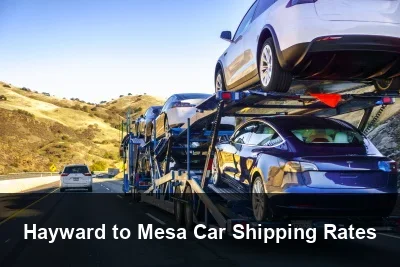
Rates on the Hayward-to-Mesa corridor are influenced by the 735-mile distance tier, seasonal snowbird demand in the October-through-April window, and fuel costs on the I-10 desert run. Summer heat doesn't reduce carrier availability, but it can tighten open-carrier scheduling on the Phoenix metro end. Diesel price swings affect this route noticeably — the I-10 corridor through the Inland Empire and desert has fewer fuel competition points than coastal routes. Check current fuel surcharge trends at https://california.auto-transport-shipping.com/articles/how-gas-prices-impact-california-auto-transport-fees.html before setting your budget.
What affects the cost of Hayward to Mesa car shipping:
- Vehicle type and size — larger vehicles take more carrier space; aftermarket additions like lift kits, oversized mirrors, or roof accessories can add fees
- Open vs. enclosed transport — open is lower cost with stronger carrier availability; enclosed protects against weather, debris, and road conditions
- Standard vs. expedited pickup — expedited prioritizes your vehicle for the next available dispatch, typically at a $100–$300 premium
- Time of year — peak demand seasons drive rates higher; off-peak windows offer the most competitive pricing
- Fuel costs — diesel prices affect carrier rates; longer routes are more sensitive to fuel price swings
- Vehicle condition — non-running vehicles require special loading equipment and cost more to ship
| Vehicle Type | Open Car Shipping (Est.) | Enclosed Car Shipping (Est.) |
|---|---|---|
| Sedan | $650 – $900 | $1,200 – $1,600 |
| SUV / Crossover | $800 – $1,050 | $1,400 – $1,850 |
| Pickup Truck | $800 – $1,050 | $1,400 – $1,850 |
| Minivan | $800 – $1,050 | $1,400 – $1,850 |
| Luxury / Classic Car | $900 – $1,200 | $1,500 – $2,000 |
| Non-Running Vehicle | Add $150–250 | Add $150–250 |
* Estimated ranges based on recent Hayward to Mesa shipments. Actual rate depends on vehicle, locations, booking date, and current fuel costs. Use the form on this page to compare real quotes from licensed carriers.
Open or Enclosed: What This Desert Route Actually Demands
Open transport is the right call for most standard vehicles on this route. The I-10 corridor is high-volume and well-served by open carriers, keeping rates lower and availability higher. The main environmental concern is blowing desert sand and road debris east of Blythe — minimal risk for daily drivers. Enclosed transport makes sense for classic cars, exotics, or vehicles with fresh paint that you don't want exposed to grit at highway speeds. If you're shipping a leased luxury vehicle or a collector car to Mesa, the enclosed premium on this route typically runs 40 to 60 percent above open rates.
How Long Does Hayward to Mesa Car Shipping Take?
Expect two to four days for Hayward-to-Mesa shipments under normal conditions. Carriers on the I-880 corridor run toward Phoenix multiple times weekly, so your load window from dispatch to pickup is typically one to two business days. The drive itself is just under 11 hours, meaning a carrier can realistically complete the leg in one long day or split it with a mandatory rest stop near Blythe or the Arizona border. Expedited booking can compress pickup to same-day or next-day — see https://california.auto-transport-shipping.com/articles/california-expedited-car-shipping-fast-cost.html for how that pricing works on this lane.
| Service Type | Typical Transit | Pickup Window | Best For |
|---|---|---|---|
| Open — Standard | 2–4 days | 2–4 business days | Best value; most common choice on this route |
| Open — Expedited | 1–2 days | 1–2 business days | Firm arrival date; faster dispatch window |
| Enclosed — Standard | 2–4 days | 3–6 business days | Luxury, classic, or modified vehicles |
| Enclosed — Expedited | 1–2 days | 1–3 business days | High-value vehicles on a firm delivery deadline |
** Summer temps above 110°F near Blythe and the Arizona border occasionally cause carriers to adjust departure timing to avoid midday heat exposure on open loads. A delay of one day is possible in July and August if the driver stages overnight. Winter fog in the Central Valley approaches is rare on the southern I-10 alignment but worth noting if pickup routes shift.
Hayward to Mesa — Route & Logistics
Carriers depart Hayward via I-880 south to I-238 or connect through SR-92 to build toward I-580 east. From there the route merges onto I-205 south to I-5 briefly, then transitions to I-10 east — the primary spine for the remaining 500-plus miles through the Inland Empire, Coachella Valley, Blythe, and straight into the Phoenix metro where Mesa sits on the east side.
Key Corridor Waypoints
- Hayward, CA — I-880 On-Ramp Zone Carriers stage pickup in Hayward's flatlands west of Mission Boulevard, near the industrial corridors off A Street and Hesperian Boulevard. The I-880 on-ramp at Whipple Road or Industrial Parkway gives carriers clean access south without navigating residential grid. Most pickups are coordinated in commercial or wide-street zones here to allow multi-car trailer maneuvering.
- Livermore, CA — I-580 / I-205 Junction This interchange at the base of the Altamont Pass is a key transition point. Carriers coming off I-580 east merge onto I-205 south before catching I-5 south toward the I-10 connection. Elevation at the Altamont summit reaches roughly 1,009 feet. Wind on this pass can affect open carriers with tall loads. No inspection station here, but weight stations nearby on I-5 are active.
- Palm Springs, CA — I-10 Mile Marker ~100 from AZ Border Palm Springs marks the midpoint of the desert run. Summer temperatures here routinely exceed 110°F from June through September. Carriers on open loads may time arrivals and departures around peak heat windows. The I-10 corridor is wide and well-patrolled through the Coachella Valley. Fuel stops at Desert Hot Springs or Cabazon are standard on this leg before the long Blythe run.
- Blythe, CA — California-Arizona Border Approach Blythe sits at the Colorado River crossing, elevation around 270 feet. This is the last major California services point. An agricultural inspection checkpoint operates east of Blythe on I-10 — carriers must stop, though auto transport trailers pass through quickly. Heat here in summer is severe. Some carriers use Blythe as an overnight or rest staging point before the final Arizona push.
- Buckeye / Goodyear, AZ — Phoenix Metro Entry I-10 enters the Phoenix metro west side through Buckeye and Goodyear. Traffic congestion increases here, especially during morning and afternoon peaks. Carriers serving multiple Phoenix-area drops may stage east of Loop 101 or 202. Mesa deliveries route east through the I-10 / US-60 split, keeping trucks out of downtown Phoenix and onto the East Valley arterials.
- Mesa, AZ — US-60 / Loop 202 Delivery Zone Mesa delivery access is generally straightforward. US-60 (Superstition Freeway) and Loop 202 (Santan and Red Mountain freeways) allow carrier access to most neighborhoods without navigating Phoenix city streets. Eastmark, Dobson Ranch, and Red Mountain areas are wide-street accessible. Older central Mesa neighborhoods near Main Street may require a staging point at a nearby parking lot for final positioning.
Pickup & Delivery Access
- Pickup Access in Hayward Hayward's industrial grid west of Mission Boulevard and along the I-880 frontage roads gives carriers the most practical pickup access. Wide commercial streets off Hesperian Boulevard, A Street, and Industrial Parkway handle multi-car trailers without the tight turns common in residential areas. If you're in the hills near Castro Valley, arrange a meet point at a flat commercial lot closer to the freeway.
- Delivery Access in Mesa Mesa is carrier-friendly for most ZIP codes. The US-60 and Loop 202 access points keep trucks out of Phoenix traffic. Most subdivisions in East Mesa and Eastmark have wide enough entry roads for standard open carriers. Older central Mesa streets near Main and Center can be tight — if your address is in that zone, a nearby big-box store parking lot works as a clean staging and handoff point.
- Nearby Pickup Locations Carriers picking up in Hayward regularly extend service to San Leandro, Castro Valley, and Union City. Call 1‑800‑590‑6492 to confirm door-to-door availability at your address.
Open vs. Enclosed Car Shipping: Hayward to Mesa
Both options use licensed, insured carriers and deliver door to door. For a full breakdown, read the pros and cons of open vs. enclosed car shipping.
Open Car Shipping
Most Popular- Lower cost — the practical choice for most vehicles
- More carriers available on this corridor
- Faster dispatch from booking to pickup
- Works well for sedans, SUVs, trucks, and minivans
- Vehicle rides on an open multi-car carrier
- Cargo insurance required on all licensed carriers
Estimated cost: $650 – $1,050
Enclosed Car Shipping
Premium Protection- Full protection from weather, debris, and road grime
- Best for luxury, exotic, and classic vehicles
- Recommended for low-clearance and custom-built cars
- Wheel-net or soft-tie systems prevent contact damage
- Higher cargo coverage — commonly $500,000 per load
- White-glove handling by experienced operators
Estimated cost: $1,200 – $1,850
Not sure which is right for your vehicle? Call 1-800-590-6492 and we'll point you in the right direction. Also worth reading: the top 10 questions to ask any car shipping company before you commit.
How to Prepare Your Car for Shipping to Mesa
A little prep before pickup protects you if there's ever a dispute about your vehicle's condition. This checklist is from our full guide on preparing your car for transport:
- Remove all personal belongings from the interior and trunk
- Leave only a quarter tank of fuel — enough to load and unload
- Take date-stamped photos of the full exterior and interior
- Remove or disable toll transponders (FasTrak, E-ZPass, etc.)
- Retract or remove roof racks, spoilers, antennas, and bike mounts
- Make sure the battery is charged and tires are properly inflated
- Tell the carrier about any existing leaks or mechanical issues
- Deactivate the car alarm before the carrier arrives
- Write down the mileage on the Bill of Lading at pickup
- Fold in side mirrors if the vehicle is wider than standard
Personal items: Most carriers won't cover belongings left in the car. Read the full rules on shipping personal items in your vehicle. Also review our Bill of Lading guide so you know exactly what to check at pickup and delivery.
When to Ship Your Car from Hayward to Mesa
This corridor has two clear demand peaks. October through April brings snowbird migration — Bay Area retirees and seasonal residents moving vehicles to Mesa for winter. June through August sees Bay Area-to-Phoenix relocation volume tied to job starts and school-year planning. Both windows compress carrier availability and push rates up 10 to 20 percent. Desert heat in summer does not reduce carrier frequency but can affect scheduling. See https://california.auto-transport-shipping.com/articles/auto-transport-challenges-during-the-winter.html for how winter weather on adjacent mountain routes can occasionally affect this corridor.
Snowbird Season (October – April)
This is the highest-demand window on the Hayward-to-Mesa route. Bay Area retirees and seasonal residents shift vehicles to Mesa for the mild Arizona winter. Carrier slots fill faster and rates climb 10 to 20 percent from October through December as trucks prioritize loads moving southwest. Book three to four weeks out if your move date falls in this window. Return loads in March and April are equally competitive — don't wait until the last week.
Summer Relocation Peak (June – August)
Bay Area tech workers and families with school-year start dates drive a secondary demand surge in June and July. Mesa's job market in aerospace, healthcare, and education pulls California residents on tight timelines. Heat on the I-10 corridor peaks during this window — temperatures between Blythe and Mesa routinely exceed 110°F. Open transport is still the standard choice, but carriers may schedule overnight legs through the desert. Book early; availability is tighter than most customers expect.
Student Move-In (Late July – Mid-August)
Arizona State University's Polytechnic campus in east Mesa and Mesa Community College both draw students from the Bay Area. The late-July through mid-August window sees a short but sharp spike in vehicles moving from Bay Area zip codes to Mesa and Chandler. One- to two-week advance booking is usually enough, but if your move date falls in the first two weeks of August, confirm carrier availability before assuming slots are open.
Spring Shoulder (March – May)
Snowbirds begin returning to California in March and April, reversing the load direction. Mesa-to-Hayward demand helps keep carrier pricing on the southbound leg competitive, but it also means carriers are watching both directions. May is generally the calmest month on this corridor — rates stabilize, availability improves, and desert temperatures are manageable. If you have flexibility on timing and want the best combination of price and transit predictability, May is the window to target.
Military PCS Cycles (May – July and October – December)
Phoenix-area military installations including Luke Air Force Base in Glendale and Goldwater Air National Guard Base generate PCS-related vehicle shipments that overlap with this corridor. Hayward-area military families connected to NAS Alameda history or Bay Area reserve units occasionally route vehicles through this lane. The May through July PCS window aligns with the summer relocation peak, making that period the most competitive for carrier availability. Book with confirmed orders in hand.
How to Choose a Hayward to Mesa Car Shipping Company
Getting multiple quotes is step one — knowing what to look for in those quotes matters just as much. Our guide on how to select a car shipping company covers the full process. Here are the six things that matter most:
FMCSA Registration
Every carrier or broker must hold a valid MC number. Verify any company at FMCSA SAFER before you book.
Proof of Insurance
Ask for a current certificate of insurance. Open carriers typically carry $100,000–$250,000 per load; enclosed commonly $500,000 or more. Learn what auto transport insurance covers.
All-In Pricing
Your quote should be a final number with no fees added after booking. Know the difference between brokers and carriers and confirm what the quote covers before you agree.
Bill of Lading
A complete Bill of Lading is filled out at pickup and delivery. Our Bill of Lading guide explains what to check. Never sign an incomplete one.
Real Reviews
Check Google and the BBB. Look at how they handled complaints and damage claims — that tells you more than a five-star average from happy customers.
Route Experience
A carrier who runs the Hayward-to-Mesa lane regularly knows that the I-880 pickup window between San Leandro and Fremont is most efficient between 7 and 10 AM before commuter traffic builds. They know the agricultural checkpoint east of Blythe on I-10 moves auto transport trailers through quickly — rarely more than a five-minute stop. They know to time the Blythe-to-Mesa leg to avoid arriving at Phoenix metro entry during the 7 to 9 AM or 4 to 6 PM congestion on I-10 west of Loop 101. They know Mesa delivery in Eastmark and Red Mountain is straightforward, but that older central Mesa near Main Street occasionally requires a parking lot staging stop before final positioning. That route knowledge is the difference between a two-day delivery and a three-and-a-half-day delivery.
Hayward to Mesa Car Shipping — FAQ
How much does it cost to ship a car from Hayward to Mesa?
Shipping a standard sedan from Hayward to Mesa on an open carrier typically runs between $650 and $950 depending on the time of year and how quickly you need pickup. SUVs and trucks run $750 to $1,100. Enclosed transport adds 40 to 60 percent to those figures. The snowbird window from October through April and the summer relocation surge in June and July both push rates toward the higher end. Booking two to three weeks out instead of last-minute will generally save you $75 to $150 on this route. Fill out the form for a locked rate tied to your specific vehicle and dates.
How long does Hayward to Mesa car shipping take?
Transit on this corridor typically runs two to four days from the time a carrier picks up your vehicle. The 735-mile drive is under 11 hours, so a carrier running a direct leg can complete it in one long driving day. In practice, most carriers on this route have multiple stops on both ends, which adds time. Pickup scheduling from Hayward to dispatch usually takes one to two business days. If you need faster movement, expedited options can compress that pickup window significantly — see https://california.auto-transport-shipping.com/articles/california-expedited-car-shipping-fast-cost.html for how expedited pricing works on this lane.
Is my car insured during transport from Hayward to Mesa?
Yes. Every licensed carrier operating on this route is federally required to carry cargo insurance. That coverage is active from the moment the driver signs the bill of lading at pickup in Hayward until delivery is completed in Mesa. Coverage limits vary by carrier — confirm the policy ceiling before you hand over keys. For vehicles valued above standard cargo limits, supplemental coverage is available. Document your vehicle's condition thoroughly with photos before pickup. If anything changes during transport, the bill of lading is your record. Full details at https://california.auto-transport-shipping.com/articles/understanding-auto-transport-insurance.html and https://california.auto-transport-shipping.com/articles/how-to-file-a-claim-for-vehicle-damage-during-transport.html
Should I choose open or enclosed transport for this route?
Open transport handles the vast majority of vehicles shipped on this corridor without issue. The primary environmental exposure on the I-10 desert run is blowing sand and road debris east of Blythe — a real but low-severity risk for standard vehicles. Enclosed transport is worth the premium if you're shipping a classic car, a freshly painted vehicle, an exotic, or a vehicle where cosmetic condition matters significantly. Summer heat does not meaningfully differentiate open from enclosed in terms of damage risk on this specific route. For a detailed comparison of both options, see https://california.auto-transport-shipping.com/articles/open-vs-enclosed-auto-transport-pros-and-cons.html
Do I have to be present at pickup and delivery?
You don't have to be present in person, but someone with authority to release or accept the vehicle needs to be available. A trusted third party — a family member, neighbor, or property manager — can handle the exchange as long as they can sign the bill of lading. The bill of lading documents your vehicle's condition at pickup and again at delivery; that document is critical if any dispute arises. Make sure whoever accepts delivery in Mesa inspects the vehicle and signs accurately before the driver leaves. Full explanation of the bill of lading process at https://california.auto-transport-shipping.com/articles/california-auto-transport-bill-of-lading-information.html
How does the desert heat between California and Arizona affect my vehicle during shipping?
Temperatures between Blythe and Mesa can exceed 115°F in June, July, and August. On an open carrier, your vehicle is exposed to that heat during the transit leg. For most modern vehicles this is not a problem — interior temperatures will spike if windows are closed, but no lasting damage occurs in a one-day transit. Do not leave anything heat-sensitive in the car: aerosol cans, medications, electronics, or items that warp or melt. Carriers may adjust departure timing to avoid peak heat hours, which can add a partial day to delivery. This is a normal operational adjustment, not a delay in the problematic sense.
When is the best time to book if I'm a snowbird moving to Mesa for winter?
If you're part of the October-through-April snowbird wave moving from the Bay Area to Mesa, book your transport four to six weeks before your target departure date. October and November are the heaviest booking months on this corridor, and carrier slots fill faster than most customers anticipate. Late September bookings for October delivery will get you the best combination of availability and rate. If you wait until two weeks out in October, you'll likely pay a premium and have less flexibility on pickup dates. The return leg in March and April has the same dynamic — book early.
Are there military PCS resources specific to the Phoenix area that affect this route's availability?
Luke Air Force Base in Glendale, Arizona and Goldwater Air National Guard Base near Florence generate military PCS moves that overlap with the California-to-Phoenix corridor. If you have PCS orders, your move timeline is usually fixed, which means booking as soon as orders are confirmed is critical — especially if your report date falls in the May-through-July or October-through-December PCS peak cycles. Military PCS moves on this corridor compete with snowbird and relocation volume during those windows. Some carriers offer military discount programs — confirm at booking. Your branch's transportation office may also have preferred vendor lists worth checking first.
Ready to Ship Your Car from Hayward to Mesa?
One form gets you up to 10 free quotes from licensed, insured carriers. Compare costs and transit times and book the best deal for your schedule.