

Chula Vista to Fort Worth Car Shipping Route
This route covers approximately 1,421 miles from Chula Vista to Fort Worth. Carriers typically access I-8 east from the South Bay grid via SR-54 or SR-125, merging into the San Diego freeway network before picking up I-10 east through the Coachella Valley and the Arizona border crossing at Blythe. From Phoenix, most carriers continue on I-10 to Tucson, then cut northeast on I-10 toward El Paso before transitioning to I-20 east into Texas. Fort Worth sits at the terminus of I-20 where it feeds into the DFW loop system. Driving this yourself means two-plus days behind the wheel, fuel costs, and wear on your vehicle — shipping removes all of that. See a full breakdown at https://california.auto-transport-shipping.com/articles/benefits-of-auto-transport-service-vs-driving-yourself.html.
Fort Worth's demand for inbound vehicles is anchored by several specific institutions. NAS JRB Fort Worth (formerly Carswell AFB) generates military PCS moves on a steady cycle, particularly in the spring and summer rotation window. Lockheed Martin's F-35 production campus employs thousands and draws relocating engineers and contractors from aerospace hubs including San Diego. TCU and Texas Wesleyan University bring seasonal student moves each August and January. The route crosses the Sonoran Desert and West Texas high plains, where summer heat regularly exceeds 110°F — relevant for vehicles with rubber seals, older paint, or stored interior items. Winter brings ice risk on the I-20 stretch through Abilene and Weatherford. Avoid the common mistakes that delay your shipment by reviewing https://california.auto-transport-shipping.com/articles/auto-transport-mistakes-to-avoid.html before you book.
Chula Vista to Fort Worth Car Shipping Rates
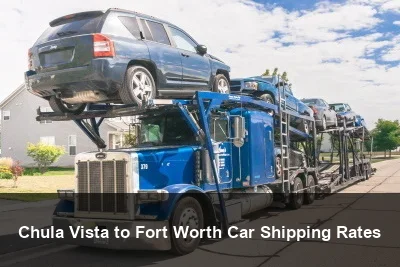
Rates on the Chula Vista–Fort Worth corridor are shaped by distance tier (1,400-plus miles places this in the long-haul pricing band), seasonal fuel costs across the desert Southwest, and directional demand balance. West-to-east loads from Southern California are plentiful, which moderates pricing compared to thinner corridors. Diesel prices between Blythe and El Paso directly affect carrier cost calculations — when fuel spikes, surcharges appear faster on desert routes than coastal ones. Review how fuel costs translate to your quote at https://california.auto-transport-shipping.com/articles/how-gas-prices-impact-california-auto-transport-fees.html.
What affects the cost of Chula Vista to Fort Worth car shipping:
- Vehicle type and size — larger vehicles take more carrier space; aftermarket additions like lift kits, oversized mirrors, or roof accessories can add fees
- Open vs. enclosed transport — open is lower cost with stronger carrier availability; enclosed protects against weather, debris, and road conditions
- Standard vs. expedited pickup — expedited prioritizes your vehicle for the next available dispatch, typically at a $100–$300 premium
- Time of year — peak demand seasons drive rates higher; off-peak windows offer the most competitive pricing
- Fuel costs — diesel prices affect carrier rates; longer routes are more sensitive to fuel price swings
- Vehicle condition — non-running vehicles require special loading equipment and cost more to ship
| Vehicle Type | Open Car Shipping (Est.) | Enclosed Car Shipping (Est.) |
|---|---|---|
| Sedan | $950 – $1,350 | $1,700 – $2,300 |
| SUV / Crossover | $1,100 – $1,600 | $1,950 – $2,700 |
| Pickup Truck | $1,100 – $1,650 | $1,950 – $2,750 |
| Minivan | $1,100 – $1,600 | $1,950 – $2,700 |
| Luxury / Classic Car | $1,300 – $1,900 | $2,200 – $3,000 |
| Non-Running Vehicle | Add $200–350 | Add $200–350 |
* Estimated ranges based on recent Chula Vista to Fort Worth shipments. Actual rate depends on vehicle, locations, booking date, and current fuel costs. Use the form on this page to compare real quotes from licensed carriers.
Open vs. Enclosed: What This Desert Route Actually Demands
Open transport is the right call for most standard vehicles on this corridor. The route does not cross alpine passes or significant snow zones under normal conditions. The main environmental exposure is desert heat and road debris on I-10 through Arizona and West Texas — manageable risk for daily drivers. Enclosed shipping makes sense if you're moving a classic, a high-value sports car, or a vehicle with fresh paint. The price premium for enclosed on a 1,421-mile run is real, so match the carrier type to actual risk, not general anxiety.
How Long Does Chula Vista to Fort Worth Car Shipping Take?
Standard transit from Chula Vista to Fort Worth runs 4 to 7 days under normal conditions. Carrier frequency out of the San Diego metro is high, so terminal dwell time before pickup is typically short — often 1 to 2 business days after booking confirmation. The driving distance for the carrier is manageable within federal HOS (hours of service) rules over 3 to 4 driving days. If your schedule is inflexible, expedited options exist but carry a meaningful price premium on a long-haul run. See what expedited shipping actually costs and when it's worth it: https://california.auto-transport-shipping.com/articles/california-expedited-car-shipping-fast-cost.html.
| Service Type | Typical Transit | Pickup Window | Best For |
|---|---|---|---|
| Open — Standard | 4–6 days | 2–5 business days | Best value; most common choice on this route |
| Open — Expedited | 2–4 days | 1–2 business days | Firm arrival date; faster dispatch window |
| Enclosed — Standard | 4–6 days | 3–7 business days | Luxury, classic, or modified vehicles |
| Enclosed — Expedited | 2–4 days | 1–3 business days | High-value vehicles on a firm delivery deadline |
** Summer heat closures or chain control events are rare on this specific route, but winter ice on I-20 between Abilene and Fort Worth can add 12 to 24 hours in January and February. Border inspection volume at the California agricultural checkpoint near Yuma can also create brief staging delays during peak produce season.
Chula Vista to Fort Worth — Route & Logistics
Carriers leave Chula Vista via SR-54 or SR-125 to access I-8 east, the primary on-ramp to the Southern California desert corridor. I-8 connects to I-10 near Casa Grande, Arizona. From there it's I-10 through Tucson and El Paso, then I-20 east through Midland, Odessa, Abilene, and into the Fort Worth metro. Total carrier driving distance is approximately 1,421 miles.
Key Corridor Waypoints
- El Centro, CA First significant staging point east of San Diego on I-8, roughly 90 miles from Chula Vista. Carriers often refuel here before crossing into the Imperial Valley. Agricultural inspection checkpoint just west of the Arizona border checks for produce and plant material. No significant elevation — El Centro sits 12 feet below sea level, the lowest city in the United States.
- Phoenix, AZ (I-10 / I-17 Junction) Major interchange where I-10 intersects I-17 and the Loop 101 beltway. Phoenix is the largest staging city between San Diego and El Paso and a common overnight or driver-change point for carriers on long-haul runs. Temperatures here regularly exceed 115°F in July and August, making this a heat-exposure milestone for open-transport vehicles.
- Tucson, AZ (I-10 / I-19 Junction) Second major Arizona city on route. Carriers pass through Tucson approximately 115 miles south of Phoenix. The stretch of I-10 east of Tucson climbs through the Dragoon Mountains before descending into the Chihuahuan Desert toward the New Mexico border. Elevation near Steins Pass reaches roughly 4,500 feet — the route's highest consistent elevation band.
- El Paso, TX / Las Cruces, NM The Texas entry point and a major carrier waypoint where I-10 crosses into West Texas. Many carriers refuel and log rest time here. El Paso–Las Cruces is also where I-10 briefly dips into New Mexico before returning to Texas. Border patrol checkpoints operate on eastbound I-10 near Sierra Blanca, approximately 80 miles east of El Paso.
- Midland–Odessa, TX (I-20 Corridor) The Permian Basin stretch of I-20 is flat, open, and heavily traveled by oilfield trucks — a road-debris hazard for open-transport loads. Carriers watch for truck tire debris and wind-blown material on this segment. Distance from El Paso to Midland is roughly 300 miles, making it a natural second overnight or fuel stop for carriers managing HOS compliance.
- Fort Worth, TX (I-20 / I-30 / I-35W Junction) Fort Worth is where I-20 terminates and feeds into I-30 and I-35W. Carriers delivering to the west side of the city — near NAS JRB Fort Worth or the Lockheed Martin campus — can exit before reaching downtown congestion. Deliveries to TCU-area addresses or the Near Southside neighborhood may require street-level coordination due to narrower residential access.
Pickup & Delivery Access
- Pickup Access in Chula Vista Chula Vista's South Bay street grid is carrier-accessible across most neighborhoods. SR-54 and SR-125 give direct access to the freeway network from the H Street, Broadway, and Third Avenue corridors. Carriers may decline to navigate dead-end streets near the Otay border crossing zone. If your street has limited turning radius or overhead clearance, arrange to meet the carrier at a nearby commercial lot or park-and-ride.
- Delivery Access in Fort Worth Most Fort Worth neighborhoods accommodate standard open transport carriers. The Alliance corridor in north Fort Worth and the area near Lockheed Martin's plant off Highway 183 have wide industrial streets ideal for carrier staging. Downtown and the Near Southside have narrower lanes and parking restrictions. Carriers delivering to TCU-adjacent addresses may stage at a nearby shopping center on University Drive and walk paperwork to you.
- Nearby Pickup Locations Carriers picking up in Chula Vista regularly extend service to National City, Bonita, and Eastlake. Call 1‑800‑590‑6492 to confirm door-to-door availability at your address.
Open vs. Enclosed Car Shipping: Chula Vista to Fort Worth
Both options use licensed, insured carriers and deliver door to door. For a full breakdown, read the pros and cons of open vs. enclosed car shipping.
Open Car Shipping
Most Popular- Lower cost — the practical choice for most vehicles
- More carriers available on this corridor
- Faster dispatch from booking to pickup
- Works well for sedans, SUVs, trucks, and minivans
- Vehicle rides on an open multi-car carrier
- Cargo insurance required on all licensed carriers
Estimated cost: $950 – $1,650
Enclosed Car Shipping
Premium Protection- Full protection from weather, debris, and road grime
- Best for luxury, exotic, and classic vehicles
- Recommended for low-clearance and custom-built cars
- Wheel-net or soft-tie systems prevent contact damage
- Higher cargo coverage — commonly $500,000 per load
- White-glove handling by experienced operators
Estimated cost: $1,700 – $2,750
Not sure which is right for your vehicle? Call 1-800-590-6492 and we'll point you in the right direction. Also worth reading: the top 10 questions to ask any car shipping company before you commit.
How to Prepare Your Car for Shipping to Fort Worth
A little prep before pickup protects you if there's ever a dispute about your vehicle's condition. This checklist is from our full guide on preparing your car for transport:
- Remove all personal belongings from the interior and trunk
- Leave only a quarter tank of fuel — enough to load and unload
- Take date-stamped photos of the full exterior and interior
- Remove or disable toll transponders (FasTrak, E-ZPass, etc.)
- Retract or remove roof racks, spoilers, antennas, and bike mounts
- Make sure the battery is charged and tires are properly inflated
- Tell the carrier about any existing leaks or mechanical issues
- Deactivate the car alarm before the carrier arrives
- Write down the mileage on the Bill of Lading at pickup
- Fold in side mirrors if the vehicle is wider than standard
Personal items: Most carriers won't cover belongings left in the car. Read the full rules on shipping personal items in your vehicle. Also review our Bill of Lading guide so you know exactly what to check at pickup and delivery.
When to Ship Your Car from Chula Vista to Fort Worth
This corridor runs year-round but shows clear pricing and timing patterns tied to military PCS cycles, desert heat, and Texas winter ice. Spring (March–May) and early summer (June–July) are the busiest booking windows due to military rotation season and college moves — expect tighter carrier availability and higher rates. Fall is generally the most cost-efficient window. Winter is operationally smooth on the desert segment but carries ice risk near Fort Worth. Read about winter-specific transport challenges at https://california.auto-transport-shipping.com/articles/auto-transport-challenges-during-the-winter.html.
Military PCS Season (March–July)
NAS JRB Fort Worth and Naval Base San Diego both run heavy PCS cycles from March through July. This is the single largest demand driver on this specific corridor. Carriers fill quickly with military moves, and rates reflect that competition. If you have orders in hand, book your transport as soon as your report date is confirmed — waiting until June means competing with hundreds of other service members for the same carrier slots.
Summer Heat Window (June–September)
Carrier availability is high in summer because demand is strong, but the I-10 corridor through Arizona and West Texas presents real heat exposure for vehicles in open transport. Interior temperatures in a parked open-transport carrier can exceed 140°F during Arizona midday. If your vehicle has a degraded cooling system, cracked dashboard, or heat-sensitive modifications, summer is the strongest argument for enclosed shipping on this route.
Fall Cost Window (September–November)
After the summer PCS rush and before winter holidays, this corridor sees reduced demand and more competitive rates. Weather is favorable — desert heat has moderated, and winter ice on I-20 hasn't started. If your timing is flexible, fall is the optimal booking window for price and carrier availability. Lead times are shorter, and carriers are more willing to negotiate on pickup dates.
Winter Ice Risk (December–February)
The desert segment of this route rarely sees winter disruption, but I-20 between Abilene and Fort Worth is susceptible to ice storms in January and February. Texas infrastructure handles ice poorly compared to northern states, and carriers may hold vehicles at Midland or Abilene staging for 24 to 48 hours during a freeze event. Budget an extra day or two into your delivery window if you're shipping in midwinter.
Student Move Season (August and January)
TCU and Texas Wesleyan pull in students from California each fall and spring semester. August sees the heaviest outbound volume from Southern California toward Fort Worth. January is smaller but still creates a secondary demand spike. If you're a student or parent shipping a vehicle for the school year, booking two to three weeks ahead of move-in dates gives you the best chance at a competitive rate and your preferred pickup window.
How to Choose a Chula Vista to Fort Worth Car Shipping Company
Getting multiple quotes is step one — knowing what to look for in those quotes matters just as much. Our guide on how to select a car shipping company covers the full process. Here are the six things that matter most:
FMCSA Registration
Every carrier or broker must hold a valid MC number. Verify any company at FMCSA SAFER before you book.
Proof of Insurance
Ask for a current certificate of insurance. Open carriers typically carry $100,000–$250,000 per load; enclosed commonly $500,000 or more. Learn what auto transport insurance covers.
All-In Pricing
Your quote should be a final number with no fees added after booking. Know the difference between brokers and carriers and confirm what the quote covers before you agree.
Bill of Lading
A complete Bill of Lading is filled out at pickup and delivery. Our Bill of Lading guide explains what to check. Never sign an incomplete one.
Real Reviews
Check Google and the BBB. Look at how they handled complaints and damage claims — that tells you more than a five-star average from happy customers.
Route Experience
A carrier who runs Chula Vista to Fort Worth regularly knows that the California agricultural checkpoint at the Yuma I-8 crossing can back up for 20 to 30 minutes during peak morning hours — not a major delay but a scheduling factor. They know that the I-10 rest stop near Desert Center, CA is a reliable fuel and rest point before crossing into Arizona. They've learned that the border patrol checkpoint east of El Paso on I-10 near Sierra Blanca is a mandatory stop that can add 15 to 45 minutes depending on traffic volume. They also know to contact Fort Worth delivery recipients before crossing into the DFW metro to coordinate, because afternoon traffic on I-20 approaching the I-35W interchange is consistently congested between 4 and 7 PM. This route-level knowledge is what separates an experienced corridor carrier from one deadheading east for the first time.
Chula Vista to Fort Worth Car Shipping — FAQ
How much does it cost to ship a car from Chula Vista to Fort Worth?
Shipping a standard sedan from Chula Vista to Fort Worth on an open carrier typically runs between $950 and $1,350 depending on the time of year, fuel prices, and how quickly you need pickup. SUVs and trucks run $1,050 to $1,500 due to size and weight. Enclosed transport adds $400 to $700 to those figures. Rates peak during military PCS season (March through July) when carrier space tightens. The most accurate number comes from a live quote based on your vehicle, dates, and current fuel costs — the rate table on this page reflects current corridor pricing.
How long does Chula Vista to Fort Worth car shipping take?
Standard transit on this 1,421-mile route runs 4 to 7 days from pickup to delivery. Carrier pickup in Chula Vista typically happens within 1 to 3 business days of booking confirmation, given the depth of the San Diego carrier pool. The driving portion takes 3 to 4 days for a carrier managing federal hours-of-service limits. Add a day in winter if I-20 near Fort Worth has ice. If you need guaranteed faster delivery, expedited options exist — review what they cost and when they're worth it at https://california.auto-transport-shipping.com/articles/california-expedited-car-shipping-fast-cost.html.
Is my car insured during transport from Chula Vista to Fort Worth?
Every licensed carrier operating on this route is required by federal law to carry cargo insurance covering your vehicle during transport. That coverage is active from the moment the carrier loads your vehicle to the moment it's delivered. Before you sign the bill of lading at pickup, document your vehicle's existing condition with timestamped photos — this is your baseline if a damage claim becomes necessary. For a full explanation of what carrier insurance covers and what it doesn't, read https://california.auto-transport-shipping.com/articles/understanding-auto-transport-insurance.html. If you ever need to file a claim, the process is outlined at https://california.auto-transport-shipping.com/articles/how-to-file-a-claim-for-vehicle-damage-during-transport.html.
Should I choose open or enclosed transport for this route?
Open transport is appropriate for most vehicles on this corridor. The route does not cross significant snow zones under normal operating conditions, and open-carrier road debris risk is comparable to any long-haul interstate run. The main environmental exposure is desert heat and the occasional gravel or tire debris on the I-20 Permian Basin stretch. Enclosed makes sense for classic cars, exotics, vehicles with fresh paint or extensive bodywork, or any car where the replacement cost of even minor cosmetic damage exceeds the enclosed price premium. Full comparison of both options is at https://california.auto-transport-shipping.com/articles/open-vs-enclosed-auto-transport-pros-and-cons.html.
Do I have to be present at pickup in Chula Vista and delivery in Fort Worth?
You don't have to be present personally, but someone who is legally authorized to release or accept the vehicle does need to be there. That can be a family member, friend, or building manager — whoever signs the bill of lading on your behalf takes responsibility for confirming the vehicle's condition at that moment. At pickup, that person should walk the vehicle with the driver and confirm every existing mark, dent, or scratch is noted on the bill of lading before signing. At delivery, they should do the same inspection before releasing the driver. Understand what the bill of lading means for your shipment at https://california.auto-transport-shipping.com/articles/california-auto-transport-bill-of-lading-information.html.
I'm a military member PCSing to NAS JRB Fort Worth — what should I know about this route?
PCS shipments from the San Diego area to Fort Worth are among the most common moves on this corridor, and carriers know it well. Your military orders document is helpful when booking because some brokers and carriers offer dedicated military pricing. Book as early as your orders allow — March through July is peak PCS season, and carrier space from San Diego tightens fast. Your vehicle counts toward your POV shipment allowance through the military, but if you're using a private carrier rather than the government system, make sure your out-of-pocket costs are documented for reimbursement purposes. Build at least a 5-day delivery window into your report date planning.
Does the desert heat on this route damage vehicles in open transport?
Desert heat exposure during transit is a real consideration on the I-10 corridor through Arizona and West Texas. Interior temperatures inside a vehicle sitting on an open carrier in direct Arizona sun can reach extreme levels during July and August. This matters most for older rubber seals, cracked dashboards, vinyl interiors, and any aerosol cans or heat-sensitive items left inside. Remove all personal items that are heat-sensitive before shipping. If your vehicle has existing paint or seal vulnerabilities, summer is the time to weigh enclosed transport more seriously. For standard vehicles in good condition, open transport on this route in summer is widely used without issue.
Are there border patrol or agricultural checkpoints that could delay my shipment on this route?
Yes, two checkpoints are standard on this corridor. The California Department of Food and Agriculture operates an inspection station on I-8 near the Arizona border — carriers are checked for produce and plant material but vehicle transport loads move through without significant inspection delay under normal conditions. The larger variable is the US Border Patrol checkpoint on I-10 near Sierra Blanca, Texas, approximately 80 miles east of El Paso. This is a mandatory stop for all eastbound traffic and can add 15 to 45 minutes depending on traffic volume and staffing. Neither checkpoint typically causes multi-hour delays, but both are factored into carrier scheduling on this run.
Ready to Ship Your Car from Chula Vista to Fort Worth?
One form gets you up to 10 free quotes from licensed, insured carriers. Compare costs and transit times and book the best deal for your schedule.