

Chula Vista to Boston Car Shipping Route
Chula Vista sits at the southern end of the San Diego metro, roughly 3,117 miles from Boston by road. Carriers access the South Bay grid via I-5 heading north toward downtown San Diego or via SR-125 connecting to SR-54, which feeds into the broader freeway network. From there, most loads move east on I-8 to I-10, then northeast through the Sun Belt before picking up I-40 or I-70 toward the Eastern Seaboard, merging eventually onto I-90 or I-95 into Boston. Driving this yourself would mean 45–50 hours behind the wheel across multiple days. Shipping saves that time, mileage wear, and lodging costs. See why transport beats driving at https://california.auto-transport-shipping.com/articles/benefits-of-auto-transport-service-vs-driving-yourself.html
Boston's demand drivers run deep. Joint Base Cape Cod and Hanscom Air Force Base generate military PCS moves that keep carriers interested in the market regardless of season. Harvard University, MIT, Boston College, and Tufts University produce a predictable student-vehicle cycle in late summer and mid-January. Major employers including Raytheon Technologies, Mass General Brigham, Fidelity Investments, and State Street Corporation bring steady professional relocation traffic. On the weather side, winter on this corridor is a real variable — I-40 and I-70 cross high-elevation stretches in New Mexico, Oklahoma, and the Appalachians, and January through March can introduce snow delays. Book early and plan buffer days in winter. Before you finalize details, read https://california.auto-transport-shipping.com/articles/auto-transport-mistakes-to-avoid.html
Chula Vista to Boston Car Shipping Rates
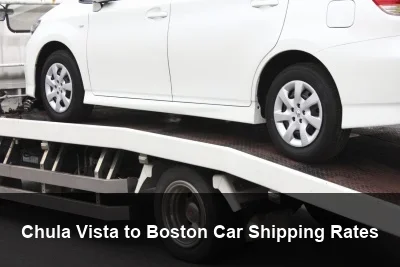
At 3,117 miles, the Chula Vista-to-Boston run sits in the longest domestic distance tier, and base rates reflect that. Expect to pay more per mile than on shorter corridors, though total cost per mile drops slightly at this range due to load efficiency. Rates spike in August when student demand at Boston universities peaks and again in May at graduation. Fuel costs on a cross-country haul this long are significant — see how gas prices affect your quote at https://california.auto-transport-shipping.com/articles/how-gas-prices-impact-california-auto-transport-fees.html
What affects the cost of Chula Vista to Boston car shipping:
- Vehicle type and size — larger vehicles take more carrier space; aftermarket additions like lift kits, oversized mirrors, or roof accessories can add fees
- Open vs. enclosed transport — open is lower cost with stronger carrier availability; enclosed protects against weather, debris, and road conditions
- Standard vs. expedited pickup — expedited prioritizes your vehicle for the next available dispatch, typically at a $100–$300 premium
- Time of year — peak demand seasons drive rates higher; off-peak windows offer the most competitive pricing
- Fuel costs — diesel prices affect carrier rates; longer routes are more sensitive to fuel price swings
- Vehicle condition — non-running vehicles require special loading equipment and cost more to ship
| Vehicle Type | Open Car Shipping (Est.) | Enclosed Car Shipping (Est.) |
|---|---|---|
| Sedan | $1,100 – $1,600 | $1,900 – $2,700 |
| SUV / Crossover | $1,300 – $1,900 | $2,200 – $3,100 |
| Pickup Truck | $1,300 – $1,950 | $2,200 – $3,150 |
| Minivan | $1,300 – $1,900 | $2,200 – $3,100 |
| Luxury / Classic Car | $1,550 – $2,200 | $2,600 – $3,600 |
| Non-Running Vehicle | Add $200–400 | Add $200–400 |
* Estimated ranges based on recent Chula Vista to Boston shipments. Actual rate depends on vehicle, locations, booking date, and current fuel costs. Use the form on this page to compare real quotes from licensed carriers.
Open or Enclosed: What This 3,100-Mile Corridor Actually Needs
Open transport handles the vast majority of vehicles on this route without issue. The corridor crosses desert terrain in Arizona and New Mexico and then passes through the Appalachians — road debris and weather exposure are real but manageable for standard vehicles. If you're shipping a classic car, a low-clearance exotic, or a vehicle with fresh paint, enclosed is worth the 30–40% premium given the distance and elevation changes. For a daily driver, late-model sedan, or SUV, open is the practical choice. Book open unless your vehicle has specific vulnerability to the conditions described.
How Long Does Chula Vista to Boston Car Shipping Take?
Standard transit time on the Chula Vista to Boston route is 7 to 12 days from pickup. That range reflects real variables: carrier frequency from the San Diego pool, how quickly a full load consolidates, and drive-time regulations that limit carriers to 11 hours per day. The driving distance alone represents roughly 47 hours of wheel time, spread across multiple days with mandatory rest. South Bay carriers generally have enough volume that dispatch within 1–3 business days of your window is realistic. If your timeline is tighter, expedited options exist — see https://california.auto-transport-shipping.com/articles/california-expedited-car-shipping-fast-cost.html
| Service Type | Typical Transit | Pickup Window | Best For |
|---|---|---|---|
| Open — Standard | 7–10 days | 2–5 business days | Best value; most common choice on this route |
| Open — Expedited | 5–7 days | 1–2 business days | Firm arrival date; faster dispatch window |
| Enclosed — Standard | 7–10 days | 4–8 business days | Luxury, classic, or modified vehicles |
| Enclosed — Expedited | 5–7 days | 2–4 business days | High-value vehicles on a firm delivery deadline |
** Winter is the primary delay risk on this corridor. Snow on I-40 through New Mexico and the Texas Panhandle, ice on I-70 in Missouri and Ohio, and winter storms along I-90 into Boston can each add 1–3 days. January through March shipments should carry a buffer of at least two extra days in your planning.
Chula Vista to Boston — Route & Logistics
Carriers access Chula Vista through the South Bay freeway grid — primarily I-5 north, SR-125, and SR-54 — before merging into the San Diego carrier pool. From there, loads typically head east on I-8 to I-10, cross through Phoenix and Tucson, then travel I-40 or I-20 east before picking up I-81 or I-95 northbound into Boston, covering approximately 3,117 miles.
Key Corridor Waypoints
- San Diego, CA Primary staging point for Chula Vista loads. Carriers consolidate here before committing to the cross-country run. The I-8 eastbound on-ramp at I-5 is the standard departure junction. Most South Bay pickups are positioned here for load balancing before dispatch. Elevation roughly 62 feet at freeway level.
- El Centro, CA / Yuma, AZ First major desert stretch after departing San Diego. I-8 drops into the Imperial Valley before crossing into Arizona. Carriers pass through a CVSA inspection checkpoint near the state line. Summer temperatures here exceed 110°F, which carriers account for when scheduling fuel and rest stops. Elevation near sea level to 200 feet.
- Phoenix, AZ Key decision junction at I-10 and I-17. Carriers moving north use I-40 via Flagstaff at 7,000 feet elevation; those staying south continue on I-10 through Tucson. Flagstaff is the more common route for loads heading to New England. Overnight stops and driver exchanges happen here regularly on longer hauls.
- Albuquerque, NM Major overnight stop on the I-40 corridor. Sits at 5,312 feet elevation. Winter carriers monitor weather east of here closely — the Texas Panhandle and Oklahoma sections of I-40 carry real ice and snow risk from November through March. Carriers may hold loads here briefly during active weather events.
- St. Louis, MO The convergence point where I-70 east takes over from I-40. Carriers transition here toward Ohio and Pennsylvania. St. Louis also serves as a potential driver relay point on longer hauls. From here, Boston is roughly 1,100 miles via I-70 to I-76 to I-95 or I-90.
- Boston, MA Final delivery zone. I-93 and I-90 (Mass Pike) are the primary inbound routes. Urban density and narrow street grids in neighborhoods like the South End, Back Bay, and Beacon Hill often require staging at a wider street or parking lot. Carriers commonly use staging areas near the South Bay Center or Myles Standish Industrial Park in Taunton for residential deliveries.
Pickup & Delivery Access
- Pickup Access in Chula Vista Chula Vista's South Bay grid is generally accessible for standard 75-foot transport rigs on major arterials like H Street, Telegraph Canyon Road, and Main Street. Some streets near the border in the Otay Ranch and border-adjacent zones have overhead restriction or tight turns. If your address is on a narrow residential block, plan to meet the carrier at a nearby shopping center parking lot or wide arterial to avoid access issues.
- Delivery Access in Boston Boston's dense urban core creates real carrier access problems. Carriers can deliver directly to suburban addresses in areas like Quincy, Brookline, and Newton without issue. For addresses in the North End, Back Bay, South End, or Beacon Hill, narrow streets and resident permit zones often require the carrier to stage nearby. Coordinate a meet point at a wide commercial lot — your carrier will advise on the specific staging location once they're within 24 hours of arrival.
- Nearby Pickup Locations Carriers picking up in Chula Vista regularly extend service to National City, Bonita, and Eastlake. Call 1‑800‑590‑6492 to confirm door-to-door availability at your address.
Open vs. Enclosed Car Shipping: Chula Vista to Boston
Both options use licensed, insured carriers and deliver door to door. For a full breakdown, read the pros and cons of open vs. enclosed car shipping.
Open Car Shipping
Most Popular- Lower cost — the practical choice for most vehicles
- More carriers available on this corridor
- Faster dispatch from booking to pickup
- Works well for sedans, SUVs, trucks, and minivans
- Vehicle rides on an open multi-car carrier
- Cargo insurance required on all licensed carriers
Estimated cost: $1,100 – $1,950
Enclosed Car Shipping
Premium Protection- Full protection from weather, debris, and road grime
- Best for luxury, exotic, and classic vehicles
- Recommended for low-clearance and custom-built cars
- Wheel-net or soft-tie systems prevent contact damage
- Higher cargo coverage — commonly $500,000 per load
- White-glove handling by experienced operators
Estimated cost: $1,900 – $3,150
Not sure which is right for your vehicle? Call 1-800-590-6492 and we'll point you in the right direction. Also worth reading: the top 10 questions to ask any car shipping company before you commit.
How to Prepare Your Car for Shipping to Boston
A little prep before pickup protects you if there's ever a dispute about your vehicle's condition. This checklist is from our full guide on preparing your car for transport:
- Remove all personal belongings from the interior and trunk
- Leave only a quarter tank of fuel — enough to load and unload
- Take date-stamped photos of the full exterior and interior
- Remove or disable toll transponders (FasTrak, E-ZPass, etc.)
- Retract or remove roof racks, spoilers, antennas, and bike mounts
- Make sure the battery is charged and tires are properly inflated
- Tell the carrier about any existing leaks or mechanical issues
- Deactivate the car alarm before the carrier arrives
- Write down the mileage on the Bill of Lading at pickup
- Fold in side mirrors if the vehicle is wider than standard
Personal items: Most carriers won't cover belongings left in the car. Read the full rules on shipping personal items in your vehicle. Also review our Bill of Lading guide so you know exactly what to check at pickup and delivery.
When to Ship Your Car from Chula Vista to Boston
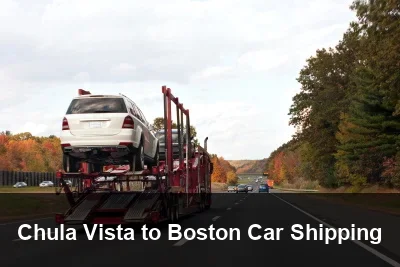
This route has two peak demand windows: late July through August driven by Boston university move-ins, and May driven by graduations and summer relocations. Both windows tighten carrier availability and push rates up 10–20%. Winter shipping from January through February is slower in demand but carries weather delay risk. For winter-specific planning on this corridor, see https://california.auto-transport-shipping.com/articles/auto-transport-challenges-during-the-winter.html
Spring Relocation Season (April–May)
Graduation cycles at Boston-area universities — Harvard, MIT, Northeastern, BU, Tufts — generate a surge of outbound vehicles in May, but inbound professional relocations also spike as companies onboard summer hires. Carriers balance loads well in this window. Book 10–14 days ahead for May shipping to lock a competitive rate before availability tightens.
Summer Peak (June–August)
The busiest window on this corridor. Military PCS orders from Naval Base San Diego and MCAS Miramar create consistent outbound California volume. Simultaneously, Boston university move-ins in late August drive heavy inbound demand. This is the highest-rate period of the year. Book 2–3 weeks in advance and expect rates 15–20% above baseline if you wait until July.
Student Vehicle Cycle (August and January)
Harvard, MIT, and Boston University alone enroll tens of thousands of students, many shipping vehicles both directions at semester start. August is the heaviest single month for this route. January sees a secondary bump when spring semester begins. If your move aligns with these windows, book early — carriers fill fast and last-minute rates climb sharply during peak student weeks.
Winter Corridor (November–February)
I-40 through New Mexico and the Texas Panhandle, I-70 through Missouri and Ohio, and I-90 into Boston all carry winter weather risk. Carriers may hold loads during active storms rather than risk road closures. Budget 1–3 extra days in your delivery window if shipping between December and February. See the winter transport guide for what to prepare for.
Military PCS Windows (May–June and September–October)
Naval Base San Diego, MCAS Miramar, and NAS North Island process large PCS order batches in late spring and early fall. These moves generate consistent westbound and eastbound volume that keeps carriers active on the California-to-New England corridor. If you're a service member, book as soon as orders are cut — government certificates of eligibility are accepted by most carriers to help offset costs.
How to Choose a Chula Vista to Boston Car Shipping Company
Getting multiple quotes is step one — knowing what to look for in those quotes matters just as much. Our guide on how to select a car shipping company covers the full process. Here are the six things that matter most:
FMCSA Registration
Every carrier or broker must hold a valid MC number. Verify any company at FMCSA SAFER before you book.
Proof of Insurance
Ask for a current certificate of insurance. Open carriers typically carry $100,000–$250,000 per load; enclosed commonly $500,000 or more. Learn what auto transport insurance covers.
All-In Pricing
Your quote should be a final number with no fees added after booking. Know the difference between brokers and carriers and confirm what the quote covers before you agree.
Bill of Lading
A complete Bill of Lading is filled out at pickup and delivery. Our Bill of Lading guide explains what to check. Never sign an incomplete one.
Real Reviews
Check Google and the BBB. Look at how they handled complaints and damage claims — that tells you more than a five-star average from happy customers.
Route Experience
A carrier who runs the Chula Vista-to-Boston corridor regularly knows that the South Bay pickup window works best Tuesday through Thursday when the San Diego carrier pool is most active and loads consolidate faster. They know to watch the NWS forecast for Amarillo and the Texas Panhandle from November through March, and they know that I-40 near Gallup, NM, closes faster than NMDT posts online — so they monitor directly. On delivery, experienced Boston carriers pre-identify staging lots in Quincy or Dedham for South End and Back Bay addresses, rather than attempting narrow residential blocks with a loaded 75-foot rig. They also know that Logan Airport traffic on I-93 southbound on Friday afternoons adds 45–90 minutes to any delivery timed for late in the week.
Chula Vista to Boston Car Shipping — FAQ
How much does it cost to ship a car from Chula Vista to Boston?
Rates on this route typically range from $1,200 to $2,200 for open transport on a standard sedan or SUV, depending on the time of year, current fuel prices, and how quickly you need to ship. The August student window and May graduation period push rates toward the higher end. Enclosed transport adds 30–40% to the open rate. Oversized vehicles — full-size trucks, lifted SUVs, longer wheelbase — cost more due to space consumed on the carrier. The only way to get an accurate number for your specific vehicle, dates, and transport type is to submit the quote form on this page.
How long does Chula Vista to Boston car shipping take?
Standard transit on this 3,117-mile corridor runs 7 to 12 days from the time the carrier picks up your vehicle. That range accounts for dispatch timing from the San Diego carrier pool, mandatory federal rest hours that limit carriers to 11 hours of driving per day, and typical relay patterns across the Sun Belt and Mid-Atlantic. Winter months can push transit toward the upper end or beyond due to weather holds on I-40 or I-70. If you're working against a hard deadline, expedited shipping options can compress the window — details at https://california.auto-transport-shipping.com/articles/california-expedited-car-shipping-fast-cost.html
Is my car insured during transport from Chula Vista to Boston?
Yes. Every FMCSA-licensed carrier is required to carry cargo insurance that covers your vehicle during transport. Before your vehicle is loaded, the carrier completes a Bill of Lading documenting pre-existing condition — inspect this carefully and note any scratches or dents before signing. At delivery, compare the vehicle's condition to that document. If damage occurred in transit, you have a documented basis for a claim. For a detailed breakdown of what carrier insurance covers and how personal auto policies interact with it, read https://california.auto-transport-shipping.com/articles/understanding-auto-transport-insurance.html. If you need to file a claim, the process is outlined at https://california.auto-transport-shipping.com/articles/how-to-file-a-claim-for-vehicle-damage-during-transport.html
Should I choose open or enclosed transport for this route?
Open transport is the right call for most vehicles on this corridor. The route crosses desert terrain, high desert passes near Flagstaff at 7,000 feet, and the Appalachian foothills — all manageable for standard vehicles on an open carrier. If you're shipping a classic car, a low-clearance sports car, a vehicle with a fresh wrap or custom paint, or anything with a market value above $80,000, enclosed is worth the added cost given the distance and weather variability. For most daily drivers, late-model sedans, crossovers, and pickups, open is the practical and cost-effective choice. Full breakdown at https://california.auto-transport-shipping.com/articles/open-vs-enclosed-auto-transport-pros-and-cons.html
Do I have to be present at pickup and delivery?
You don't have to be present in person, but someone over 18 must be available to sign the Bill of Lading at both ends. At pickup in Chula Vista, that person inspects the vehicle with the carrier and signs confirming the documented pre-existing condition. At delivery in Boston, the same process happens in reverse — inspect the vehicle before signing the delivery Bill of Lading. If you can't be there personally, a designated representative with authority to sign works fine. Never sign the delivery BOL before completing the inspection. Full details on what the BOL covers are at https://california.auto-transport-shipping.com/articles/california-auto-transport-bill-of-lading-information.html
How does winter weather affect shipping from Chula Vista to Boston?
Winter is the main risk variable on this corridor. I-40 through New Mexico and the Texas Panhandle sees snow and ice from November through February. I-70 through Missouri and Ohio can close during major storms. I-90 into Boston carries its own winter weather risk from December through March. Carriers will hold a load rather than drive into an active road closure — that's the right call, but it can add 1–3 days to your transit. If you're shipping between December and February, build buffer days into your delivery window and read the winter transport guide at https://california.auto-transport-shipping.com/articles/auto-transport-challenges-during-the-winter.html
Does military PCS affect carrier availability or rates on this route?
Yes, noticeably. Naval Base San Diego, MCAS Miramar, and NAS North Island are among the largest military installations on the West Coast. PCS order batches in late May through June and again in September through October create concentrated outbound demand from the San Diego metro that directly affects Chula Vista carrier availability. During peak PCS windows, carriers book out faster and rates can firm up. If you have military orders, book as soon as they're cut. Most reputable carriers accept government transportation office documentation, and some offer reduced rates for service members — ask when you request your quote.
Is August really the hardest time to book this route?
August is the single most competitive month on the Chula Vista-to-Boston corridor. Boston-area universities — including Harvard, MIT, Boston University, Northeastern, and Tufts — all begin the fall semester between mid-August and early September, driving a concentrated surge of inbound vehicle shipments to the Boston metro. At the same time, summer PCS moves from San Diego installations are still clearing. The combination tightens carrier availability and pushes rates 15–20% above what you'd pay in October or March. If your move is August-bound, submit your booking request no later than mid-July to secure a carrier and a competitive rate.
Ready to Ship Your Car from Chula Vista to Boston?
One form gets you up to 10 free quotes from licensed, insured carriers. Compare costs and transit times and book the best deal for your schedule.