

Riverside to Kansas City Car Shipping Route
The Riverside to Kansas City route covers approximately 1,583 miles. Carriers exit Riverside via I-215 north to SR-60 east, or take I-15 north connecting to I-40 east near Barstow — both approaches funnel into the transcontinental freight corridor crossing the Mojave Desert, through Arizona on I-40, and north through Oklahoma City on I-35 or through Joplin, Missouri on I-44 before reaching Kansas City. Elevation ranges from the 1,000-foot Inland Empire floor through the 4,000-plus-foot Flagstaff plateau before dropping into the Great Plains. Shipping rather than driving eliminates roughly 23 hours of road time and significant fuel cost; see the full breakdown at https://california.auto-transport-shipping.com/articles/benefits-of-auto-transport-service-vs-driving-yourself.html.
Kansas City demand is anchored by real economic weight. Ford's Claycomo Assembly Plant and GM's Fairfax Assembly facility collectively employ thousands, generating steady corporate relocation traffic. Whiteman Air Force Base in Knob Noster, about 65 miles southeast, produces predictable PCS cycles each spring and summer. UMKC, Rockhurst University, and Kansas State University's med campus draw student relocations every August and January. Sprint's former campus — now a mixed corporate hub — sustains ongoing professional migration from California. Winter on this corridor means potential ice across the Oklahoma panhandle and Missouri; spring brings severe weather. Before you book, review common mistakes at https://california.auto-transport-shipping.com/articles/auto-transport-mistakes-to-avoid.html.
Riverside to Kansas City Car Shipping Rates
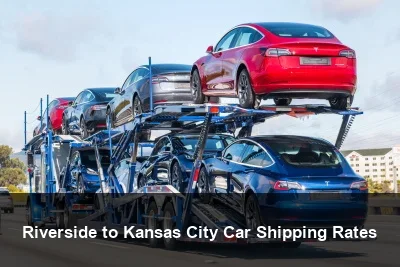
At roughly 1,583 miles, this route falls in the mid-to-long-haul pricing tier where per-mile rates typically drop compared to shorter corridors but total cost is substantial. Expect rate spikes in summer when military PCS and student demand both peak simultaneously. Winter can add fuel and weather surcharges across Arizona's high-elevation stretch and Oklahoma's ice belt. Diesel pricing directly affects carrier bids on a route this long; track how fuel costs factor into your quote at https://california.auto-transport-shipping.com/articles/how-gas-prices-impact-california-auto-transport-fees.html.
What affects the cost of Riverside to Kansas City car shipping:
- Vehicle type and size — larger vehicles take more carrier space; aftermarket additions like lift kits, oversized mirrors, or roof accessories can add fees
- Open vs. enclosed transport — open is lower cost with stronger carrier availability; enclosed protects against weather, debris, and road conditions
- Standard vs. expedited pickup — expedited prioritizes your vehicle for the next available dispatch, typically at a $100–$300 premium
- Time of year — peak demand seasons drive rates higher; off-peak windows offer the most competitive pricing
- Fuel costs — diesel prices affect carrier rates; longer routes are more sensitive to fuel price swings
- Vehicle condition — non-running vehicles require special loading equipment and cost more to ship
| Vehicle Type | Open Car Shipping (Est.) | Enclosed Car Shipping (Est.) |
|---|---|---|
| Sedan | $950 – $1,350 | $1,700 – $2,300 |
| SUV / Crossover | $1,100 – $1,600 | $1,950 – $2,700 |
| Pickup Truck | $1,100 – $1,650 | $1,950 – $2,750 |
| Minivan | $1,100 – $1,600 | $1,950 – $2,700 |
| Luxury / Classic Car | $1,300 – $1,900 | $2,200 – $3,000 |
| Non-Running Vehicle | Add $200–350 | Add $200–350 |
* Estimated ranges based on recent Riverside to Kansas City shipments. Actual rate depends on vehicle, locations, booking date, and current fuel costs. Use the form on this page to compare real quotes from licensed carriers.
Open vs. Enclosed: The Right Call for This 1,583-Mile Haul
Open transport is the practical choice for standard vehicles on this route. The I-40 and I-44 corridors are well-maintained freight arteries, and road debris exposure is manageable. Enclosed makes sense for vehicles with values above $50,000, fresh paint, or low-clearance ground effects — primarily because of Oklahoma and Missouri's spring hail season, which can catch open carriers between April and June. If you're shipping a classic, exotic, or recently restored vehicle and timing falls in spring, enclosed eliminates the hail exposure risk. For a daily driver in fall or winter, open is the economical default.
How Long Does Riverside to Kansas City Car Shipping Take?
Riverside to Kansas City typically runs 5 to 8 transit days under normal conditions. Carrier frequency from the Inland Empire is high enough that pickup windows are usually 1 to 3 days after dispatch. The driving distance alone represents roughly 22 to 24 hours behind the wheel across multiple drivers or days. Route-specific variables include weigh station queues in Arizona, permit requirements near metro Kansas City for oversized loads, and weekend delivery restrictions in some urban zones. If your timeline is firm, expedited options exist — review costs and trade-offs at https://california.auto-transport-shipping.com/articles/california-expedited-car-shipping-fast-cost.html.
| Service Type | Typical Transit | Pickup Window | Best For |
|---|---|---|---|
| Open — Standard | 4–6 days | 2–5 business days | Best value; most common choice on this route |
| Open — Expedited | 2–4 days | 1–2 business days | Firm arrival date; faster dispatch window |
| Enclosed — Standard | 4–6 days | 3–7 business days | Luxury, classic, or modified vehicles |
| Enclosed — Expedited | 2–4 days | 1–3 business days | High-value vehicles on a firm delivery deadline |
** Winter ice across the Oklahoma panhandle and freezing rain in Missouri can add 1 to 2 days to transit between December and February. Spring severe weather — tornadoes and hail from April through June — occasionally forces carriers to hold near Joplin or Oklahoma City until conditions clear. Plan buffer days during both seasons.
Riverside to Kansas City — Route & Logistics
Carriers depart Riverside using I-215 to SR-60 east, or I-15 north to I-40 east at Barstow. From there, the primary path follows I-40 through Needles, Kingman, Flagstaff, and Albuquerque, then connects via I-44 east through Oklahoma City and Joplin into Kansas City — 1,583 miles of mostly freeway-grade infrastructure with consistent truck stops and staging options.
Key Corridor Waypoints
- Barstow, CA First major staging point after leaving the Inland Empire. Carriers connecting from I-15 north merge to I-40 east here. Barstow has fuel, inspection facilities, and rest stops sized for commercial freight. Elevation around 2,175 feet. Drivers typically complete pre-departure vehicle checks here before entering the Mojave's sustained desert stretch eastbound toward Needles.
- Needles, CA / Arizona State Line The California-Arizona border crossing at Needles includes an agricultural inspection checkpoint where carriers stop briefly. Summer temperatures at this crossing routinely exceed 115°F, which is relevant for vehicles with fluid leaks or cooling issues. Elevation drops to roughly 480 feet at the Colorado River crossing. Most carriers pass through early morning to avoid peak heat in summer months.
- Flagstaff, AZ Flagstaff sits at 6,909 feet elevation — the highest point on this corridor. Winter snow and ice between November and March can slow carriers significantly on the I-40 grades approaching and departing the city. Arizona's commercial vehicle weight and brake inspection stations are active here. Carriers often fuel and check tire pressure before descending eastward toward Albuquerque.
- Albuquerque, NM Major interchange city where I-40 east continues toward Oklahoma. Carriers sometimes stage overnight here on longer multi-driver runs. Kirtland Air Force Base and Sandia National Laboratories generate local auto transport demand that keeps return freight flowing. Elevation around 5,312 feet. I-40 east out of Albuquerque is a long, flat corridor through eastern New Mexico with few services.
- Oklahoma City, OK Key junction where some carriers transition from I-40 to I-35 north toward Kansas City — roughly 340 miles out from the destination. Tinker Air Force Base here adds military transport volume that keeps the I-35 northbound lane active. Spring severe weather is a genuine operational risk between April and June. Carriers monitor storm systems before committing to overnight runs north.
- Kansas City, MO Final delivery metro accessible via I-35 south from the north or I-70 from the east and west. The Ford Claycomo plant is northeast of downtown; the GM Fairfax Assembly facility is in Kansas City, Kansas. Whiteman AFB deliveries require staging in Lee's Summit or Independence for residential off-load. Urban core streets in Midtown and Westport may require curb-side delivery coordination.
Pickup & Delivery Access
- Pickup Access in Riverside Riverside's freeway grid makes carrier access straightforward. The downtown Riverside area near UC Riverside, the Eastside neighborhoods, and the Arlington and Canyon Crest districts are all accessible to standard 75-foot transport rigs. Wide arterials like University Avenue, Iowa Avenue, and Chicago Avenue allow door-adjacent pickup in most cases. For tighter residential cul-de-sacs, meet-point coordination at nearby shopping centers or freeway-adjacent parking lots is standard practice.
- Delivery Access in Kansas City Most Kansas City residential areas accommodate standard open carriers without issue. The Westport, Midtown, and 18th and Vine districts have narrow streets where drivers stage nearby and walk vehicles to final position. The Northland suburbs — Liberty, Gladstone, Platte City — present no access problems. For deliveries near Whiteman AFB in Knob Noster, carriers typically stage in Warrensburg or Sedalia and complete the final leg by appointment.
- Nearby Pickup Locations Carriers picking up in Riverside regularly extend service to Norco, Jurupa Valley, and Corona. Call 1‑800‑590‑6492 to confirm door-to-door availability at your address.
Open vs. Enclosed Car Shipping: Riverside to Kansas City
Both options use licensed, insured carriers and deliver door to door. For a full breakdown, read the pros and cons of open vs. enclosed car shipping.
Open Car Shipping
Most Popular- Lower cost — the practical choice for most vehicles
- More carriers available on this corridor
- Faster dispatch from booking to pickup
- Works well for sedans, SUVs, trucks, and minivans
- Vehicle rides on an open multi-car carrier
- Cargo insurance required on all licensed carriers
Estimated cost: $950 – $1,650
Enclosed Car Shipping
Premium Protection- Full protection from weather, debris, and road grime
- Best for luxury, exotic, and classic vehicles
- Recommended for low-clearance and custom-built cars
- Wheel-net or soft-tie systems prevent contact damage
- Higher cargo coverage — commonly $500,000 per load
- White-glove handling by experienced operators
Estimated cost: $1,700 – $2,750
Not sure which is right for your vehicle? Call 1-800-590-6492 and we'll point you in the right direction. Also worth reading: the top 10 questions to ask any car shipping company before you commit.
How to Prepare Your Car for Shipping to Kansas City
A little prep before pickup protects you if there's ever a dispute about your vehicle's condition. This checklist is from our full guide on preparing your car for transport:
- Remove all personal belongings from the interior and trunk
- Leave only a quarter tank of fuel — enough to load and unload
- Take date-stamped photos of the full exterior and interior
- Remove or disable toll transponders (FasTrak, E-ZPass, etc.)
- Retract or remove roof racks, spoilers, antennas, and bike mounts
- Make sure the battery is charged and tires are properly inflated
- Tell the carrier about any existing leaks or mechanical issues
- Deactivate the car alarm before the carrier arrives
- Write down the mileage on the Bill of Lading at pickup
- Fold in side mirrors if the vehicle is wider than standard
Personal items: Most carriers won't cover belongings left in the car. Read the full rules on shipping personal items in your vehicle. Also review our Bill of Lading guide so you know exactly what to check at pickup and delivery.
When to Ship Your Car from Riverside to Kansas City
This route follows a predictable seasonal pattern driven by military PCS cycles, university calendars, and Midwest weather. Summer peaks in June and July compress carrier availability and push rates up. Winter creates weather-related surcharges and occasional delays without necessarily reducing demand, since Kansas City's economy runs year-round. For a detailed breakdown of cold-weather transport risks on Midwest-bound routes, see https://california.auto-transport-shipping.com/articles/auto-transport-challenges-during-the-winter.html.
Spring (March – May)
Military PCS orders from March Air Reserve Base near Riverside begin processing in March, adding outbound volume to an already active corridor. Simultaneously, severe weather across Oklahoma and Missouri peaks April through May — carriers monitor tornado and hail systems actively. Book early if you need spring delivery; capacity tightens as PCS orders hit. Enclosed shipping is worth considering if your vehicle is high-value and April or May is your window.
Summer Peak (June – August)
The highest-demand window on this corridor. UC Riverside and Cal Baptist graduations push student relocations outbound in June. Military PCS transfers peak in June and July. Kansas City employers see the highest corporate relocation volume in summer. Carrier availability tightens, spot rates climb 15 to 25 percent above winter baselines. Book two to three weeks ahead if possible, and confirm your pickup window in writing before the move date.
Student Relocation (August & January)
UMKC, Rockhurst, and UC Riverside all generate predictable move-in surges in mid-August and early January. August is the sharper peak — carriers filling Kansas City-bound loads faster than supply can meet demand. January is softer but still notable. Both windows mean 7- to 10-day lead times are advisable. Students shipping economy vehicles should book open transport; the price advantage over enclosed is most visible at these volume peaks.
Winter (December – February)
Demand from Kansas City doesn't collapse in winter — the auto manufacturing economy and military activity continue. But the route itself becomes operationally harder. Ice on I-44 through Oklahoma and Missouri is a documented delay factor. Carriers may hold in Oklahoma City for 24 to 48 hours during ice events. Budget an extra day or two into your planning. Rates are typically lower than summer, but weather surcharges can partially offset the savings.
Military PCS Season (March – July)
Whiteman Air Force Base southeast of Kansas City and March Air Reserve Base in Riverside both generate PCS volume on this exact corridor. The overlap is direct: service members receiving orders from one base to the other — or to installations near either city — produce consistent two-way demand. This keeps carriers running the lane regularly, which benefits all shippers. If you hold military orders, book as soon as dates are confirmed; PCS season capacity moves fast.
Fall (September – November)
The most operationally stable window on this route. Weather across the Southwest and Southern Plains is generally cooperative through October. Demand moderates after summer PCS and student peaks, so carrier availability improves and rates soften. November is the last clean booking window before winter weather begins affecting the Oklahoma and Missouri portions of the route. If your schedule is flexible, September through early November is the easiest shipping window on this corridor.
How to Choose a Riverside to Kansas City Car Shipping Company
Getting multiple quotes is step one — knowing what to look for in those quotes matters just as much. Our guide on how to select a car shipping company covers the full process. Here are the six things that matter most:
FMCSA Registration
Every carrier or broker must hold a valid MC number. Verify any company at FMCSA SAFER before you book.
Proof of Insurance
Ask for a current certificate of insurance. Open carriers typically carry $100,000–$250,000 per load; enclosed commonly $500,000 or more. Learn what auto transport insurance covers.
All-In Pricing
Your quote should be a final number with no fees added after booking. Know the difference between brokers and carriers and confirm what the quote covers before you agree.
Bill of Lading
A complete Bill of Lading is filled out at pickup and delivery. Our Bill of Lading guide explains what to check. Never sign an incomplete one.
Real Reviews
Check Google and the BBB. Look at how they handled complaints and damage claims — that tells you more than a five-star average from happy customers.
Route Experience
A carrier who runs Riverside to Kansas City regularly knows that Barstow is the real departure checkpoint — not Riverside itself. They check tire pressure and fluid levels there before committing to the Mojave crossing, because the next full-service stop capable of handling a loaded transport rig is Kingman, Arizona. They know the Arizona weigh stations on I-40 run random inspections, and they know Flagstaff in March can shut the grade with ice while Riverside is 75 degrees. They know Oklahoma City is the weather decision point in spring — whether to push north toward Kansas City or hold 12 hours for a storm system to clear. They know Kansas City's west side loads easier than the urban core, and that Whiteman AFB deliveries require a staging stop in Warrensburg. That operational knowledge is what separates a smooth 5-day transit from an 8-day one.
Riverside to Kansas City Car Shipping — FAQ
How much does it cost to ship a car from Riverside to Kansas City?
On this 1,583-mile corridor, open transport for a standard sedan typically runs between $950 and $1,350 depending on season and carrier availability. SUVs and trucks add $100 to $200 due to size and weight. Enclosed transport runs $1,500 to $2,100 for the same distance. Rates peak in June and July when military PCS and student demand both hit simultaneously — sometimes 20 percent above the annual baseline. Winter rates are generally lower, though weather surcharges can narrow the gap. Fuel price swings affect carrier bids directly on a haul this long; see how diesel pricing works into your quote at https://california.auto-transport-shipping.com/articles/how-gas-prices-impact-california-auto-transport-fees.html.
How long does Riverside to Kansas City car shipping take?
Standard transit on this route runs 5 to 8 days after carrier pickup. Pickup itself typically occurs 1 to 3 days after dispatch confirmation, given the high carrier frequency out of the Inland Empire. The driving distance represents roughly 22 to 24 hours of road time across the full corridor, spread over multiple driver shifts. Winter ice in Oklahoma and Missouri, or spring severe weather between April and June, can add 1 to 2 days. If your delivery date is fixed, expedited options exist — review the cost trade-offs at https://california.auto-transport-shipping.com/articles/california-expedited-car-shipping-fast-cost.html.
Is my car insured during transport from Riverside to Kansas City?
Yes. Every licensed carrier operating on this route is required to carry cargo insurance as a condition of their FMCSA operating authority. Coverage typically ranges from $100,000 to $250,000 per load. Before your vehicle is loaded, the driver completes a Bill of Lading documenting existing condition — note every scratch and ding at pickup and photograph them. If damage occurs in transit, that document is your claim baseline. For a full explanation of what carrier insurance covers and what it doesn't, read https://california.auto-transport-shipping.com/articles/understanding-auto-transport-insurance.html. If you ever need to file a claim, the process is outlined at https://california.auto-transport-shipping.com/articles/how-to-file-a-claim-for-vehicle-damage-during-transport.html.
Should I choose open or enclosed transport for this Riverside to Kansas City route?
Open transport handles the vast majority of vehicles on this corridor without incident. The I-40 and I-44 routes are well-traveled freight corridors with manageable road debris exposure. The main argument for enclosed on this specific route is spring hail — Oklahoma and Missouri see active hail seasons from April through June, and an open carrier caught in a hail event has no overhead protection. If you're shipping a vehicle worth over $50,000, a classic, or a recently restored vehicle and your timing falls in spring, enclosed eliminates that risk. For a detailed comparison of both options, see https://california.auto-transport-shipping.com/articles/open-vs-enclosed-auto-transport-pros-and-cons.html.
Do I have to be present at pickup in Riverside and delivery in Kansas City?
You don't have to be present personally, but an authorized representative does need to be available at both ends. At pickup in Riverside, someone must inspect the vehicle with the driver, sign the Bill of Lading, and hand over the keys. At delivery in Kansas City, someone must inspect the vehicle again, note any new damage on the delivery Bill of Lading before signing, and take possession of keys. If you sign the delivery receipt without noting damage, the damage claim becomes significantly harder to pursue. For everything you need to know about the Bill of Lading process, see https://california.auto-transport-shipping.com/articles/california-auto-transport-bill-of-lading-information.html.
Does winter weather significantly affect Riverside to Kansas City shipping?
Yes, more than most California-origin routes. The Flagstaff, Arizona segment reaches 6,909 feet elevation and sees snow and ice from November through March. More significantly, the Oklahoma and Missouri portions of this route — particularly I-44 between Oklahoma City and Joplin — experience ice storms that can force carriers to hold for 24 to 48 hours. Missouri itself sees winter precipitation events that affect Kansas City delivery windows. If you're shipping December through February, build at least two extra days into your planning timeline and discuss winter contingencies with your broker before booking. See https://california.auto-transport-shipping.com/articles/auto-transport-challenges-during-the-winter.html for the full picture.
I'm a service member with PCS orders involving March ARB or Whiteman AFB — how does military auto transport work on this corridor?
This corridor connects two active military communities directly — March Air Reserve Base in the Riverside metro and Whiteman Air Force Base southeast of Kansas City. Carriers run this lane regularly specifically because PCS demand is consistent in both directions. As a service member, you may be entitled to a government travel reimbursement for vehicle shipping depending on your orders; confirm with your transportation office before booking. Book as soon as your orders are confirmed — PCS season peaks June and July and carrier slots fill fast. Whiteman AFB deliveries typically require staging in Warrensburg or Sedalia for the final residential off-load leg.
Can carriers from Riverside also pick up vehicles in nearby cities like Norco, Jurupa Valley, or Corona?
Yes. Norco, Jurupa Valley, and Corona are all within the Inland Empire carrier service radius, and most brokers can schedule pickup in those cities on the same dispatch order. Norco's rural roads and horse properties occasionally require meet-point coordination at a nearby commercial lot rather than door pickup, but SR-91 and I-15 access from Corona and Jurupa Valley is straightforward for standard transport rigs. If you're in one of these neighboring cities, specify your exact address when requesting a quote — pickup cost is typically the same as Riverside-origin shipping on this corridor.
Ready to Ship Your Car from Riverside to Kansas City?
One form gets you up to 10 free quotes from licensed, insured carriers. Compare costs and transit times and book the best deal for your schedule.