

Oceanside to Columbus Car Shipping Route
The Oceanside to Columbus route covers approximately 2,089 miles. Carriers pick up in Oceanside via I-5 north or south to connect to I-15 north through Temecula and Riverside, then join I-40 east at Barstow or continue to I-15 north before picking up I-70 east through Utah and Colorado. The route crosses the Mojave Desert, the Colorado Plateau, and the Appalachian foothills before dropping into Ohio. Driving this yourself would take four to five days of hard driving, burn several hundred dollars in fuel, add mileage to your vehicle, and expose you to real mechanical risk. A comparison of those costs is covered in detail at https://california.auto-transport-shipping.com/articles/benefits-of-auto-transport-service-vs-driving-yourself.html.
Columbus demand is driven by Ohio State University's roughly 60,000-student enrollment, which creates two major relocation windows in August and January. Major employers including Honda Manufacturing in Marysville, Nationwide Insurance, JPMorgan Chase, and Amazon's regional fulfillment network generate continuous corporate transfer volume. On the origin side, Camp Pendleton — one of the largest Marine Corps bases in the country — produces significant PCS traffic between March and August, and carriers positioned to handle military-adjacent moves often deadhead through Oceanside. Winter weather across New Mexico, the Texas Panhandle if routing via I-40, or through Colorado on I-70 can affect scheduling. Before booking, review https://california.auto-transport-shipping.com/articles/auto-transport-mistakes-to-avoid.html to avoid common errors that delay shipments.
Oceanside to Columbus Car Shipping Rates
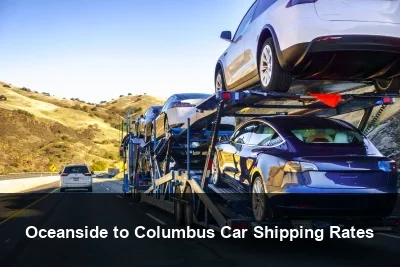
At roughly 2,089 miles, this route falls in the long-haul pricing tier where per-mile rates drop but total cost is higher than shorter corridors. Rates spike from March through August because of Camp Pendleton PCS season and the Ohio State University summer move-in cycle hitting simultaneously. Fuel costs matter on a corridor this long — price changes at California and Nevada pumps have a direct impact on carrier quotes. See https://california.auto-transport-shipping.com/articles/how-gas-prices-impact-california-auto-transport-fees.html for a breakdown of how that pricing mechanism works.
What affects the cost of Oceanside to Columbus car shipping:
- Vehicle type and size — larger vehicles take more carrier space; aftermarket additions like lift kits, oversized mirrors, or roof accessories can add fees
- Open vs. enclosed transport — open is lower cost with stronger carrier availability; enclosed protects against weather, debris, and road conditions
- Standard vs. expedited pickup — expedited prioritizes your vehicle for the next available dispatch, typically at a $100–$300 premium
- Time of year — peak demand seasons drive rates higher; off-peak windows offer the most competitive pricing
- Fuel costs — diesel prices affect carrier rates; longer routes are more sensitive to fuel price swings
- Vehicle condition — non-running vehicles require special loading equipment and cost more to ship
| Vehicle Type | Open Car Shipping (Est.) | Enclosed Car Shipping (Est.) |
|---|---|---|
| Sedan | $1,100 – $1,600 | $1,900 – $2,700 |
| SUV / Crossover | $1,300 – $1,900 | $2,200 – $3,100 |
| Pickup Truck | $1,300 – $1,950 | $2,200 – $3,150 |
| Minivan | $1,300 – $1,900 | $2,200 – $3,100 |
| Luxury / Classic Car | $1,550 – $2,200 | $2,600 – $3,600 |
| Non-Running Vehicle | Add $200–400 | Add $200–400 |
* Estimated ranges based on recent Oceanside to Columbus shipments. Actual rate depends on vehicle, locations, booking date, and current fuel costs. Use the form on this page to compare real quotes from licensed carriers.
Open vs. Enclosed: What This 2,089-Mile Corridor Requires
Open transport covers the overwhelming majority of moves on this route without incident. Standard sedans, SUVs, and trucks ship open regularly through the Mojave Desert and across the Midwest with no issue — carriers use this lane constantly and know the route. Enclosed makes sense if you're shipping a classic car, a high-value sports car, or a luxury vehicle where any road debris exposure is unacceptable. If you're running an enclosed move, book at least a week earlier than open — fewer enclosed carriers operate this specific corridor, and availability tightens fast during PCS season.
How Long Does Oceanside to Columbus Car Shipping Take?
Standard transit on the Oceanside to Columbus corridor runs seven to ten days once a carrier is assigned. Carrier assignment typically takes one to three business days from booking, depending on how close your pickup date falls to peak PCS or university move season. The drive itself is roughly 30 to 32 hours of road time, spread across multiple driver days. Carriers running this corridor are often linking San Diego County to Midwest loops on I-40 or I-70, so load matching is generally reliable. If your timeline is fixed, expedited options exist — see https://california.auto-transport-shipping.com/articles/california-expedited-car-shipping-fast-cost.html.
| Service Type | Typical Transit | Pickup Window | Best For |
|---|---|---|---|
| Open — Standard | 7–10 days | 2–5 business days | Best value; most common choice on this route |
| Open — Expedited | 5–7 days | 1–2 business days | Firm arrival date; faster dispatch window |
| Enclosed — Standard | 7–10 days | 4–8 business days | Luxury, classic, or modified vehicles |
| Enclosed — Expedited | 5–7 days | 2–4 business days | High-value vehicles on a firm delivery deadline |
** Winter weather is the most common delay factor on this route. I-40 through New Mexico and Arizona can see snow and ice closures from November through February. I-70 through Colorado's mountain passes — particularly Eisenhower Tunnel at 11,158 feet — is subject to closures that can add one to two days to delivery.
Oceanside to Columbus — Route & Logistics
Carriers access this route from Oceanside via I-5 to I-15 north, passing through Temecula and the Inland Empire before reaching Barstow. At Barstow, most trucks take I-40 east through Needles, Flagstaff, Albuquerque, and Amarillo, then pick up I-44 or I-70 east into Columbus. The full corridor is approximately 2,089 miles of primarily interstate driving.
Key Corridor Waypoints
- Barstow, CA Barstow is the first major staging point after carriers leave the I-15 north corridor from Oceanside. Trucks confirm load integrity here before entering the Mojave Desert stretch. It's the decision junction — most carriers heading to Columbus take I-40 east from here. Fuel and rest stops are positioned for overnight stops or early-morning departure into Arizona.
- Flagstaff, AZ — elevation 6,909 ft Flagstaff sits at nearly 7,000 feet elevation on I-40 and is the first significant high-altitude point on the route. From October through April, carriers monitor weather closely here — snow and black ice are real possibilities. Carriers often time their arrival to cross the Flagstaff plateau during daylight hours and avoid overnight mountain driving in winter months.
- Albuquerque, NM Albuquerque is a major carrier interchange point on I-40. Drivers running team loads or single-driver long hauls often do a required rest stop here. It's also where carriers can pick up or drop freight to adjust load weight before the long flat run east through the Texas Panhandle. No special access issues — the I-25 and I-40 interchange is well-maintained.
- Oklahoma City, OK Oklahoma City is where I-40 east intersects with I-35 and carriers confirm their Midwest routing. Trucks heading to Columbus typically stay on I-40 to I-44 east, bypassing the I-35 north option. This is frequently an overnight rest point for single-driver carriers on a standard multi-day run. Weather in winter can include ice storms that delay departures by a half-day.
- St. Louis, MO — I-44 / I-70 junction St. Louis is the final major interchange before Columbus. Carriers transition from I-44 north to I-70 east here, entering the final 360-mile leg into Columbus. Traffic through the metro area slows progress during morning and afternoon rush windows. Carriers familiar with this run typically time the St. Louis pass for early morning to maintain schedule through Indianapolis and into Columbus.
- Columbus, OH — I-70 / I-71 delivery zone Columbus is accessed from I-70 east with I-71 running north-south through the city. Most residential deliveries happen in suburbs like Dublin, Westerville, Hilliard, and Gahanna where carriers have full street access. The Ohio State University area near High Street has tighter access and carriers often stage at nearby parking lots or campus perimeter roads for final delivery.
Pickup & Delivery Access
- Pickup Access in Oceanside Oceanside carrier pickup works well throughout most of the city. The I-5 frontage roads, El Camino Real, and Mission Avenue all provide carrier-accessible staging. North Oceanside neighborhoods near SR-76 are straightforward. If you're located near Camp Pendleton, carriers cannot enter the base — civilian meet points at the Mainside gate area on Vandegrift Boulevard or at commercial lots on Harbor Drive are standard practice.
- Delivery Access in Columbus Columbus suburban areas including Dublin, Hilliard, Westerville, and Gahanna offer full carrier access with no staging complications. Downtown Columbus and the Short North have narrow streets and parking restrictions that make direct delivery difficult — carriers typically stage at a nearby commercial lot or park-and-ride and coordinate final delivery. The Ohio State campus area during move-in weekends requires advance coordination due to pedestrian and vehicle congestion.
- Nearby Pickup Locations Carriers picking up in Oceanside regularly extend service to Carlsbad, Vista, and Camp Pendleton area. Call 1‑800‑590‑6492 to confirm door-to-door availability at your address.
Open vs. Enclosed Car Shipping: Oceanside to Columbus
Both options use licensed, insured carriers and deliver door to door. For a full breakdown, read the pros and cons of open vs. enclosed car shipping.
Open Car Shipping
Most Popular- Lower cost — the practical choice for most vehicles
- More carriers available on this corridor
- Faster dispatch from booking to pickup
- Works well for sedans, SUVs, trucks, and minivans
- Vehicle rides on an open multi-car carrier
- Cargo insurance required on all licensed carriers
Estimated cost: $1,100 – $1,950
Enclosed Car Shipping
Premium Protection- Full protection from weather, debris, and road grime
- Best for luxury, exotic, and classic vehicles
- Recommended for low-clearance and custom-built cars
- Wheel-net or soft-tie systems prevent contact damage
- Higher cargo coverage — commonly $500,000 per load
- White-glove handling by experienced operators
Estimated cost: $1,900 – $3,150
Not sure which is right for your vehicle? Call 1-800-590-6492 and we'll point you in the right direction. Also worth reading: the top 10 questions to ask any car shipping company before you commit.
How to Prepare Your Car for Shipping to Columbus
A little prep before pickup protects you if there's ever a dispute about your vehicle's condition. This checklist is from our full guide on preparing your car for transport:
- Remove all personal belongings from the interior and trunk
- Leave only a quarter tank of fuel — enough to load and unload
- Take date-stamped photos of the full exterior and interior
- Remove or disable toll transponders (FasTrak, E-ZPass, etc.)
- Retract or remove roof racks, spoilers, antennas, and bike mounts
- Make sure the battery is charged and tires are properly inflated
- Tell the carrier about any existing leaks or mechanical issues
- Deactivate the car alarm before the carrier arrives
- Write down the mileage on the Bill of Lading at pickup
- Fold in side mirrors if the vehicle is wider than standard
Personal items: Most carriers won't cover belongings left in the car. Read the full rules on shipping personal items in your vehicle. Also review our Bill of Lading guide so you know exactly what to check at pickup and delivery.
When to Ship Your Car from Oceanside to Columbus
This route has two distinct demand peaks that push pricing up and compress carrier availability. The first runs March through August, driven by Camp Pendleton PCS orders and Ohio State University's summer enrollment cycle. The second is a smaller winter relocation wave in January tied to the spring semester. Winter routing through Flagstaff and Colorado adds weather risk between November and February. For a detailed breakdown of winter transport challenges, see https://california.auto-transport-shipping.com/articles/auto-transport-challenges-during-the-winter.html.
PCS Season (March–August)
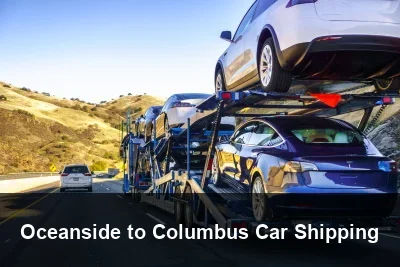
Camp Pendleton generates a large volume of PCS-related vehicle shipments between March and August as Marines receive new duty station orders. Civilian shippers booking on the same Oceanside-to-Midwest corridor during this window compete for the same carrier space. Book at least two weeks out during peak PCS months. Rates typically run 10 to 15 percent higher than the fall shoulder season on this specific lane.
Ohio State Move-In (Late July–August)
Ohio State University's fall semester arrival window creates a surge in Columbus-bound vehicle demand from late July through the third week of August. Students and faculty relocating from California, including the San Diego metro, represent a meaningful share of inbound load demand. Carrier availability for Columbus delivery tightens noticeably during this period. If your move lands in this window, book as early as possible and confirm your delivery window with the carrier.
Fall Shoulder Season (September–October)
September and October offer the best combination of pricing, availability, and weather on this corridor. PCS season has wound down, universities have settled, and winter weather has not yet arrived in Flagstaff or the Colorado Rockies. Carriers are still running this lane frequently to reposition for winter loads. If your schedule is flexible, this is the optimal booking window for Oceanside to Columbus transport.
Winter Weather Window (November–February)
The I-40 corridor through Flagstaff and the I-70 corridor through Colorado's Eisenhower Tunnel both carry real winter closure risk from November through February. Carriers may reroute south through I-10 to avoid mountain passes, adding distance and transit time. Budget an extra two to three days on your delivery estimate for any winter booking and confirm your carrier's planned routing before dispatch.
Spring Booking (February–March)
Late February and early March see early PCS orders begin moving and Ohio State spring semester transitions creating modest demand. Pricing starts rising from winter lows. This is your last window to book at near-off-season rates before the full spring surge hits. Weather through the Southwest is generally improving but Flagstaff can still see late-season snow, so confirm carrier weather contingency plans when booking in February.
How to Choose a Oceanside to Columbus Car Shipping Company
Getting multiple quotes is step one — knowing what to look for in those quotes matters just as much. Our guide on how to select a car shipping company covers the full process. Here are the six things that matter most:
FMCSA Registration
Every carrier or broker must hold a valid MC number. Verify any company at FMCSA SAFER before you book.
Proof of Insurance
Ask for a current certificate of insurance. Open carriers typically carry $100,000–$250,000 per load; enclosed commonly $500,000 or more. Learn what auto transport insurance covers.
All-In Pricing
Your quote should be a final number with no fees added after booking. Know the difference between brokers and carriers and confirm what the quote covers before you agree.
Bill of Lading
A complete Bill of Lading is filled out at pickup and delivery. Our Bill of Lading guide explains what to check. Never sign an incomplete one.
Real Reviews
Check Google and the BBB. Look at how they handled complaints and damage claims — that tells you more than a five-star average from happy customers.
Route Experience
A carrier who regularly runs the Oceanside to Columbus lane knows a few things that matter. They know the Barstow staging timing — leaving Oceanside early enough to clear the Cajon Pass before midday desert heat in summer. They know the Flagstaff overnight window and will avoid arriving on I-40 in the 6,000 to 7,000 foot elevation stretch between midnight and 6 a.m. in winter. They know the St. Louis rush hour pattern on I-44 to I-70 and time their pass for 5 a.m. They know Columbus delivery staging near Ohio State versus suburban drops in Dublin or Westerville behave completely differently and require different lead time for final coordination. That operational knowledge is what separates a carrier who has run this pair twenty times from one who is running it blind on a load board.
Oceanside to Columbus Car Shipping — FAQ
How much does it cost to ship a car from Oceanside to Columbus?
Rates on the Oceanside to Columbus corridor typically range from $1,050 to $1,600 for standard open transport on a sedan or SUV, depending on season, current fuel prices, and carrier availability. Peak PCS season from March through August pushes rates toward the higher end of that range. Enclosed transport runs $1,700 to $2,400 for the same vehicle class. These figures reflect the roughly 2,089-mile distance and long-haul carrier pricing on the I-40 and I-70 corridors. The most accurate number comes from a live quote, which accounts for current diesel prices and actual carrier availability on your specific dates.
How long does Oceanside to Columbus car shipping take?
Total time from booking to delivery typically runs nine to thirteen days. Carrier assignment after booking takes one to three business days under normal conditions — longer during peak PCS season in summer. Once a carrier picks up your vehicle in Oceanside, the drive to Columbus runs seven to ten days depending on routing, driver schedule, and whether winter weather creates any delays through Flagstaff or the Colorado mountain passes on I-70. If you have a hard delivery deadline, discuss expedited options with your broker before booking. Details on expedited shipping are at https://california.auto-transport-shipping.com/articles/california-expedited-car-shipping-fast-cost.html.
Is my car insured during transport from Oceanside to Columbus?
Every carrier operating legally on this route is required to carry cargo insurance as a condition of their FMCSA operating authority. That coverage applies to your vehicle while it is loaded on the transport truck. Before pickup, walk the vehicle with the carrier and document all existing condition on the Bill of Lading — photographs and written notes of any pre-existing scratches, dents, or chips. At delivery in Columbus, inspect the vehicle against that same document before signing. For a full explanation of how coverage works, see https://california.auto-transport-shipping.com/articles/understanding-auto-transport-insurance.html. If you need to file a claim, the process is covered at https://california.auto-transport-shipping.com/articles/how-to-file-a-claim-for-vehicle-damage-during-transport.html.
Should I choose open or enclosed transport for this route?
Open transport is the right call for most vehicles on this corridor. The I-40 and I-70 routes are well-traveled, carriers are experienced, and standard vehicles arrive without issue in the overwhelming majority of shipments. Enclosed transport is worth the premium if you're shipping a classic car, a low-clearance sports car, or a high-value luxury vehicle where any exposure to road debris or weather during the desert and plains crossing is unacceptable. Enclosed carrier availability on this specific lane is limited compared to open, so plan for a longer booking lead time. A full comparison is at https://california.auto-transport-shipping.com/articles/open-vs-enclosed-auto-transport-pros-and-cons.html.
Do I have to be present at pickup in Oceanside and delivery in Columbus?
You or an authorized representative must be present at both pickup and delivery to sign the Bill of Lading. At pickup in Oceanside, you or your designee walks the vehicle with the carrier, confirms the condition report is accurate, and signs the document. At delivery in Columbus, the same process happens in reverse — your representative inspects the vehicle against the pickup condition report before signing off. You cannot authorize release to a carrier without a signature, and you should not sign at delivery without inspecting. For details on what the Bill of Lading covers and why it matters, see https://california.auto-transport-shipping.com/articles/california-auto-transport-bill-of-lading-information.html.
How does Camp Pendleton affect car shipping pickup in Oceanside?
Camp Pendleton is an active Marine Corps installation and commercial carriers cannot enter the base to pick up vehicles. If you live on base or your vehicle is stored there, you need to arrange a civilian meet point outside the main gate. Common staging areas include commercial lots near the Mainside gate on Vandegrift Boulevard and along Harbor Drive in Oceanside. Coordinate this with your broker before booking so the carrier's instructions reflect the correct pickup location. Trying to change a pickup point after a carrier has been assigned adds delay and sometimes a rescheduling fee.
Does winter weather on the I-40 or I-70 route affect my shipment timeline?
Yes, and it is the single most common delay factor on this corridor between November and February. The I-40 crossing through Flagstaff, Arizona sits at nearly 7,000 feet elevation and can see snow and ice closures during winter storms. I-70 east through Colorado, including the Eisenhower Tunnel at 11,158 feet, is subject to mandatory closures when conditions deteriorate. Carriers may reroute south on I-10 to avoid the mountain passes, which adds distance. When you book a winter shipment on this route, build in an extra two to three days beyond the standard transit estimate. Details on winter transport challenges are at https://california.auto-transport-shipping.com/articles/auto-transport-challenges-during-the-winter.html.
Are there specific times of year when I should avoid booking this route due to price or availability?
The hardest window to book at a competitive rate is late May through early August, when Camp Pendleton PCS season and Ohio State University summer move-in overlap. Carrier space on California-to-Ohio lanes tightens, rates rise 10 to 15 percent above baseline, and lead times for carrier assignment stretch from two to three days to five or more. If your move falls in that window, book three weeks out minimum and lock your rate as soon as you have firm dates. September and October are the optimal booking window — PCS season is over, weather is clear through Flagstaff and Colorado, and carriers are actively running the corridor to reposition for fall loads.
Ready to Ship Your Car from Oceanside to Columbus?
One form gets you up to 10 free quotes from licensed, insured carriers. Compare costs and transit times and book the best deal for your schedule.