

Huntington Beach to Phoenix Car Shipping Route
Huntington Beach sits on the southern edge of the Los Angeles basin, approximately 370 driving miles from Phoenix via I-405 north to the I-10 interchange, then east on I-10 through San Bernardino, the Inland Empire, and across the Colorado River into Arizona. Carriers stage locally via SR-1 and SR-39 before connecting to the freeway grid inland. The route crosses the Mojave Desert fringe and climbs briefly through the San Gorgonio Pass before descending into the low desert. Driving this yourself means heat exposure, fuel costs, and wear on your vehicle. Shipping instead protects your car and your time — see a full breakdown at https://california.auto-transport-shipping.com/articles/benefits-of-auto-transport-service-vs-driving-yourself.html.
Phoenix demand is driven by several permanent institutions. Luke Air Force Base in Glendale processes F-35 pilot training rotations year-round, generating consistent PCS-related vehicle moves. Arizona State University's four-campus system enrolls over 140,000 students, producing strong seasonal shipping demand each August and January. Major employers including Intel's Chandler fab, Banner Health, and USAA's Phoenix campus attract relocating employees from Southern California regularly. Weather on this corridor is a real consideration: summer desert crossings can exceed 115°F, which affects open-carrier vehicle exposure. Winter months are mild and high-demand with snowbird migration from coastal California. Avoid common planning mistakes by reading https://california.auto-transport-shipping.com/articles/auto-transport-mistakes-to-avoid.html before you book.
Huntington Beach to Phoenix Car Shipping Rates
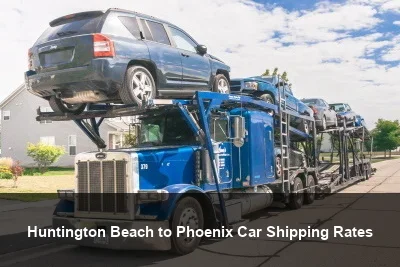
At 370 miles, this route sits in the mid-haul distance tier — long enough that carrier economics work well, short enough that transit is predictable. Rates typically range from $350 to $650 for standard open transport depending on season and vehicle size. Summer months (June–September) see modest price increases due to high desert heat surcharges and elevated snowbird-reverse traffic. Fuel costs on this desert crossing directly affect carrier pricing — review how that works at https://california.auto-transport-shipping.com/articles/how-gas-prices-impact-california-auto-transport-fees.html.
What affects the cost of Huntington Beach to Phoenix car shipping:
- Vehicle type and size — larger vehicles take more carrier space; aftermarket additions like lift kits, oversized mirrors, or roof accessories can add fees
- Open vs. enclosed transport — open is lower cost with stronger carrier availability; enclosed protects against weather, debris, and road conditions
- Standard vs. expedited pickup — expedited prioritizes your vehicle for the next available dispatch, typically at a $100–$300 premium
- Time of year — peak demand seasons drive rates higher; off-peak windows offer the most competitive pricing
- Fuel costs — diesel prices affect carrier rates; longer routes are more sensitive to fuel price swings
- Vehicle condition — non-running vehicles require special loading equipment and cost more to ship
| Vehicle Type | Open Car Shipping (Est.) | Enclosed Car Shipping (Est.) |
|---|---|---|
| Sedan | $350 – $500 | $700 – $950 |
| SUV / Crossover | $400 – $600 | $800 – $1,100 |
| Pickup Truck | $400 – $600 | $800 – $1,100 |
| Minivan | $400 – $600 | $800 – $1,100 |
| Luxury / Classic Car | $500 – $700 | $950 – $1,300 |
| Non-Running Vehicle | Add $100–200 | Add $100–200 |
* Estimated ranges based on recent Huntington Beach to Phoenix shipments. Actual rate depends on vehicle, locations, booking date, and current fuel costs. Use the form on this page to compare real quotes from licensed carriers.
Open vs. Enclosed: What This Desert Route Actually Demands
Open transport is the practical choice for most vehicles on this corridor. The I-10 desert crossing is well-traveled and paved with minimal debris risk, but summer temperatures regularly exceed 110°F in the Blythe–Phoenix stretch. For standard daily drivers, open carriers handle this without issue. If you're shipping a classic, exotic, or freshly painted vehicle, enclosed transport makes sense — not because of road hazards, but because enclosed trailers shield paint and interiors from sustained radiant heat and UV exposure during summer crossings. Budget an additional $250–$400 for enclosed on this route.
How Long Does Huntington Beach to Phoenix Car Shipping Take?
Most Huntington Beach to Phoenix shipments complete in one to two days once the carrier dispatches. The driving distance is under seven hours, which means a carrier picking up in the morning can deliver the following day in Phoenix without an overnight stop. Carrier frequency on this lane is high given the LA-to-Phoenix volume, so dispatch usually happens within one to three business days of order placement. If your window is tight, expedited options can cut that to same-day or next-day dispatch — see https://california.auto-transport-shipping.com/articles/california-expedited-car-shipping-fast-cost.html for how that pricing works.
| Service Type | Typical Transit | Pickup Window | Best For |
|---|---|---|---|
| Open — Standard | 1–2 days | 1–3 business days | Best value; most common choice on this route |
| Open — Expedited | Same–1 day | Next day–1 business day | Firm arrival date; faster dispatch window |
| Enclosed — Standard | 2–3 days | 2–5 business days | Luxury, classic, or modified vehicles |
| Enclosed — Expedited | 1–2 days | 1–2 business days | High-value vehicles on a firm delivery deadline |
** Summer heat is the primary delay variable on this route. Carriers crossing the I-10 desert segment between Blythe and Phoenix during peak afternoon hours (noon–5 PM) in June through September sometimes reschedule legs to early morning to protect vehicles. This can add half a day to one full day to delivery.
Huntington Beach to Phoenix — Route & Logistics
Carriers picking up in Huntington Beach access the freeway grid via SR-39 north or I-405 north, connecting to I-10 east near the El Monte/Pomona interchange. From there it is a direct run east on I-10 through the Inland Empire, over San Gorgonio Pass at roughly 2,600 feet, across the Coachella Valley, through Blythe at the California–Arizona border, and into the Phoenix metro — approximately 370 miles total.
Key Corridor Waypoints
- Costa Mesa / I-405 On-Ramp, CA Carriers loading in Huntington Beach typically stage in the inland flatlands near Costa Mesa or Fountain Valley before accessing I-405 north. Beach-adjacent streets near Pacific Coast Highway have parking enforcement and narrow lanes, so carriers prefer the commercial corridors one to two miles inland. This is where the vehicle is loaded and the bill of lading is signed before the freeway run begins.
- Ontario / I-10 East Interchange, CA The I-405 to I-10 transition near Ontario marks the corridor's main artery. Carriers merge onto I-10 eastbound here and commit to the desert crossing. Ontario is also a secondary staging point for carriers consolidating loads from multiple LA-area pickups before running east. Traffic through the Inland Empire — Riverside, San Bernardino, Redlands — is the most congestion-prone segment of the route.
- San Gorgonio Pass, CA (Elev. ~2,600 ft) I-10 climbs through the San Gorgonio Pass between the San Bernardino Mountains and San Jacinto Mountains before descending sharply into the Coachella Valley. Wind is a consistent factor here — the pass funnels strong gusts that affect high-profile carriers. Drivers typically reduce speed through this segment. The descent into Palm Springs marks the transition from coastal-influenced climate to full desert conditions.
- Blythe, CA — California–Arizona Border Blythe sits at the Colorado River crossing and marks the California–Arizona state line. Agricultural inspection stations operate here, though auto transport carriers are generally waved through. This is the midpoint fuel stop for many carriers running the corridor. Summer temperatures at Blythe regularly exceed 115°F, making this the hottest segment of the route and the point where morning departures matter most.
- Tonopah / I-10 West Phoenix Approach, AZ Tonopah is roughly 50 miles west of central Phoenix on I-10 and serves as a practical staging decision point. Carriers delivering to the West Valley — Glendale, Surprise, Luke Air Force Base — may exit here. Those delivering to Scottsdale, Tempe, or Chandler continue east on I-10 and pick up Loop 101 or I-17 south depending on the final destination address.
- Phoenix Metro Delivery Zone, AZ The Phoenix metro is carrier-accessible throughout most suburban areas. Wide arterial streets, large residential lots, and commercial staging areas near I-10, Loop 101, and Loop 202 make large-carrier delivery straightforward. High-density downtown Phoenix and Old Town Scottsdale have narrower lanes that may require the owner to meet the carrier at a nearby parking lot, gas station, or shopping center for safe vehicle drop-off.
Pickup & Delivery Access
- Pickup Access in Huntington Beach Huntington Beach's beach-adjacent blocks along PCH and the downtown Pier area have timed parking and restricted commercial vehicle zones. Carriers prefer inland pickup locations — neighborhoods near Beach Boulevard, Magnolia Street, or the commercial corridors in Fountain Valley and Costa Mesa provide unrestricted access for multi-car haulers. If your address is within two blocks of the coast, plan to meet the carrier one mile inland at a parking lot or side street.
- Delivery Access in Phoenix Most Phoenix-area neighborhoods — Mesa, Tempe, Chandler, Scottsdale, Glendale, and Peoria — are fully accessible to standard 75-foot car haulers. Downtown Phoenix streets and gated communities with low overhead clearances may require a meet-point delivery at a nearby retail or commercial parking area. Carriers familiar with this route know the Luke AFB base access protocols and can coordinate civilian delivery near the gate if needed.
- Nearby Pickup Locations Carriers picking up in Huntington Beach regularly extend service to Fountain Valley, Costa Mesa, and Seal Beach. Call 1‑800‑590‑6492 to confirm door-to-door availability at your address.
Open vs. Enclosed Car Shipping: Huntington Beach to Phoenix
Both options use licensed, insured carriers and deliver door to door. For a full breakdown, read the pros and cons of open vs. enclosed car shipping.
Open Car Shipping
Most Popular- Lower cost — the practical choice for most vehicles
- More carriers available on this corridor
- Faster dispatch from booking to pickup
- Works well for sedans, SUVs, trucks, and minivans
- Vehicle rides on an open multi-car carrier
- Cargo insurance required on all licensed carriers
Estimated cost: $350 – $600
Enclosed Car Shipping
Premium Protection- Full protection from weather, debris, and road grime
- Best for luxury, exotic, and classic vehicles
- Recommended for low-clearance and custom-built cars
- Wheel-net or soft-tie systems prevent contact damage
- Higher cargo coverage — commonly $500,000 per load
- White-glove handling by experienced operators
Estimated cost: $700 – $1,100
Not sure which is right for your vehicle? Call 1-800-590-6492 and we'll point you in the right direction. Also worth reading: the top 10 questions to ask any car shipping company before you commit.
How to Prepare Your Car for Shipping to Phoenix
A little prep before pickup protects you if there's ever a dispute about your vehicle's condition. This checklist is from our full guide on preparing your car for transport:
- Remove all personal belongings from the interior and trunk
- Leave only a quarter tank of fuel — enough to load and unload
- Take date-stamped photos of the full exterior and interior
- Remove or disable toll transponders (FasTrak, E-ZPass, etc.)
- Retract or remove roof racks, spoilers, antennas, and bike mounts
- Make sure the battery is charged and tires are properly inflated
- Tell the carrier about any existing leaks or mechanical issues
- Deactivate the car alarm before the carrier arrives
- Write down the mileage on the Bill of Lading at pickup
- Fold in side mirrors if the vehicle is wider than standard
Personal items: Most carriers won't cover belongings left in the car. Read the full rules on shipping personal items in your vehicle. Also review our Bill of Lading guide so you know exactly what to check at pickup and delivery.
When to Ship Your Car from Huntington Beach to Phoenix
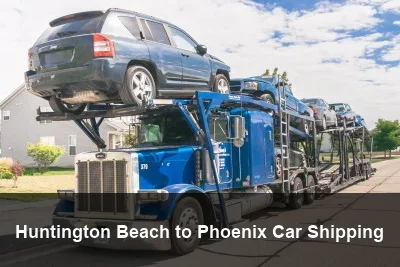
This corridor runs year-round but has two distinct demand peaks. Winter (November–March) brings heavy snowbird traffic — retired Californians relocating vehicles to Arizona for the season — which drives up both volume and rates. Summer (June–September) creates a heat-management challenge and mild surcharges for desert crossings. Spring and fall offer the most favorable pricing windows. For winter-specific planning considerations, see https://california.auto-transport-shipping.com/articles/auto-transport-challenges-during-the-winter.html.
Spring (March–May)
Spring is the most balanced window on this route — mild desert temperatures, post-snowbird-season carrier availability, and no summer heat surcharges. Rates are competitive, and carriers moving back to California from Arizona for return loads keep westbound and eastbound pricing tight. If you have flexibility in your schedule, this is the most cost-effective period to ship from Huntington Beach to Phoenix.
Summer Heat Season (June–September)
Desert temperatures between Blythe and Phoenix regularly exceed 115°F in July and August. Carriers adjust departure times to avoid peak heat — most runs on this segment leave before 7 AM or after 6 PM. This can extend transit by half a day. Enclosed transport is worth considering for high-value vehicles during this window to limit UV and heat exposure during potential staging delays.
Snowbird Season (October–December)
The October-through-December window is the busiest eastbound period on this corridor. Retired Californians shipping vehicles to Scottsdale, Sun City, and Peoria for the winter generate sustained demand that compresses carrier availability and pushes rates upward. Book two to three weeks ahead during this period rather than the standard one week. Waiting until November to book risks both higher rates and longer dispatch windows.
ASU Move-In Season (July–August)
Arizona State University's fall semester starts in mid-August, and incoming students from the Southern California coast represent a measurable share of this corridor's summer volume. Families shipping vehicles to Tempe, Mesa, and Scottsdale for student use book heavily in late July and early August. If you're shipping for an ASU student, book at least ten days before your target pickup date to secure capacity during this compressed window.
Military PCS Season (May–August)
Luke Air Force Base in Glendale, AZ processes a significant number of F-35 pilot assignments, and military PCS orders are heavily concentrated between May and August. Service members relocating from Southern California installations — including Camp Pendleton and Naval Base San Diego — often ship through this corridor. Military PCS shipments qualify for specific booking documentation; confirm with your broker that PCS paperwork is submitted at the time of order.
Snowbird Return (February–April)
February through April sees heavy westbound return traffic as snowbirds ship vehicles back to California from Arizona. This actually benefits eastbound shippers — carriers returning from Phoenix are often available for backhaul loads at reduced rates. If you're shipping Huntington Beach to Phoenix during this window, ask your broker whether backhaul pricing applies to your load given the directional carrier surplus.
How to Choose a Huntington Beach to Phoenix Car Shipping Company
Getting multiple quotes is step one — knowing what to look for in those quotes matters just as much. Our guide on how to select a car shipping company covers the full process. Here are the six things that matter most:
FMCSA Registration
Every carrier or broker must hold a valid MC number. Verify any company at FMCSA SAFER before you book.
Proof of Insurance
Ask for a current certificate of insurance. Open carriers typically carry $100,000–$250,000 per load; enclosed commonly $500,000 or more. Learn what auto transport insurance covers.
All-In Pricing
Your quote should be a final number with no fees added after booking. Know the difference between brokers and carriers and confirm what the quote covers before you agree.
Bill of Lading
A complete Bill of Lading is filled out at pickup and delivery. Our Bill of Lading guide explains what to check. Never sign an incomplete one.
Real Reviews
Check Google and the BBB. Look at how they handled complaints and damage claims — that tells you more than a five-star average from happy customers.
Route Experience
A carrier who regularly runs Huntington Beach to Phoenix knows to avoid the I-405/I-605 interchange between 7–9 AM and 4–7 PM — that bottleneck near Long Beach can add 45 minutes without warning. They know the San Gorgonio Pass wind advisory zones and plan accordingly for high-profile loads. They know the Blythe Flying J is a reliable fuel and inspection point. They know that Phoenix metro deliveries east of Loop 101 require navigating HOA-controlled neighborhoods where wide haulers need pre-planned turn radii. They also know that Luke AFB deliveries need to be scheduled for civilian-accessible staging rather than base entry. Generic carriers figuring this out on the first run cost you time.
Huntington Beach to Phoenix Car Shipping — FAQ
How much does it cost to ship a car from Huntington Beach to Phoenix?
Standard open transport on this 370-mile corridor typically runs $350 to $550 for a standard sedan or SUV. Enclosed transport adds $250–$400 to that range. Rates vary based on vehicle size, season, and current carrier availability. Summer months and the October–December snowbird season see the highest prices due to demand compression. Oversized vehicles — lifted trucks, full-size vans, dually pickups — carry surcharges of $75–$150. Fuel prices directly affect carrier pricing on desert crossings; see https://california.auto-transport-shipping.com/articles/how-gas-prices-impact-california-auto-transport-fees.html for a breakdown of how that works. Book early to lock in the lowest available rate.
How long does Huntington Beach to Phoenix car shipping take?
Once a carrier dispatches, transit is typically one to two days. The driving distance is under seven hours, so a morning pickup in Huntington Beach can result in a next-day Phoenix delivery without an overnight stop. Dispatch — the time between order placement and a carrier picking up your vehicle — usually runs one to three business days on this corridor given the high lane volume. If you need faster placement, expedited dispatch is available and explained in detail at https://california.auto-transport-shipping.com/articles/california-expedited-car-shipping-fast-cost.html. Summer heat crossings can add a partial day if the carrier reschedules the desert segment to avoid peak afternoon temperatures.
Is my car insured during transport from Huntington Beach to Phoenix?
Every licensed carrier operating on this route is required by federal law to carry cargo insurance. That coverage is active from the moment your vehicle is loaded onto the trailer in Huntington Beach until it is unloaded in Phoenix. Before dispatch, ask your broker to confirm the carrier's cargo coverage limit — standard policies range from $100,000 to $250,000 per load. Document your vehicle's condition thoroughly before pickup with dated photos. If damage occurs, the bill of lading is the key document for any claim. Read the full insurance overview at https://california.auto-transport-shipping.com/articles/understanding-auto-transport-insurance.html and understand the claims process at https://california.auto-transport-shipping.com/articles/how-to-file-a-claim-for-vehicle-damage-during-transport.html.
Should I choose open or enclosed transport for this route?
Open transport is appropriate for the majority of vehicles shipping from Huntington Beach to Phoenix. The I-10 corridor is a paved, well-maintained interstate with minimal debris risk. The main consideration on this route is heat — summer desert crossings expose vehicles to sustained temperatures above 110°F and intense UV. For daily drivers and standard vehicles, open carriers manage this without issue. For classics, exotics, freshly painted vehicles, or any car where paint and interior preservation are a priority, enclosed makes sense during summer months specifically. A full comparison of both options is at https://california.auto-transport-shipping.com/articles/open-vs-enclosed-auto-transport-pros-and-cons.html.
Do I have to be present at pickup in Huntington Beach and delivery in Phoenix?
You or an authorized representative must be present at both ends of the shipment — at pickup to sign the bill of lading and confirm the pre-transport vehicle condition report, and at delivery to sign off on the post-transport inspection. If you cannot be present, you can designate someone else to act on your behalf; that person will sign the bill of lading in your place. The bill of lading is the legally binding condition record that protects you if any damage dispute arises. Read exactly what that document covers and how to use it at https://california.auto-transport-shipping.com/articles/california-auto-transport-bill-of-lading-information.html.
Does the summer desert heat damage vehicles during transport on this route?
For most vehicles, no. Open carriers transport vehicles through the I-10 desert corridor regularly throughout summer without damage. The primary risk is to interior components — dashboards, leather seats, and electronics in vehicles left staged in direct sun for extended periods. Experienced carriers on this route time their desert crossings for early morning hours to minimize heat exposure and avoid peak afternoon temperatures between Blythe and Phoenix. If your vehicle has heat-sensitive modifications, aftermarket electronics, or a wax-sensitive paint job, enclosed transport eliminates the risk entirely during June through September.
I'm shipping for a military PCS move to Luke Air Force Base — is there anything specific I need to know?
Luke Air Force Base in Glendale, AZ is one of the key demand drivers on this corridor, and carriers familiar with the route know the delivery logistics. Civilian transport carriers cannot enter the base without a visitor pass and advance coordination. Plan to receive your vehicle at a civilian staging point near the Litchfield Road gate area or at a nearby commercial lot rather than on base. Notify your broker that this is a PCS move at the time of booking — some carriers specialize in military relocations and carry documentation that streamlines the process. Confirm your PCS order number is on file with your broker.
When is the best time to book to get the lowest rate on this route?
The two lowest-rate windows on the Huntington Beach–Phoenix corridor are spring (March–May) and early fall (September–October). Both avoid the winter snowbird demand spike and the summer heat-adjustment pricing. Within any given month, booking seven to fourteen days ahead of your target pickup date gives brokers time to match your load to a carrier already running the lane at the best available rate. Last-minute bookings — within 48 hours — are possible given the lane's volume, but you'll pay a premium for expedited placement. Avoid booking in late October through December if rate sensitivity matters.
Ready to Ship Your Car from Huntington Beach to Phoenix?
One form gets you up to 10 free quotes from licensed, insured carriers. Compare costs and transit times and book the best deal for your schedule.