

Fresno to Virginia Beach Car Shipping Route
Fresno sits at roughly 330 feet elevation in the Central Valley and connects to the national highway network via SR-99, SR-41, SR-168, and SR-180. Carriers servicing this route typically access SR-99 to merge onto I-40 east near Barstow, then run I-40 through Arizona, New Mexico, Texas, Oklahoma, Tennessee, and North Carolina before reaching coastal Virginia via I-64. Total driving distance is approximately 2,847 miles — a trip that takes most drivers five to six days minimum. Shipping your vehicle instead eliminates that mileage from your odometer, your fuel costs, and your time. For a detailed breakdown of what you save, see https://california.auto-transport-shipping.com/articles/benefits-of-auto-transport-service-vs-driving-yourself.html.
Virginia Beach is defined by military infrastructure: Naval Station Norfolk — the largest naval base in the world — sits just across the city line, and Joint Expeditionary Base Little Creek-Fort Story handles amphibious operations. Langley Air Force Base is roughly 20 miles north in Hampton. Defense contractors including Huntington Ingalls Industries, Booz Allen Hamilton, and SAIC employ tens of thousands in the metro area. Old Dominion University and Virginia Wesleyan University generate student relocation demand each fall. Weather-wise, the I-40 corridor through the Appalachian approach can produce ice and delays November through February. Plan around those windows. Before you book, review https://california.auto-transport-shipping.com/articles/auto-transport-mistakes-to-avoid.html to avoid common scheduling and preparation errors.
Fresno to Virginia Beach Car Shipping Rates
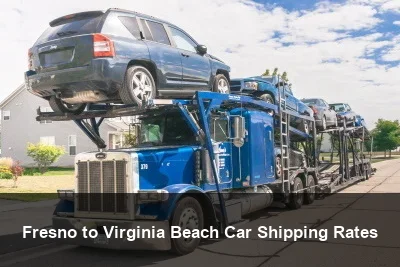
At 2,847 miles, this route falls into the long-haul pricing tier — typically $1,200 to $1,800 for standard open transport on a sedan, depending on the season and fuel costs. Diesel prices across I-40 states directly affect carrier bids on this corridor. Summer military PCS season (May through August) tightens capacity and pushes rates up. Winter can add a small weather premium on the Appalachian segment. For a real-time look at how fuel prices move your quote, see https://california.auto-transport-shipping.com/articles/how-gas-prices-impact-california-auto-transport-fees.html.
What affects the cost of Fresno to Virginia Beach car shipping:
- Vehicle type and size — larger vehicles take more carrier space; aftermarket additions like lift kits, oversized mirrors, or roof accessories can add fees
- Open vs. enclosed transport — open is lower cost with stronger carrier availability; enclosed protects against weather, debris, and road conditions
- Standard vs. expedited pickup — expedited prioritizes your vehicle for the next available dispatch, typically at a $100–$300 premium
- Time of year — peak demand seasons drive rates higher; off-peak windows offer the most competitive pricing
- Fuel costs — diesel prices affect carrier rates; longer routes are more sensitive to fuel price swings
- Vehicle condition — non-running vehicles require special loading equipment and cost more to ship
| Vehicle Type | Open Car Shipping (Est.) | Enclosed Car Shipping (Est.) |
|---|---|---|
| Sedan | $1,100 – $1,600 | $1,900 – $2,700 |
| SUV / Crossover | $1,300 – $1,900 | $2,200 – $3,100 |
| Pickup Truck | $1,300 – $1,950 | $2,200 – $3,150 |
| Minivan | $1,300 – $1,900 | $2,200 – $3,100 |
| Luxury / Classic Car | $1,550 – $2,200 | $2,600 – $3,600 |
| Non-Running Vehicle | Add $200–400 | Add $200–400 |
* Estimated ranges based on recent Fresno to Virginia Beach shipments. Actual rate depends on vehicle, locations, booking date, and current fuel costs. Use the form on this page to compare real quotes from licensed carriers.
Open vs. Enclosed on the Fresno to Virginia Beach Run
Open transport is the practical choice for most vehicles on this route. The I-40 corridor is well-maintained and carriers run it constantly, so road exposure risk is manageable. Enclosed makes sense if you're shipping a classic car, a high-value sports car, or a luxury SUV — particularly because the coastal Virginia delivery zone sees salt air and humidity that can affect freshly exposed paint. If your vehicle is worth more than $80,000 or is unrestored, the enclosed premium of $400 to $700 on this distance is reasonable insurance.
How Long Does Fresno to Virginia Beach Car Shipping Take?
Fresno to Virginia Beach typically takes 7 to 10 days from carrier pickup to delivery. The driving distance is 2,847 miles, and federal hours-of-service regulations cap carrier driving time, so even direct-route drivers need 5 to 6 days behind the wheel with stops. Fresno sees SR-99 carrier traffic regularly, which reduces wait time before loading. If your schedule requires a tighter window, expedited options exist — see https://california.auto-transport-shipping.com/articles/california-expedited-car-shipping-fast-cost.html — but standard booking on this corridor is reliable without paying the expedited premium.
| Service Type | Typical Transit | Pickup Window | Best For |
|---|---|---|---|
| Open — Standard | 7–10 days | 2–5 business days | Best value; most common choice on this route |
| Open — Expedited | 5–7 days | 1–2 business days | Firm arrival date; faster dispatch window |
| Enclosed — Standard | 7–10 days | 4–8 business days | Luxury, classic, or modified vehicles |
| Enclosed — Expedited | 5–7 days | 2–4 business days | High-value vehicles on a firm delivery deadline |
** November through February, winter weather on I-40 through the Tennessee-Virginia border and the Appalachian approach to I-64 can add one to two days. Ice events near the Blue Ridge crossing occasionally force carriers to stage overnight. Book with buffer days if you're moving during that window.
Fresno to Virginia Beach — Route & Logistics
Carriers move this route primarily on I-40 east from Barstow, covering roughly 2,847 miles through Arizona, New Mexico, Texas, Oklahoma, Arkansas, Tennessee, and North Carolina before transitioning to I-64 east into coastal Virginia. Fresno pickups access I-40 via SR-99 south to SR-58, or via SR-99 north to I-5 south to I-15 to I-40 at Barstow — carriers select the entry point based on their current load configuration.
Key Corridor Waypoints
- Barstow, CA The critical I-40 on-ramp point for Fresno vehicles coming south on SR-99 to SR-58. Barstow is a major carrier staging hub where loads are consolidated and drivers swap or rest before the long Mojave and Arizona run. Many brokers see a 12 to 24 hour staging window here while carriers fill remaining slots on eastbound rigs.
- Albuquerque, NM Approximately 790 miles from Barstow, Albuquerque sits at 5,312 feet elevation and is the first major overnight stop for drivers on I-40 east. It's also a fuel and inspection point. Elevation and dry desert air are non-factors for vehicles, but carriers check tie-downs after the long desert stretch before continuing east.
- Oklahoma City, OK Roughly the midpoint of the full Fresno-to-Virginia Beach corridor. Oklahoma City is where I-40 carriers often swap drivers or take a mandatory 10-hour rest break. It's also a junction where carriers picking up or dropping local freight may pause. Expect one of the longer overnight holds of the transit here.
- Nashville, TN Where I-40 transitions from the Great Plains into the Appalachian approach. Nashville is a busy carrier hub with its own freight demand. From here, the route climbs toward the Cumberland Plateau and later the western Blue Ridge foothills. Winter ice risk increases east of Nashville. Carriers familiar with this corridor time this leg carefully November through February.
- Roanoke, VA — I-81 / I-581 Corridor Carriers heading to Virginia Beach from I-40 often jog north on I-81 through the Shenandoah Valley before picking up I-64 east at Staunton. Roanoke at 900 feet elevation is the last significant mountain-terrain checkpoint. From here, I-64 descends toward Richmond and then the coastal plain into Hampton Roads.
- Hampton Roads / I-64 Terminus, VA The final approach into Virginia Beach runs I-64 east through Richmond and into the Hampton Roads tunnel system. Carriers must navigate the Hampton Roads Bridge-Tunnel or the Monitor-Merrimac Memorial Bridge-Tunnel — both are toll points and can back up during peak hours. Drivers familiar with the area time morning delivery before 7 a.m. or after 9 a.m. to avoid tunnel delays.
Pickup & Delivery Access
- Pickup Access in Fresno Fresno's grid is fully accessible for standard carrier rigs. SR-99 carriers make regular stops in the metro area. Pickup is most efficient when you arrange a meet point near SR-99 frontage roads, the Blackstone Avenue corridor, or commercial lots near Shaw Avenue. Residential streets in Tower District or Fig Garden neighborhoods can be tight for multi-car haulers — a nearby parking lot meeting point resolves that quickly.
- Delivery Access in Virginia Beach Virginia Beach delivery is generally accessible in open residential areas like Kempsville, Great Neck, and Oceanfront neighborhoods, though the resort strip near Atlantic Avenue has seasonal congestion and narrow commercial zones. Drivers delivering to base housing at Naval Station Norfolk or JEB Little Creek need gate access coordinated in advance. If your delivery address is in a restricted or narrow street zone, arrange a staging meet at a shopping center lot nearby.
- Nearby Pickup Locations Carriers picking up in Fresno regularly extend service to Clovis, Madera, and Sanger. Call 1‑800‑590‑6492 to confirm door-to-door availability at your address.
Open vs. Enclosed Car Shipping: Fresno to Virginia Beach
Both options use licensed, insured carriers and deliver door to door. For a full breakdown, read the pros and cons of open vs. enclosed car shipping.
Open Car Shipping
Most Popular- Lower cost — the practical choice for most vehicles
- More carriers available on this corridor
- Faster dispatch from booking to pickup
- Works well for sedans, SUVs, trucks, and minivans
- Vehicle rides on an open multi-car carrier
- Cargo insurance required on all licensed carriers
Estimated cost: $1,100 – $1,950
Enclosed Car Shipping
Premium Protection- Full protection from weather, debris, and road grime
- Best for luxury, exotic, and classic vehicles
- Recommended for low-clearance and custom-built cars
- Wheel-net or soft-tie systems prevent contact damage
- Higher cargo coverage — commonly $500,000 per load
- White-glove handling by experienced operators
Estimated cost: $1,900 – $3,150
Not sure which is right for your vehicle? Call 1-800-590-6492 and we'll point you in the right direction. Also worth reading: the top 10 questions to ask any car shipping company before you commit.
How to Prepare Your Car for Shipping to Virginia Beach
A little prep before pickup protects you if there's ever a dispute about your vehicle's condition. This checklist is from our full guide on preparing your car for transport:
- Remove all personal belongings from the interior and trunk
- Leave only a quarter tank of fuel — enough to load and unload
- Take date-stamped photos of the full exterior and interior
- Remove or disable toll transponders (FasTrak, E-ZPass, etc.)
- Retract or remove roof racks, spoilers, antennas, and bike mounts
- Make sure the battery is charged and tires are properly inflated
- Tell the carrier about any existing leaks or mechanical issues
- Deactivate the car alarm before the carrier arrives
- Write down the mileage on the Bill of Lading at pickup
- Fold in side mirrors if the vehicle is wider than standard
Personal items: Most carriers won't cover belongings left in the car. Read the full rules on shipping personal items in your vehicle. Also review our Bill of Lading guide so you know exactly what to check at pickup and delivery.
When to Ship Your Car from Fresno to Virginia Beach
This route sees its highest demand and tightest carrier availability from May through August, driven by military PCS season out of Hampton Roads. That peak pushes rates up and requires earlier booking. Fall is moderate and typically well-priced. Winter introduces weather risk on the Appalachian and I-64 segments — budget extra transit days if shipping December through February. For a full picture of winter shipping risks on long-haul corridors, see https://california.auto-transport-shipping.com/articles/auto-transport-challenges-during-the-winter.html.
Spring (March–April)
Carrier availability improves through March as winter weather clears the I-40 and Appalachian segments. Rates are moderate before the PCS rush begins. If your move allows flexibility, late March and April offer a solid pricing window. Book two to three weeks ahead to secure a slot before summer military orders start competing for the same eastbound capacity.
Military PCS Peak (May–August)
This is the single biggest demand driver on the Fresno to Virginia Beach corridor. Naval Station Norfolk and JEB Little Creek process a large share of Navy PCS orders between May and August. Carrier slots eastbound fill faster during this window and rates climb 10 to 20 percent above baseline. Book four to six weeks out if your order falls in this range — waiting costs money and availability.
Fall (September–November)
Fall is a practical shipping window on this route. PCS volume drops after August, rates ease, and I-40 weather is stable through October. University-related moves to Old Dominion University and Virginia Wesleyan add some eastbound demand in late August and early September, but not enough to create a capacity crunch. November is the last clean weather window before winter risk enters the Appalachian segment.
Winter (December–February)
Ice and snow on I-40 through Tennessee and on I-64 near the Blue Ridge approach can delay transit by one to two days. Carriers may stage longer at Nashville or Roanoke during weather events. Rates are typically lower in winter on this corridor, but budget extra time in your schedule. Enclosed transport demand from collectors moving vehicles out of cold storage slightly tightens that carrier pool.
Student Moves (August–September)
Old Dominion University in Norfolk enrolls over 23,000 students, and Virginia Wesleyan University adds to the August inflow. Families relocating from California, including the Central Valley, ship vehicles east at the start of the academic year. This creates a modest but real spike in demand during the last two weeks of August. If you're shipping for a student, book early in August to avoid the rush.
Defense Contractor Relocations (Year-Round)
Huntington Ingalls, General Dynamics, Leidos, and Booz Allen Hamilton continuously cycle employees in and out of the Hampton Roads area. This creates a steady baseline of California-to-Virginia vehicle shipping demand that keeps carriers running the corridor even in off-peak months. The year-round nature of this demand is why you can usually find carrier availability on this route without a long lead time outside of PCS peak.
How to Choose a Fresno to Virginia Beach Car Shipping Company
Getting multiple quotes is step one — knowing what to look for in those quotes matters just as much. Our guide on how to select a car shipping company covers the full process. Here are the six things that matter most:
FMCSA Registration
Every carrier or broker must hold a valid MC number. Verify any company at FMCSA SAFER before you book.
Proof of Insurance
Ask for a current certificate of insurance. Open carriers typically carry $100,000–$250,000 per load; enclosed commonly $500,000 or more. Learn what auto transport insurance covers.
All-In Pricing
Your quote should be a final number with no fees added after booking. Know the difference between brokers and carriers and confirm what the quote covers before you agree.
Bill of Lading
A complete Bill of Lading is filled out at pickup and delivery. Our Bill of Lading guide explains what to check. Never sign an incomplete one.
Real Reviews
Check Google and the BBB. Look at how they handled complaints and damage claims — that tells you more than a five-star average from happy customers.
Route Experience
A carrier who runs Fresno to Virginia Beach regularly knows that the Hampton Roads Bridge-Tunnel is the choke point at delivery — trucks time their approach before 7 a.m. or after 9 a.m. to avoid backed-up tunnel approaches on I-64. They know that Barstow staging can run 12 to 24 hours on eastbound consolidations and that Oklahoma City is a realistic overnight stop near the route midpoint. They know gate access to Naval Station Norfolk or JEB Little Creek requires the recipient's base privileges arranged in advance, and that delivering to the resort strip near the Virginia Beach oceanfront is easier before Memorial Day weekend than during it. These details separate a carrier who runs this lane from one who is running it for the first time.
Fresno to Virginia Beach Car Shipping — FAQ
How much does it cost to ship a car from Fresno to Virginia Beach?
Standard open transport on this 2,847-mile corridor typically runs $1,200 to $1,800 for a sedan, depending on the time of year and current diesel prices. SUVs and trucks run $1,400 to $2,100 due to size and weight. Enclosed transport adds $400 to $700 on top of those figures. The highest rates occur May through August during military PCS season, when eastbound carrier capacity tightens. Fall and winter tend to be lower-cost windows. Get a quote with your exact vehicle specs and dates — those two variables move the number more than anything else.
How long does Fresno to Virginia Beach car shipping take?
Expect 7 to 10 days from carrier pickup to delivery under normal conditions. The driving distance is 2,847 miles, and federal hours-of-service rules limit how many hours carriers can drive per day, so even a direct run takes 5 to 6 days minimum with mandatory rest stops. Fresno has consistent SR-99 carrier traffic, which typically keeps the pre-pickup wait to 2 to 4 days after booking. Winter weather on the Appalachian approach and Hampton Roads Bridge-Tunnel congestion are the two most common delay factors on this specific corridor.
Is my car insured during transport from Fresno to Virginia Beach?
Yes. Every licensed carrier operating on this corridor is required by FMCSA regulations to carry cargo insurance — typically $100,000 minimum. That coverage applies to your vehicle while it's loaded on the carrier's truck. Before pickup, do a thorough walk-around and document existing scratches, dents, or paint chips on the Bill of Lading — this is your evidence baseline if anything happens in transit. For a full explanation of how coverage works, read https://california.auto-transport-shipping.com/articles/understanding-auto-transport-insurance.html. If you ever need to file a claim, the process is outlined at https://california.auto-transport-shipping.com/articles/how-to-file-a-claim-for-vehicle-damage-during-transport.html.
Should I choose open or enclosed transport for this route?
Open transport is the right call for most standard vehicles on the Fresno to Virginia Beach run. The I-40 corridor is well-traveled and carriers manage road exposure effectively. Enclosed becomes the better choice if you're shipping a classic, a luxury vehicle over $80,000, or a car with fresh paint — particularly because Virginia Beach's coastal humidity and salt air can affect an exposed vehicle's finish during delivery staging. The enclosed premium on this distance runs $400 to $700. For a full comparison of both options, see https://california.auto-transport-shipping.com/articles/open-vs-enclosed-auto-transport-pros-and-cons.html.
Do I have to be present at pickup in Fresno and delivery in Virginia Beach?
You don't have to be present personally, but someone with authority to sign the Bill of Lading must be at both ends. At pickup, that person inspects the vehicle with the driver and signs off on the condition report. At delivery, they do the same walk-around and confirm the vehicle arrived as documented. If you can't be there yourself, a trusted contact works fine — just make sure they understand the inspection process. For details on what the Bill of Lading covers and why it matters, see https://california.auto-transport-shipping.com/articles/california-auto-transport-bill-of-lading-information.html.
How does military PCS affect shipping from Fresno to Virginia Beach?
Naval Station Norfolk — the largest naval base in the world — and Joint Expeditionary Base Little Creek-Fort Story drive enormous vehicle shipping volume into Virginia Beach. The annual military PCS window runs May through August, when personnel receive orders and need vehicles moved across the country. During this period, eastbound carrier slots from California fill faster and rates climb 10 to 20 percent above the annual average. If you have a PCS order to Hampton Roads, book your vehicle transport as soon as orders are confirmed — waiting until two weeks before your report date risks paying a premium or missing your window.
Does winter weather cause problems on this specific route?
Yes, on specific segments. The I-40 corridor through eastern Tennessee and the approach to I-64 near the Blue Ridge can see ice and snow from December through February. Carriers staging at Nashville or Roanoke sometimes hold for 24 to 48 hours during active weather events. The Hampton Roads area itself doesn't get heavy snow often, but even a light ice event can delay tunnel traffic on I-64. If you're shipping December through February, add two buffer days to any schedule-dependent move. See https://california.auto-transport-shipping.com/articles/auto-transport-challenges-during-the-winter.html for broader winter shipping guidance.
Can carriers access Naval Station Norfolk or base housing for delivery?
Not automatically. Military installations in the Hampton Roads area require vehicle access authorization, and a commercial carrier truck needs a base pass or must be escorted. In practice, most carrier deliveries to base housing happen at the main gate area or a designated staging point just outside the installation — your recipient drives the vehicle the final distance on-base. Coordinate this logistics detail with whoever is receiving the vehicle before the carrier arrives. Failing to plan this ahead is one of the more common delivery snags on the Virginia Beach military routes.
Ready to Ship Your Car from Fresno to Virginia Beach?
One form gets you up to 10 free quotes from licensed, insured carriers. Compare costs and transit times and book the best deal for your schedule.